
D.C. council roundtable urges faster, trauma‑informed behavioral‑health responses and expanded non‑police options
Get AI-powered insights, summaries, and transcripts
Sign Up Free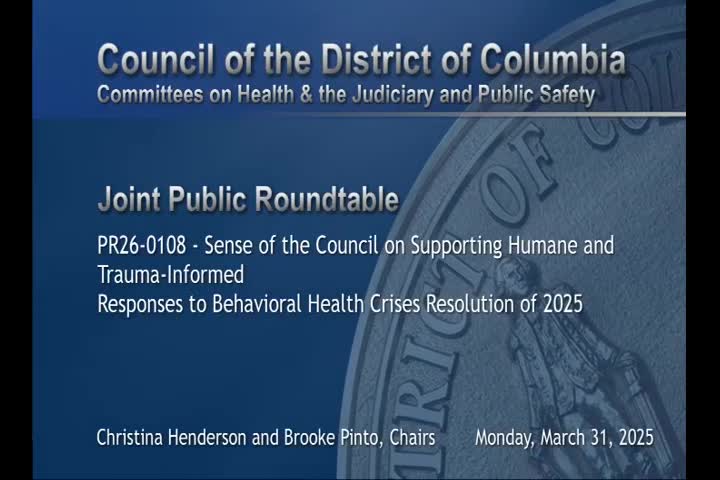
Summary
A joint Committee on Health and Committee on Judiciary and Public Safety roundtable on March 31, 2025, reviewed PR 205‑108 and called for faster 988/OUC call handling, expanded mobile crisis teams and crisis stabilization options, and clearer protocols to reduce police involvement in behavioral‑health crises.
A joint roundtable of the D.C. Council's Committee on Health and the Committee on Judiciary and Public Safety heard public testimony on March 31, 2025, about PR 205‑108, the "sense of the council" resolution urging a more coordinated, trauma‑informed response to behavioral‑health crises. Chair Christina Henderson, an at‑large council member and chair of the Committee on Health, and Ward 2 Council member Brooke Pinto, chair of the Committee on Judiciary and Public Safety, presided over the hearing and heard professional, advocacy and lived‑experience testimony on gaps in current services and possible reforms.
The resolution urges the mayor and executive agencies to strengthen call‑center operations so at least 90% of diverted calls from the Office of Unified Communications (OUC) are answered within 15–20 seconds by 2027; to implement warm handoffs for 988 and the DBH access helpline so staff stay on the line until a provider is reached; to expand and properly resource mobile crisis teams; to invest in crisis stabilization options such as community crisis beds, short‑term observation units and respite centers; and to permit people with behavioral health disabilities to specify their preferred responder.
Why it matters: Witnesses told the committees that many D.C. residents still default to 911 in crises and too often encounter police or long waits for behavioral‑health responders. Kristen Ewing, policy counsel for DC Appleseed, testified, "When behavioral health providers respond to crises, several positive things occur," adding that a care‑first approach can reduce unnecessary arrest, hospitalization and use of law‑enforcement resources. Georgetown Law Center executive director Tahir Duckett said the nation’s most successful alternatives share features including direct 911 dispatch of nonpolice teams and competitive pay for responders: "People have been socialized since childhood to call 911 when we need the government's help. And when we add additional layers between 911 dispatch and first responders, we tend to see slower response times and additional opportunities for errors."
Key testimony and data: Multiple witnesses pointed to operational shortfalls in D.C.'s current system. Ewing and other witnesses noted the community response team (CRT) had about 44 full‑time positions with 19 vacancies and an average response time of roughly 52 minutes; CHAMPS (the child and adolescent mobile psychiatric service) operates weekdays 8 a.m.–8 p.m. and has an average response time cited in testimony of about 76 minutes. Children's Law Center behavioral‑health analyst Chris Gamble said involuntary hospitalizations of children (FD12s) rose from 50 in FY2023 to 124 in FY2024 and highlighted confusion about transportation protocols — DBH paperwork lists FEMS as transport, while DBH verbally told a government hearing that MPD transports children, a difference witness described as urgent to clarify given MPD policies that can include handcuffing minors during transport.
Witnesses described models and local pilots elsewhere: Duckett described programs in Albuquerque, Durham and Denver where nonpolice community responders are directly dispatched from 911 and report faster on‑scene times; Lennas and others cited Durham's HEART and Denver's STAR programs. Community organizers and residents urged D.C. to increase public education about 988 so the public knows it is an alternative to 911 and to expand DBH's call‑taking capacity so diverted calls are reliably routed to behavioral‑health responders rather than defaulting back to MPD.
Crisis stabilization and recovery housing: Providers and community organizations described existing stabilization work and unmet needs. Community Bridges representatives said their stabilization center has reduced emergency‑room burden and that the organization opened a new level‑3 recovery residency (Fellowship House) with 10 beds (six single rooms, four doubles) and a waiting list. Community Bridges and other speakers recommended developing mental‑health stabilization centers distinct from substance‑use stabilization and expanding short‑term observation and respite beds across wards.
Children and youth: Several witnesses, including Chris Gamble, Rachel White (DC Action), and Children’s National psychiatry chief Adelaide Robb, pressed for child‑specific services and continuous CHAMPS availability. Gamble emphasized that reduced CHAMPS hours have pressed the adult CRT into coverage gaps for children during nights and weekends; he and other witnesses urged DBH to ensure that children have mobile teams and local inpatient/partial‑hospitalization options and that transport protocols avoid retraumatizing practices.
System capacity, workforce and financing: Speakers highlighted workforce and funding constraints. Ewing and others urged higher pay, recruitment pipelines and staff expansion to retain clinicians and peers; Kristy Blaylock of RAP and other treatment providers said underfunded residential SUD reimbursement rates in D.C. hamper capacity and recommended a DHCF rate study to adjust residential SUD rates upward so community treatment is financially sustainable and prevents crises.
Court and jail settings: Shannon Walsh of the Court Urgent Care Clinic described a courthouse‑based model that provides same‑day assessment and said clinicians often avert unnecessary hospitalizations; she also testified that when police transport is required, the practice of handcuffing patients can retraumatize people and dissuade future help‑seeking.
Recommendations heard at the roundtable (non‑exhaustive): improve OUC/988 call‑answer times and warm handoffs; expand and staff CRT and CHAMPS for 24/7 coverage; pursue direct 911 dispatch for appropriate nonpolice responders; invest in crisis stabilization beds and respite centers across wards; create behavioral‑health urgent‑care and walk‑in options; clarify transport protocols to reduce use of police vehicles/handcuffs; run public education campaigns to publicize 988 and available alternatives; and conduct rigorous evaluation of local pilots and peer programs.
What was not decided: The roundtable collected testimony and urged executive follow‑up; the executive branch did not provide witnesses at the session, and no formal Council vote occurred on PR 205‑108 during the hearing. Chair Henderson said the Council will follow up with DBH, OUC and MPD for additional operational information.
Speakers quoted in this article appear in the witness list below; quotations are verbatim from their oral testimony at the March 31, 2025 roundtable.