Get Full Government Meeting Transcripts, Videos, & Alerts Forever!
Get email alerts on the Data Centers topic
No spam. Unsubscribe anytime.
Committee lays over bill to require data centers to help fund grid upgrades, set community protections
Summary
House File 2928, carried by Chair Acom, was amended (A2) and laid over after testimony from utilities, state agencies, consumer advocates and data center industry representatives on how to protect ratepayers, water resources and Minnesota’s clean‑energy goals as the state considers more data center development.
House File 2928, carried by Chair Acom, was amended (A2) and laid over for possible inclusion after a committee hearing that drew utilities, consumer advocates, state agencies and proponents and opponents from the data center industry.
The bill, as described by the author, has three goals: require environmental review to protect natural resources, create a community benefit program to promote energy efficiency and weatherization, and add consumer protections to ensure data centers pay for the generation and transmission capacity they require. "The bill develops a community benefit program to help achieve that efficiency," the author said during introductory remarks.
Why it matters: committee members and testifiers framed the proposal as an attempt to balance economic development opportunities from data center investment with potential risks to Minnesota’s grid reliability, water resources and ratepayers. Several witnesses argued that, without guardrails, rapid data center load growth could threaten the state’s statutory goal of 100% carbon‑free electricity by 2040 and could shift infrastructure costs onto residential customers.
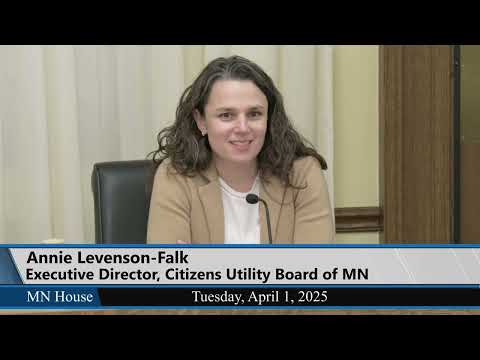
Consumer advocates and state agencies urged protections. Annie Levinson Faulk, executive director of the Citizens Utility Board of Minnesota, said section 10 — described in the amendment as a "clean energy tariff" — is “primarily about ensuring that the costs and the risks from new data center customers are not shifted onto existing rate payers.” Faulk told the committee that experience in other states shows serving data centers without cost shifts is "a very narrow needle to thread." Cindy Lee of the Minnesota Department of Commerce told lawmakers that the bill’s requirement for finer‑grained (hourly) carbon accounting would align state policy with emerging practices and federal guidance, and that existing utility REC tracking could be extended to support more granular tracking.
Water and siting concerns were raised by the Minnesota Department of Natural Resources. Katie Smith, director of the DNR’s Ecological and Water Resources Division, told the committee that water availability varies across the state and that early coordination with DNR is important, because the agency often does not learn of water‑intensive proposals until a permit application is filed, which can make mitigation and redesign costly or infeasible.
Utilities and utility associations expressed mixed views. Great River Energy and Dakota Electric said existing statutes and regulatory processes can protect members and ratepayers and suggested some requirements in the bill could be redundant or expensive. Great River Energy argued that an hourly matching requirement would be "challenging and very likely expensive with minimal if any benefits from a total carbon accounting perspective." Dakota Electric said it has received inquiries representing thousands of megawatts of potential load and that it is already addressing carbon compliance in planning.
Industry groups and developers argued against mandated public disclosure and additional permitting burdens. Dan DiIorio of the Data Center Coalition emphasized concerns about public reporting of facility‑level energy and water use, saying such disclosures raise competitive and security concerns and that cost and rate design issues are best addressed in regulatory proceedings before the Minnesota Public Utilities Commission. Industry and employer groups including the Minnesota Chamber told the committee that new regulatory burdens could deter investment and associated local tax revenues.
Other public commenters favored the bill’s protections and community benefits. Witnesses from the Center for Energy and Environment and the Energy Cents Coalition supported provisions that would direct data center contributions toward weatherization and low‑income programing designed to protect ratepayers while enabling beneficial electrification.
Formal action taken: Chair Acom moved adoption of the A2 amendment and to lay over House File 2928 for possible inclusion; the chair announced the amendment was adopted and the bill was laid over. No final policy decision was made; the bill was laid over for further consideration.
Where the process goes next: committee members and the author signaled additional stakeholder work. The author said she remains open to further conversations with utilities, developers and advocates on implementation details and the balance between community protections and economic development.