Get Full Government Meeting Transcripts, Videos, & Alerts Forever!
Get email alerts on the Housing Committee Roundup topic
No spam. Unsubscribe anytime.
Committee hears several housing bills including Rondo CLT pilot, HRA trust fund change, The Heights bond request and stabilization task‑force measure; most laid
Summary
The Minnesota House Housing Finance and Policy Committee took up a broad set of housing bills, hearing testimony from nonprofit developers, county and city housing leaders, community land trusts and resident organizers; most measures were laid over for further work.
The Minnesota House Housing Finance and Policy Committee took up a broad set of housing bills in a session that included testimony from nonprofit developers, county and city housing agency leaders, community land trusts, and housing‑provider representatives. Most bills were laid over for further work or referral to Ways and Means; one bill was re‑referred to Ways and Means by voice vote.
Rondo Community Land Trust pilot (House File 02‑1959) Representative Ibrahim Hussain introduced House File 02‑1959 to create a home‑buyer initiative pilot that would support the Rondo Community Land Trust’s work expanding into Ramsey and Dakota counties. Nikia (Nikia/Nikia spelled as in transcript) Griffin, executive director of Rondo Community Land Trust and chair of the Minnesota Community Land Trust Coalition, testified that the land‑trust model creates permanent affordability with a one‑time public investment and that the organization has a pipeline of mortgage‑ready buyers. Griffin said last year the CLT educated over 600 families and had nearly 100 mortgage‑ready buyers in its pipeline. The committee laid the bill over.
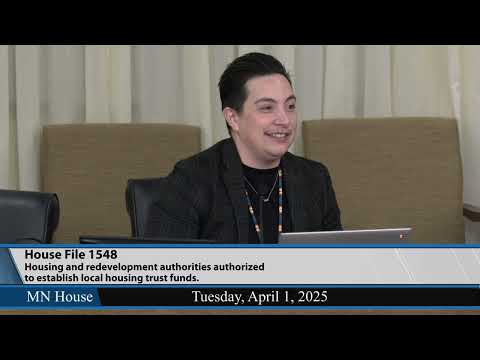
Housing and Redevelopment Authorities and local housing trust funds (House File 15‑48) Representative Vice Chair Kozlowski presented House File 15‑48 to allow Housing and Redevelopment Authorities (HRAs) to be named as local governments that may establish local housing trust funds. Melissa Taphorn, executive director of the Washington County Community Development Agency and legislative chair of the Minnesota chapter of the National Association of Housing and Redevelopment Officials, testified that the change would reduce administrative burden for multi‑county HRAs and help small and rural HRAs access state match programs. The committee laid the bill over.
School building adaptive reuse (House File 13‑40) Representative Lee described House File 13‑40, which would broaden the use of housing infrastructure bonds to support adaptive reuse of school buildings for supported and very‑low‑income housing. The author said communities across Minnesota have asked how empty school buildings can be repurposed for housing; the bill was laid over.
The Heights — St. Paul infrastructure bond request (House File 25‑49) Representative Lee presented House File 25‑49, requesting $44,600,000 in housing infrastructure bonds to fund the public portion of housing development at The Heights (the former Hillcrest Golf Course site). Todd Hurley, President and CEO of the Saint Paul Port Authority, described a master plan for a redevelopment that would include roughly 1,000 affordable housing units, mixed‑income ownership opportunities, and up to 1,000 jobs on a 112‑acre site. Hurley said the project already has site remediation and partial infrastructure work under way and requested the remaining gap funding; the committee laid the bill over for possible inclusion.
Accessible housing task force (House File 16‑73) Chair Howard moved House File 16‑73, which would create a task force to study accessible and affordable housing for Minnesotans with disabilities. Judy Moe, director of the Richfield Disability Advocacy Partnership, testified that less than 5% of U.S. housing is accessible and that people with disabilities and aging residents need coordinated policy attention. The committee adopted a technical E1 amendment to add a member to the task force and laid the bill over as amended.
Housing‑provider stabilization and task‑force recommendations (House File 27‑40) Chair Howard described House File 27‑40, carrying recommendations from a housing‑provider stabilization task force that studied financial pressures facing nonprofit and supportive housing providers. Testimony from Chris Latondres, CEO of Beacon Interfaith Housing Collaborative, and task‑force members described cash‑flow declines, rising operating costs and a nearly $50 million annual sector revenue shortfall between 2018 and 2023. The bill asks Minnesota Housing to collect and report key data, convene local governments and interagency stakeholders, create a policy framework for stabilization, and includes funding to help with preservation and repairs. The committee adopted an A‑1 amendment and laid the bill over.
African American Affordable Homeownership Development Program (House File 25‑07) Representative Amani Hiltzley presented House File 25‑07 to establish state support for Black‑led homeownership development, land acquisition, workforce development, and capacity building for Black‑led housing organizations. Naida Presley, president‑elect of the Saint Paul NAACP and former Aurora Saint Anthony Neighborhood Development Corporation executive director, testified in support. The committee laid the bill over.
Manufactured‑home assistance (House File 24‑61) Representative Norris presented House File 24‑61, requesting $5,000,000 for down‑payment assistance for manufactured‑home buyers and a $5,000,000 revolving loan fund for cooperative park purchases and conversions. Emily Stewart of North Country Cooperative Foundation testified that Minnesota has about 805 manufactured‑home communities and that resident ownership can preserve affordability; the committee laid the bill over.
Administrative and referral actions - The committee re‑referred House File 11‑43 to the Committee on Ways and Means by voice vote. - Multiple bills on the agenda were laid over for possible inclusion in the omnibus housing bill to allow further negotiation and fiscal review.
Why it matters The hearing bundled short‑term financing requests, statutory fixes, and multi‑year policy work. Taken together, the bills touch core housing supply and affordability levers: gap financing for large projects, local trust fund administration, preservation and conversion of existing structures, accessible housing for people with disabilities, and stabilization of nonprofit housing providers.
Next steps Most bills were laid over; committee members asked for follow‑up data from Minnesota Housing and other agencies and signaled additional amendments and negotiations ahead.