Get Full Government Meeting Transcripts, Videos, & Alerts Forever!
Get email alerts on the School Threat Reporting topic
No spam. Unsubscribe anytime.
Committee lays over bill to fund and require anonymous school threat reporting and reporting to fusion center
Summary
The committee laid over House File 1901 after witnesses from Sandy Hook Promise and the Violence Prevention Project testified in favor of anonymous threat-reporting systems and associated training; the author's amendment adding tribal schools was adopted.
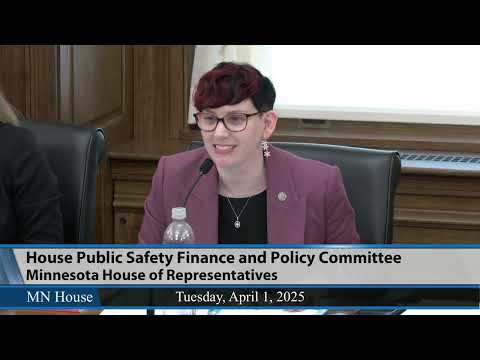
Chair Mueller presented House File 1901 and moved the author's A4 amendment to add tribal schools to grant eligibility; the committee adopted the amendment by voice vote and laid the bill over.
Sponsor Chair Erin Mueller said the bill seeks to keep students and staff safe by appropriating grant funding for anonymous threat-reporting systems and requiring reporting of active-shooter threats to the Bureau of Criminal Apprehension (BCA) fusion center. "Research shows us that those who commit mass violence often share their plans with someone," Mueller said, and she cited research indicating that many shooters told at least one person of their plans before acting.
Nicole Hockley, co-founder and CEO of Sandy Hook Promise, testified that anonymous reporting systems paired with training help students report threats and receive timely intervention. "When this happens, not only do students use it, they use it as a prevention tool," Hockley said, describing the program's tip triage and the organization's experience averting planned attacks nationally.
Jillian Peterson, executive director of the Violence Prevention Project, summarized the group's research: "Ninety-four percent of school shooters who kill four or more people tell someone else that they're going to do it before they do it," she said, and anonymous reporting increases the likelihood classmates will tell adults. Peterson also noted the need for data to design prevention and to resource schools.
Committee members focused on accessibility, potential misuse, and privacy. Representative Engin asked whether people who do not attend a school could submit tips; witnesses indicated the systems can be accessible to alumni, family members and in many implementations to the general public.
Representative Hudson asked about the potential for prank or malicious reports; witnesses and the sponsor said the effectiveness depends on trained triage personnel and local protocols to investigate and avoid punitive overreactions. On privacy, Chair Mueller clarified that the bill's language does not give student names to the BCA; local law enforcement would receive identifying information if follow-up were needed.
The A4 amendment adding tribal schools to grant eligibility was adopted. The committee laid over House File 1901 for further consideration of the grant funding and implementation details.