Get Full Government Meeting Transcripts, Videos, & Alerts Forever!
Get email alerts on the School Funding Seasonal Properties topic
No spam. Unsubscribe anytime.
Minnesota bill would give seasonal-property districts state aid to boost chances of passing school operating levies
Summary
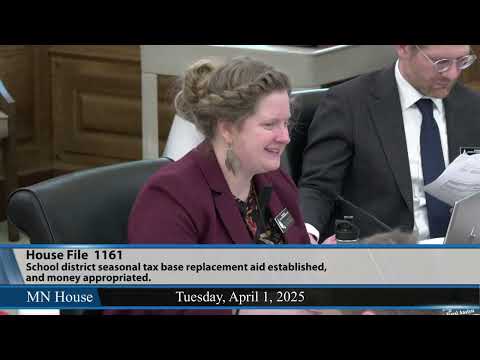
Representative Paul Igoe introduced House File 1161 on April 1 before the House Education Finance Committee, proposing seasonal and recreational tax-base replacement aid to lower the local tax effort required for voter-approved school operating levies in districts with large seasonal-property markets.
Representative Paul Igoe introduced House File 1161 on April 1 before the House Education Finance Committee, proposing a seasonal and recreational tax-base replacement aid to reduce local tax effort required for voter-approved school operating levies in districts with high shares of seasonal recreational residential property.
The bill would not change how cabins are taxed or give school boards additional levy authority; it would apply an adjustment factor to the referendum levy amount and create state aid that reduces the local levy rate used for referendum calculations. "This bill does not change how our cabins are taxed," Igoe said. "The bill creates seasonal and recreational tax based replacement aid aimed at reducing the local tax effort required for voters to approve levies." (Representative Paul Igoe, author)
Why it matters: Testimony from several Greater Minnesota educators described recurring budget cuts, eliminated staff and program reductions they tied to unequal levy outcomes. Aaron Riley, a sixth-grade teacher in Grand Rapids, said his district had cut the equivalent of a small school over five years and that the bill would help return tax revenue generated by cabin properties to his community. "Tax revenue from cabin properties in Grand Rapids should stay in Grand Rapids for our students," Riley said. (Aaron Riley, teacher)
Superintendents from Lake Superior School District and Grand Rapids described the scale of the issue for their districts. Lake Superior Superintendent Gina Clive said her district spans about 2,500 square miles, has large amounts of public land and a high percentage of seasonal properties excluded from referendum market value. She offered an example that a $600-per-pupil levy could be reduced by about $226,000 under the bill’s proposed 31.4% reduction in referendum tax rate in her district’s projection. "That reduction would be a game changer," Clive said. (Gina Clive, superintendent)
House Fiscal staff summarized the bill’s fiscal note: the state general fund cost is estimated at $8,196,000 in fiscal year 2027 and about $18,476,000 in fiscal years 2028 and 2029. The fiscal note explains the taxable property classification referenced in the bill corresponds to class 4c (seasonal and recreational residential occupancy) in Minnesota Statutes section 273.13, subdivision 4c, paragraph 12. (Solvei Beckel, House Fiscal)
Discussion and disposition: Committee members asked clarifying questions about the fiscal assumptions and how the adjustment factor would be applied to referendum aid. Representative Igoe and testifiers emphasized the bill preserves voters’ authority to approve levies while aiming to reduce the perceived tax burden on year-round residents in high-seasonal-property districts. The chair laid House File 1161 over for possible inclusion in an omnibus bill and further discussion.
What the bill would not do: It would not change tax classification for cabins, would not grant additional levy authority to local school boards, and would not itself enact any levy without voter approval. The fiscal note notes minimal one-time IT recoding costs estimated around $14,000 for the Department of Education to implement changes to levy and general education program coding.
Next steps: House File 1161 was laid over by the committee for possible inclusion in an omnibus bill or later discussion.