Get Full Government Meeting Transcripts, Videos, & Alerts Forever!
Senate public safety committee advances bills on weaponized robots, drones near critical sites, stalking protections for pets and other public-safety measures
Summary
The California State Senate Committee on Public Safety met to hear a package of bills and advanced most to appropriations or other committees, debating measures on weaponized robots and drones, updated drone rules around critical infrastructure, changes to stalking law to include threats to pets, oversight of sexually violent predator releases, penalties for furnishing fentanyl to minors, protections for utility workers and training to identify transnational repression.
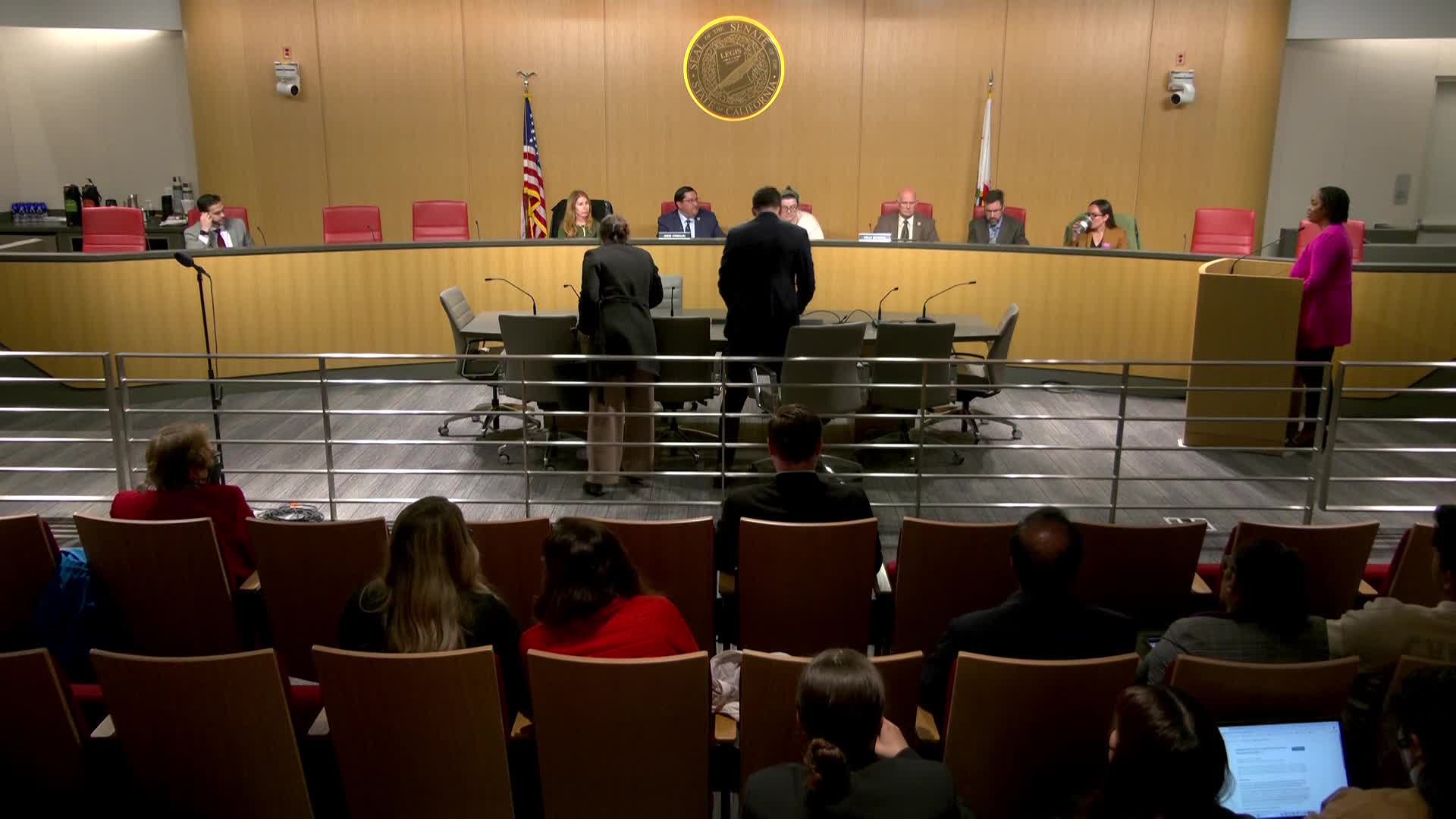
The California State Senate Committee on Public Safety met in a series of hearings to consider a package of public-safety bills, advancing most to the next committee with amendments while debating narrower issues such as government versus private use of weaponized robots and the scope of permanent protective orders.
The committee advanced a mix of technology, victim-protection and public-safety bills. Key actions included advancing SB 93 (prohibiting private individuals from weaponizing robots and drones) and SB 260 (tighter rules for drone flights over critical infrastructure) to appropriations/insurance committees; passing SB 221 (adding threats to pets to the stalking statute) to appropriations; moving SB 379 (changes to the conditional release process for sexually violent predators) to appropriations; and approving measures on fentanyl supplied to minors and training for law enforcement to recognize transnational repression. Lawmakers also debated SB 421 (often called "Kaylee's Law," proposing lifetime protective orders for certain violent felony convictions), which failed a first vote and was the subject of a granted reconsideration request on the floor of the hearing.
Why it matters: the bills would affect criminal penalties, the duties and training of law enforcement, protections for victims and their households, and the legal rules around emerging technologies such as autonomous robots and drones. Several measures drew significant public testimony from industry representatives, civil liberties advocates and crime victims, and the committee frequently noted the difference between private use and government (law enforcement) use when drafting exemptions.
Weaponized robots and drones (SB 93) Sen. Dr. Weber Pearson, the bill author, told the committee SB 93 "simply prohibits members of the general public from weaponizing robots and drones," and said the bill includes targeted exemptions for academic research, film and startup activity and for government agencies acting within their legal mission. Grant Baker, senior manager of government affairs at the Association for Uncrewed Vehicle Systems International (AUVSI), and McKinley Thompson Morley of Boston Dynamics testified in support, saying the measure promotes public trust while allowing research and limited government uses. Opponents including Yoel Hail of the ACLU of Northern California said the bill "legitimizes the ability of police departments ... to deploy weaponized robotic devices" because the bill excludes and does not regulate government use; Hail warned that police use of weaponized robots could exacerbate police violence. The committee voted to pass SB 93 as amended to the appropriations committee…
Already have an account? Log in
Subscribe to keep reading
Unlock the rest of this article — and every article on Citizen Portal.
- Unlimited articles
- AI-powered breakdowns of topics, speakers, decisions, and budgets
- Instant alerts when your location has a new meeting
- Follow topics and more locations
- 1,000 AI Insights / month, plus AI Chat