Get Full Government Meeting Transcripts, Videos, & Alerts Forever!
Get email alerts on the Public Safety Committee Hearing topic
No spam. Unsubscribe anytime.
Senate public safety committee advances bills on weaponized robots, drones near critical sites, stalking protections for pets and other public-safety measures
Summary
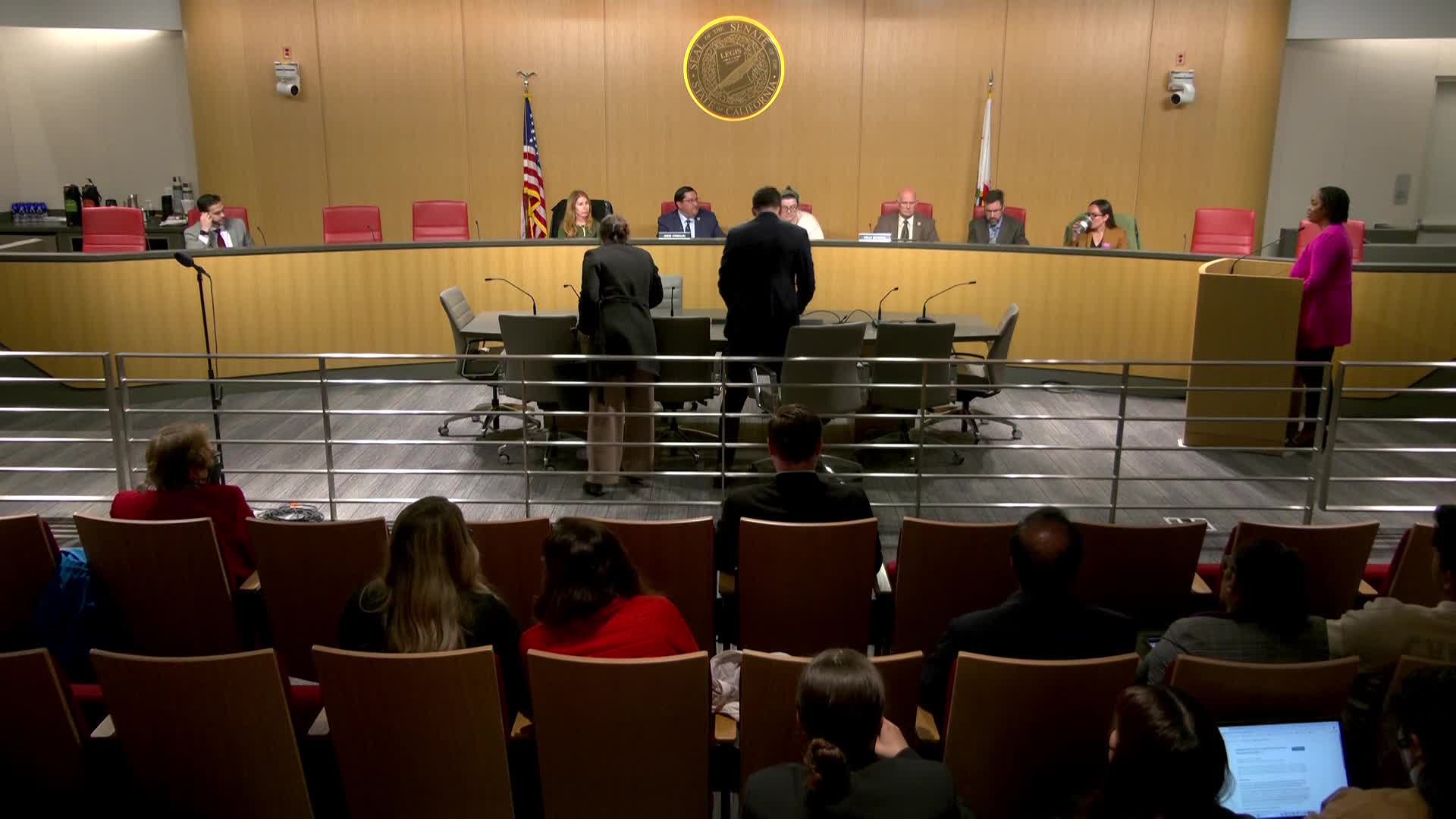
The California State Senate Committee on Public Safety met to hear a package of bills and advanced most to appropriations or other committees, debating measures on weaponized robots and drones, updated drone rules around critical infrastructure, changes to stalking law to include threats to pets, oversight of sexually violent predator releases, penalties for furnishing fentanyl to minors, protections for utility workers and training to identify transnational repression.
The California State Senate Committee on Public Safety met in a series of hearings to consider a package of public-safety bills, advancing most to the next committee with amendments while debating narrower issues such as government versus private use of weaponized robots and the scope of permanent protective orders.
The committee advanced a mix of technology, victim-protection and public-safety bills. Key actions included advancing SB 93 (prohibiting private individuals from weaponizing robots and drones) and SB 260 (tighter rules for drone flights over critical infrastructure) to appropriations/insurance committees; passing SB 221 (adding threats to pets to the stalking statute) to appropriations; moving SB 379 (changes to the conditional release process for sexually violent predators) to appropriations; and approving measures on fentanyl supplied to minors and training for law enforcement to recognize transnational repression. Lawmakers also debated SB 421 (often called "Kaylee's Law," proposing lifetime protective orders for certain violent felony convictions), which failed a first vote and was the subject of a granted reconsideration request on the floor of the hearing.
Why it matters: the bills would affect criminal penalties, the duties and training of law enforcement, protections for victims and their households, and the legal rules around emerging technologies such as autonomous robots and drones. Several measures drew significant public testimony from industry representatives, civil liberties advocates and crime victims, and the committee frequently noted the difference between private use and government (law enforcement) use when drafting exemptions.
Weaponized robots and drones (SB 93) Sen. Dr. Weber Pearson, the bill author, told the committee SB 93 "simply prohibits members of the general public from weaponizing robots and drones," and said the bill includes targeted exemptions for academic research, film and startup activity and for government agencies acting within their legal mission. Grant Baker, senior manager of government affairs at the Association for Uncrewed Vehicle Systems International (AUVSI), and McKinley Thompson Morley of Boston Dynamics testified in support, saying the measure promotes public trust while allowing research and limited government uses. Opponents including Yoel Hail of the ACLU of Northern California said the bill "legitimizes the ability of police departments ... to deploy weaponized robotic devices" because the bill excludes and does not regulate government use; Hail warned that police use of weaponized robots could exacerbate police violence. The committee voted to pass SB 93 as amended to the appropriations committee (recorded vote: 4–0 on the committee roll call recorded later in the hearing).
Drones and critical infrastructure (SB 260) Sen. Dr. Wahab presented SB 260, which would update state guidelines for unmanned aircraft flights near critical infrastructure and for certain private-insurance and inspection uses. Jonathan Feldman of the California Police Chiefs Association supported the bill and noted the measure aligns with Federal Aviation Administration guidance limiting restrictions to lower altitudes. The committee accepted amendments and passed SB 260 as amended and referred it to the Insurance Committee (committee vote recorded as 4–0).
Stalking law: threats to pets (SB 221) Sen. Chabot described SB 221 as a reintroduction of prior legislation to allow threats to a victim’s pet to be used as part of a pattern of stalking. Nicholas Peterson, a deputy district attorney with the Riverside County DA’s Office, gave a victim example and urged the change so that threats to a pet can support stalking charges before an animal is harmed. Supporters included multiple law-enforcement, animal-protection and victims’ groups. The ACLU and other commenters opposed, citing risks of overcriminalization and the availability of animal-cruelty laws; the committee passed the bill to appropriations (vote recorded 4–0).
Sexually violent predator conditional-release oversight (SB 379) Sen. Jones explained SB 379 would require the Department of State Hospitals to increase oversight when sexually violent predators (SVPs) are placed back into communities and to approve leases the department’s vendor signs for placements. Family members and local officials from rural communities described placements in remote areas with limited law enforcement as a public-safety concern. The bill was advanced to appropriations (recorded as passed in committee roll call).
Fentanyl and minors (SB 432) Sen. Sayardo presented SB 432 addressing heightened penalties for furnishing fentanyl to minors. The author accepted committee amendments intended to narrow the offense to cases with knowledge the substance contained fentanyl. Researchers and public-health advocates opposed harsher criminal penalties and urged public-health responses (treatment, naloxone distribution and education), while prosecutors and sheriffs supported stronger penalties with the author’s amendment. The committee passed the bill as amended to appropriations.
Utility and infrastructure worker protections (SB 431) Sen. Bioticene presented SB 431 to make assaults on public utility and essential-infrastructure workers eligible for the enhanced penalties already applied to some other protected workers. Utility unions and large utilities described documented incidents — from threats and racist taunts to physical assaults and firearms — and urged the committee to add specific deterrent penalties. Civil-rights and criminal-justice reform groups opposed expanding sentence enhancements, noting research that longer sentences do not reliably deter crime and arguing enforcement, identification and community interventions are the practical issues. The committee moved the bill to appropriations (vote recorded on the roll call).
Transnational repression and law-enforcement training (SB 509) Sen. Caballero introduced SB 509 to require the Office of Emergency Services and the Commission on Peace Officer Standards and Training (POST) to develop training so local police can identify and record cases in which foreign governments target diaspora communities. Supporters included immigrant-rights advocates and a wide coalition of community organizations who described threats and harassment tied to foreign-state repression; the committee referred SB 509 to the Governmental Organization Committee (vote recorded as approved).
Racial Justice Act and due-process protections for officers (SB 734) SB 734, sponsored by PORAC, would add procedural protections for peace officers when a court makes a finding in a California Racial Justice Act hearing. Supporters said the bill preserves defendants’ CRJA remedies while ensuring employers and POST follow standard disciplinary and licensing processes before taking employment or licensing actions; the committee passed the bill (motion passed to appropriations).
Kaylee’s Law and lifetime protective orders (SB 421) Sen. Valadares presented SB 421 ("Kaylee’s Law"), proposing lifetime criminal protective orders for certain violent and sex-related felonies. Victims and survivor advocates testified in support; public-defense groups and civil-rights organizations testified in opposition, noting concerns about breadth, retroactivity, collateral consequences and the potential for overbroad application in cases where victims later reconcile. The committee held a roll-call vote on the bill; the motion did not carry on that initial vote (several members voted no), and the hearing record shows a request for reconsideration was later granted. The committee record in this hearing does not contain a final passed-on-the-merits roll call after reconsideration.
Votes at a glance (committee actions recorded in this hearing) - SB 93 (weaponized robots/drones) — motion passed as amended and referred to Appropriations (committee roll-call later recorded 4–0). - SB 260 (drones/critical infrastructure) — motion passed as amended and referred to Insurance (committee roll-call recorded 4–0). - SB 221 (threats to pets added to stalking law) — motion passed to Appropriations (committee roll-call recorded 4–0). - SB 379 (SVP release oversight) — motion passed to Appropriations (committee roll-call recorded as passed). - SB 432 (furnishing fentanyl to a minor, as amended) — motion passed as amended to Appropriations. - SB 509 (training on transnational repression) — motion passed to Governmental Organization (committee roll-call recorded in hearing). - SB 734 (CRJA/due process protections for officers) — motion passed as amended to Appropriations. - SB 431 (assaults on utility and infrastructure workers) — motion passed to Appropriations (committee roll-call recorded as passed). - SB 421 (Kaylee’s Law, lifetime protective orders) — initial motion failed on the roll call; committee minutes record reconsideration was granted but a final committee disposition was not recorded in this hearing transcript.
What to watch next: most bills were referred to appropriations or the next policy committee, where lawmakers and stakeholders will negotiate funding language, narrower definitions or additional exemptions. Bills that increase criminal penalties (SB 431, parts of SB 432) or that touch on police authority (SB 93 exemptions for government use) drew the most pointed testimony and are likely to see further amendment.
Quotes (selected) - "This bill simply prohibits members of the general public from weaponizing robots and drones," — Sen. Dr. Weber Pearson, bill author (SB 93). - "We are proud to cosponsor SB 93 ... to promote the safe and ethical use of robotics in the state of California," — Grant Baker, Senior Manager of Government Affairs, AUVSI (supporting SB 93). - "Arming police departments with killer robots would exacerbate police violence," — Yoel Hail, Director, Criminal Justice Program, ACLU of Northern California (opposing SB 93). - "If your loved one came to you and said an ex was threatening a pet to instill fear, would you want to tell them there is nothing the law can do?" — Nicholas Sackett, Social Compassion in Legislation (supporting SB 221). - "Currently the contractor has complete control of the release process with little to no oversight," — Mary Jeters, Antelope Valley resident (testifying on SB 379).
Ending: Committee members on both sides emphasized they were trying to balance enforcement, public safety and civil-rights protections. Several authors accepted committee amendments during the hearing to narrow scope or add procedural safeguards; many bills will return to appropriations or the next policy committee where funding, penalty levels and exemptions will be refined.
(Committee transcript of the hearing available; written analyses and the final committee votes will be posted to the Senate committee website.)