Get Full Government Meeting Transcripts, Videos, & Alerts Forever!
Get email alerts on the Voter Access topic
No spam. Unsubscribe anytime.
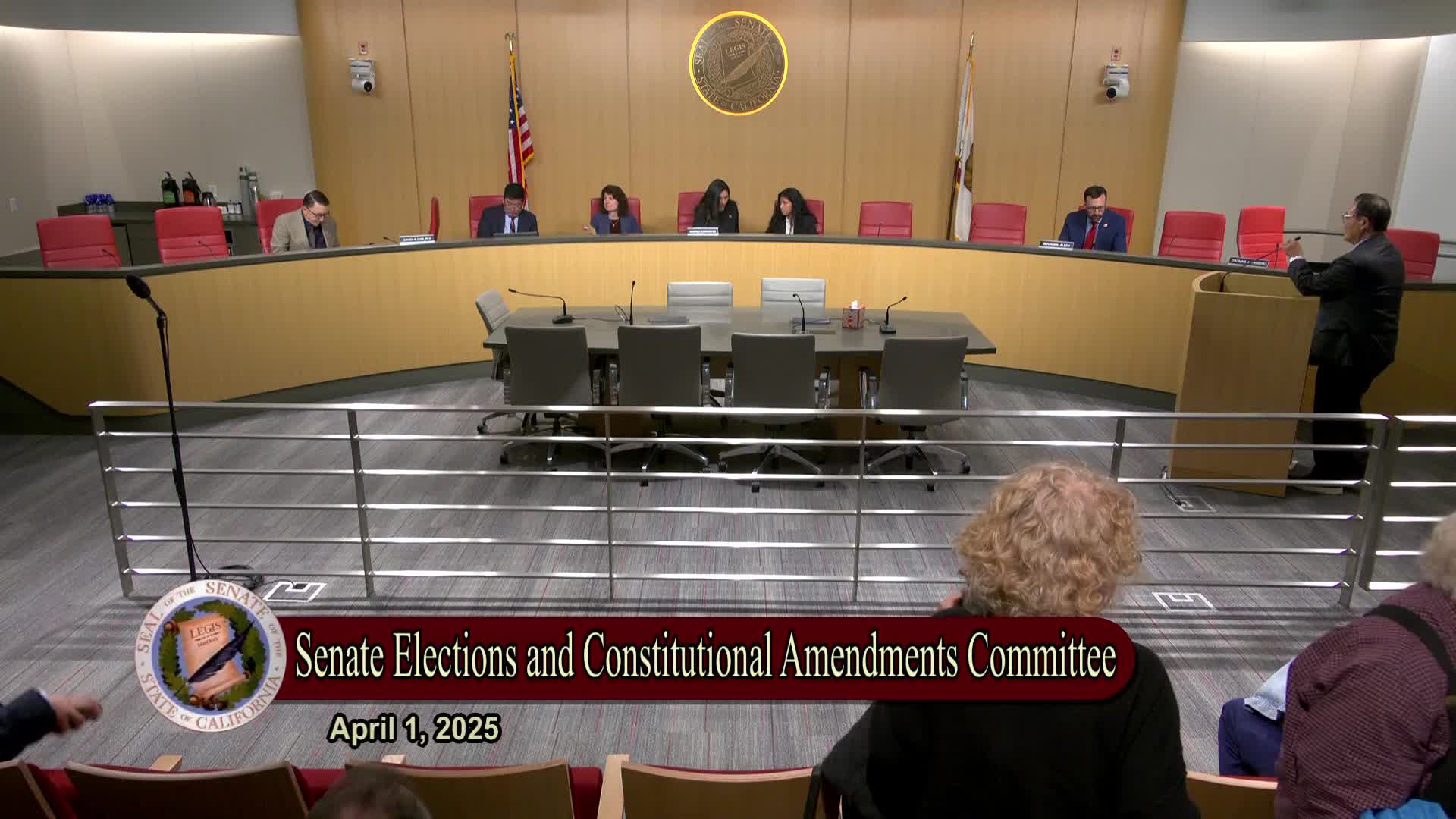
Committee holds SB 405 after contentious debate over local voter ID authority
Summary
SB 405 would repeal the state prohibition on local governments requiring photo identification for in‑person voting. Supporters argued it strengthens election integrity; opponents said it would disproportionately burden older, low‑income and minority voters. No motion was made and the bill remained in committee.
Senate Bill 405, introduced by Senator A. Choi, would repeal a recent state prohibition and allow local governments to require photo identification for in‑person voting. The measure drew extended, partisan discussion and competing testimony from voting-rights and election-integrity advocates; the committee did not take a final vote and the bill remained in committee.
Senator Choi framed SB 405 as restoring local authority for local governments to set photo-ID rules for in-person voting, arguing local officials are better positioned to choose an appropriate form of identification for their communities. Collin Britton of the Election Integrity Project California testified in support, describing investigations and data he said raised questions about registration anomalies and asserting that voter ID laws enjoy broad public support.
Opponents included Dora Rose of the League of Women Voters of California and Cynthia Valencia of ACLU California Action, both of whom testified the bill would create barriers for historically marginalized communities, citing studies showing millions of voting-age citizens lack current government-issued photo IDs or have mismatched documentation. The League said California’s existing voter-verification and mail-ballot systems effectively safeguard elections and that strict ID laws have been shown to suppress turnout among Black, Latino, low-income, older and disabled voters.
Committee members expressed differing views. Some members, including the chair, expressed philosophical objections and cited California’s signature-matching, voter-registration verification and high mail‑ballot participation as reasons to preserve the existing prohibition. Others emphasized public confidence and personal responsibility in returning ballots. Given two committee members were temporarily absent and no member moved the bill, committee action was deferred.