Get Full Government Meeting Transcripts, Videos, & Alerts Forever!
Get email alerts on the Campaign Finance topic
No spam. Unsubscribe anytime.
Committee advances measure to let general-law cities, counties adopt local public campaign financing
Summary
SB 42 would remove the statewide ban preventing general-law cities and counties from establishing local public financing systems; the committee voted to report the bill to Appropriations after supporters argued it would expand options for small-dollar public financing and include protections against discrimination in local programs.
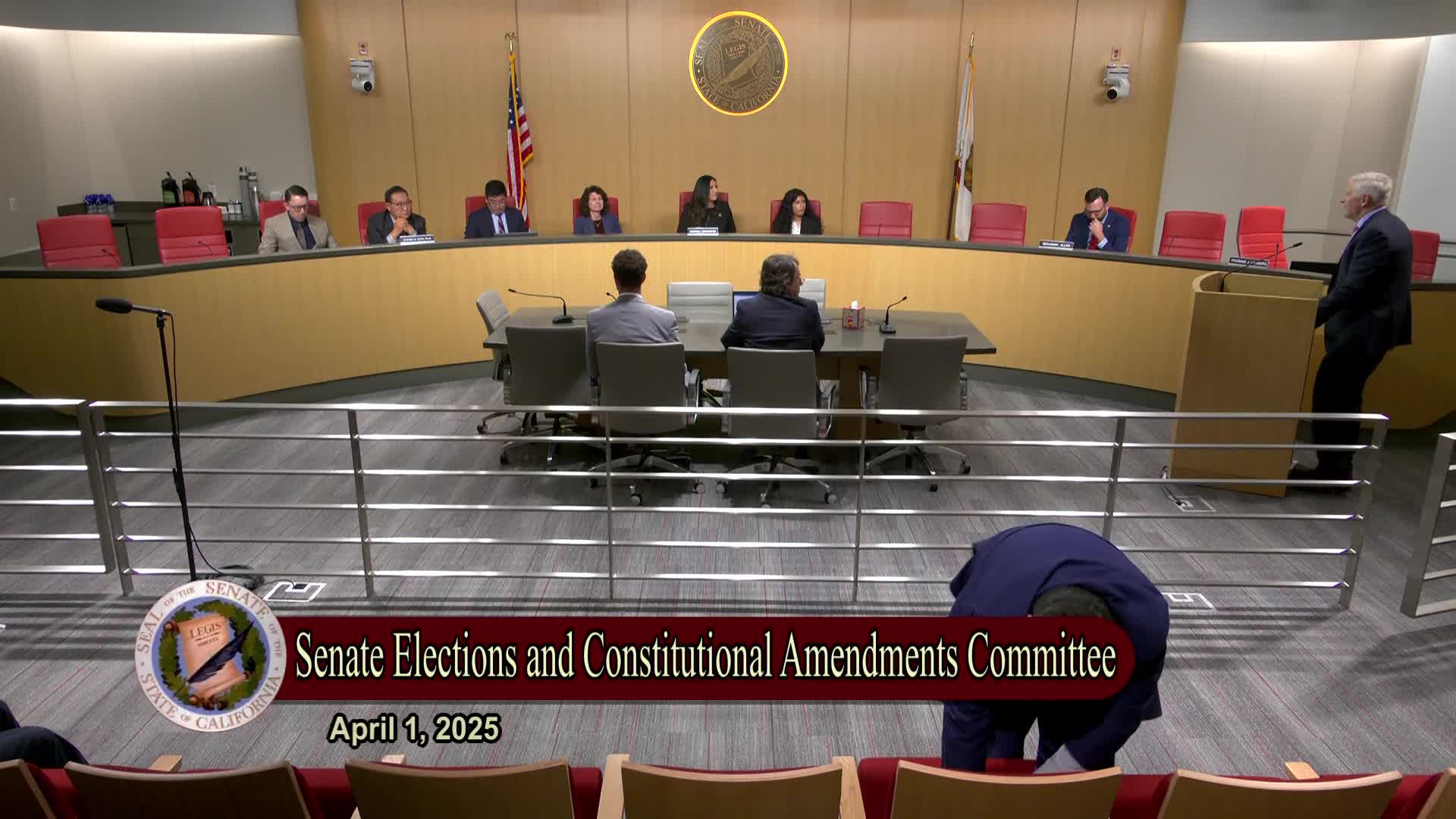
Senate Bill 42, authored by Senator Tom Umberg with Senator Allen listed as a joint author in committee discussion, would lift a state ban that prevents general-law cities and counties from enacting local public campaign financing. The committee voted to pass SB 42 as amended to the Committee on Appropriations.
Senator Umberg and proponents said the bill does not require jurisdictions to adopt public financing; rather it removes a prohibition so local voters can decide by charter, ordinance or ballot measure whether to create public financing systems. Trent Lang of the California Clean Money Campaign and David Shore of California Common Cause testified that public financing can broaden the donor base and reduce perceived influence from large donors; Lang described implemented systems with low budgetary costs (cited ranges of 0.02%–0.07% of local budgets) and said SB 42 would require safeguards such as nondiscrimination by party and limits on funds’ uses.
A broad coalition of civic organizations, labor groups, city and county representatives, and activists voiced support in committee. No witnesses testified in opposition. Members discussed fiscal concerns and safeguards, and Senator Umberg stressed the bill is a two-step process: it would place an option on the ballot for voters in 2026 and any local program would still require a local vote and funding decisions.
Senator Allen moved the measure; the committee recorded a roll call with multiple votes (Chair aye, Vice Chair no) and the measure was reported as passed as amended to Appropriations; the clerk recorded the measure on call and later the bill was reported as passed by a committee tally of 4-1 during the lift.