Get Full Government Meeting Transcripts, Videos, & Alerts Forever!
Get email alerts on the Elections Integrity topic
No spam. Unsubscribe anytime.
Committee backs bill banning pay or prizes for voter registration drive inducements
Summary
SB 398 would make it a crime to knowingly pay or offer money or valuables to induce registration or voting; committee passed the measure to the Committee on Public Safety after testimony citing recent national lottery-style inducements.
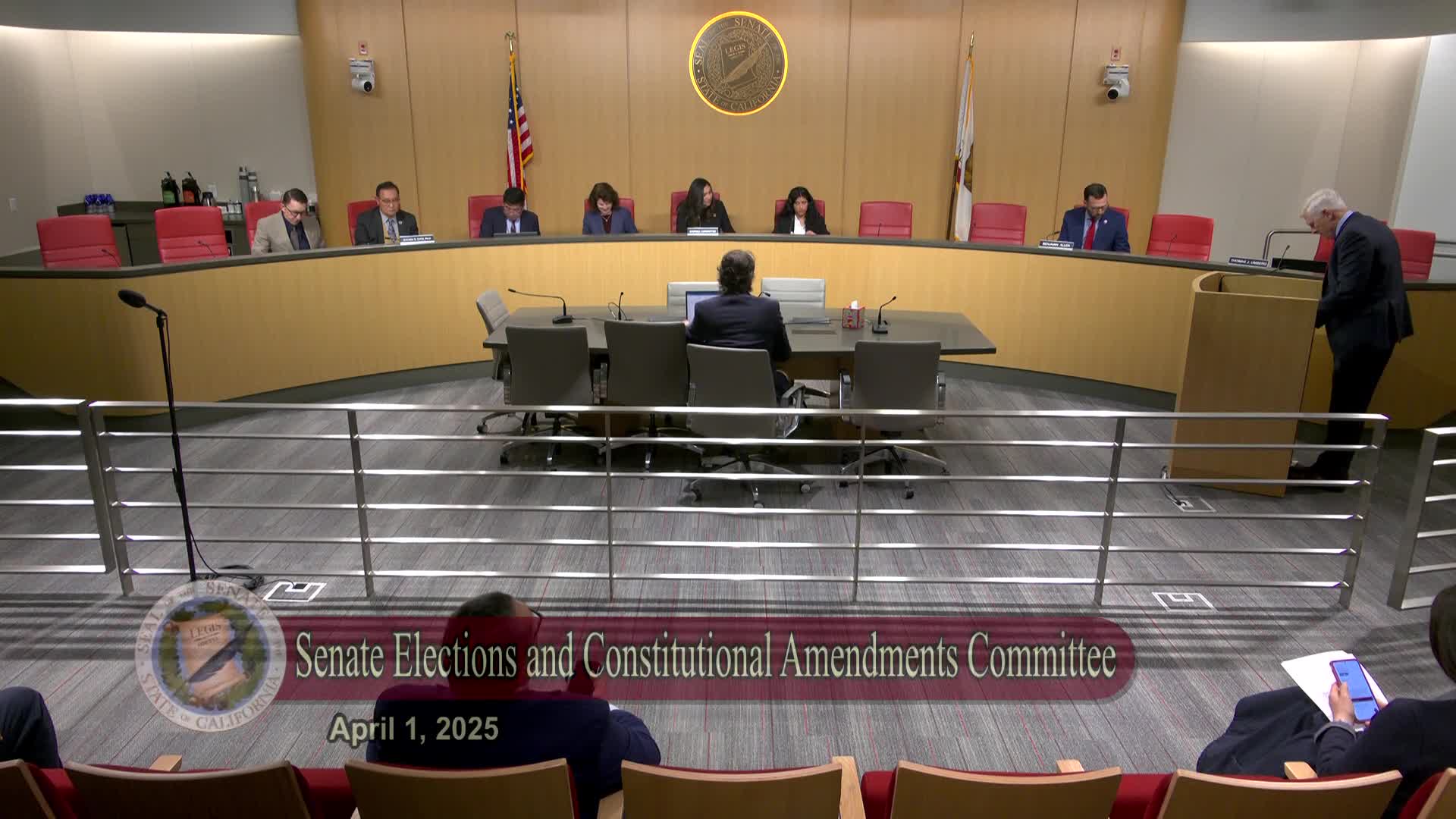
Senate Bill 398, authored by Senator Tom Umberg, was approved by the Senate Committee on Elections and Constitutional Amendments and ordered to the Committee on Public Safety after committee members voted to move the bill out of committee.
The bill would prohibit offering money or other valuable consideration to induce a person to register to vote or to vote, closing an identified loophole that proponents said had allowed lottery-style inducements in other states. Senator Umberg framed the measure as protecting against schemes that would pay or reward people to register or vote; he called the proposal a closing of a “loophole” and urged an aye vote.
Trent Lang, president and executive director of the California Clean Money Campaign, testified in support and described recent national examples where lotteries and large prizes were used in voter registration or get-out-the-vote efforts. Lang said federal law already prohibits offering payments in exchange for registering, but that some campaigns have attempted to use lotteries as an inducement. He and other supporters urged that California explicitly ban such practices and apply penalties comparable to federal law.
Other organizations and witnesses — including the American Federation of State County Municipal Employees, the Asian Law Caucus, and individual community members — spoke in support; no witnesses testified in opposition. Senator Allen moved the measure; the committee initially recorded a 3-1 vote with the vice chair voting no, but the clerk later showed the measure passed 5-0 after a correction to a committee member’s vote. The measure will be considered next by the Committee on Public Safety.