Get Full Government Meeting Transcripts, Videos, & Alerts Forever!
Get email alerts on the Mental Health topic
No spam. Unsubscribe anytime.
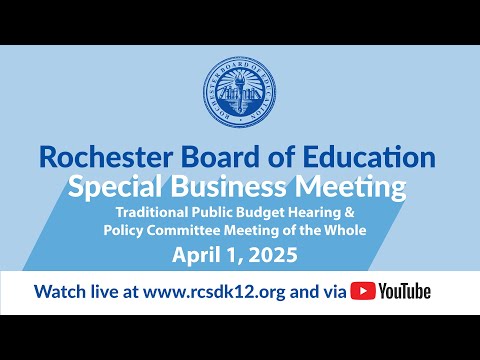
Rochester parents, advocates press RCSD for more mental-health, safety and instructional resources at budget hearing
Summary
Chrissy Miller, a Rochester resident who works with families in the community, told the Rochester City School District budget hearing on April 1 that “we need more money to support our babies,” calling for expanded student and family mental-health services.
Chrissy Miller, a Rochester resident who works with families in the community, told the Rochester City School District budget hearing on April 1 that “we need more money to support our babies,” saying “40 percent of our girls have depression” and urging district funding for both student groups and family training in mental health.
The call for increased mental-health resources was echoed across several speakers during the public comment portion. Stephanie Krause, a parent of two children at Anna Murray-Douglass School 12, said the school’s staffing reductions left one school safety officer to cover “over 4,740 students from pre-K to sixth grade” after the position count fell from three to one, and asked the district to restore safety staffing and maintain instructional coaches used for intervention and curriculum work. Krause also urged the district to address food waste, describing uneaten meals as a fiscal and environmental concern.
Melissa Rodriguez Meehan, an early-childhood professor at Brockport and parent in RCSD, urged the district to prioritize social-emotional supports and to preserve unstructured play and classroom libraries. She asked why funds were directed to scripted curricula and tracking programs when, she said, classroom educators and more library books support literacy and student engagement.
Eamon Scanlon, who said his organization works with parents and partners with RCSD families, commended the district for adding an object summary to the budget book — a change he said added clarity — and urged continued funding and expansion of school-climate and mental-health efforts, including satellite clinics and telehealth, so they persist through leadership changes.
Several speakers tied mental-health concerns to safety. Anna Ramos, speaking as a grandparent of a student at Frederick Douglass School 42, reported incidents of fights on buses and urged regular meetings between principals and parents and better bus monitoring. Maria Gonzalez, another grandparent, described symptoms she associates with trauma and anxiety among children and said community mental-health services can be slow to reach families.
Laurie Thomas, who identified herself as a taxpayer, offered a detailed critique of RCSD budget line items and staffing numbers. She cited the budget summary language that preschool special-education costs “are subsidized by the general fund,” and read several line-item changes the proposed budget shows: an increase in funding for students with disabilities (budget line “22 50 grama”) by more than $10 million tied to roughly 100 FTE positions; a change in psychological services (line “28 20”) showing an increase from 13.5 FTEs funded at approximately $820,000 to a plan for 72 FTEs funded at nearly $6,000,000; and reductions and shifts in social-work and teacher staffing across grade spans. Thomas pressed the board on how those added dollars and positions would be distributed and asked for transparent explanations of which positions were reduced.
Dr. Josh Mack, who said he has worked in the district for 28 years, proposed formally expanding the existing school-based mental-health clinic partnership at Monroe High School with Strong Memorial Hospital to at least four additional school sites as a pilot. Mack said a school-based clinic model “would enable students to access these mental-health services without leaving their schools” and that the model complements existing counselors, social workers and psychologists. He asked the policy committee to request a comprehensive report from administration on the current state of mental-health services and providers across the district to inform any ad hoc work.
Not all speakers were uniformly critical: Scanlon and others praised some incremental transparency steps in the budget documents. No formal budget votes were taken during the public comment hearing. The hearing concluded and the committee moved on to its business meeting.
Ending: Speakers asked for clearer budget reporting, restored and expanded mental-health staffing and school-based clinic pilots; board members and staff said the budget process will continue with additional meetings and materials for commissioners and the public.