Get Full Government Meeting Transcripts, Videos, & Alerts Forever!
Get email alerts on the Capital Improvement Plan topic
No spam. Unsubscribe anytime.
Hanford staff presents $460 million capital-improvement plan; council to refine priorities
Summary
Finance and department staff presented a multi-year capital improvement plan that lists about $460 million in projects over five years, focusing council direction on fiscal years 2026–27 and enterprise funds. Staff and council stressed the plan is aspirational: only the first two budget years contain authorized spending.
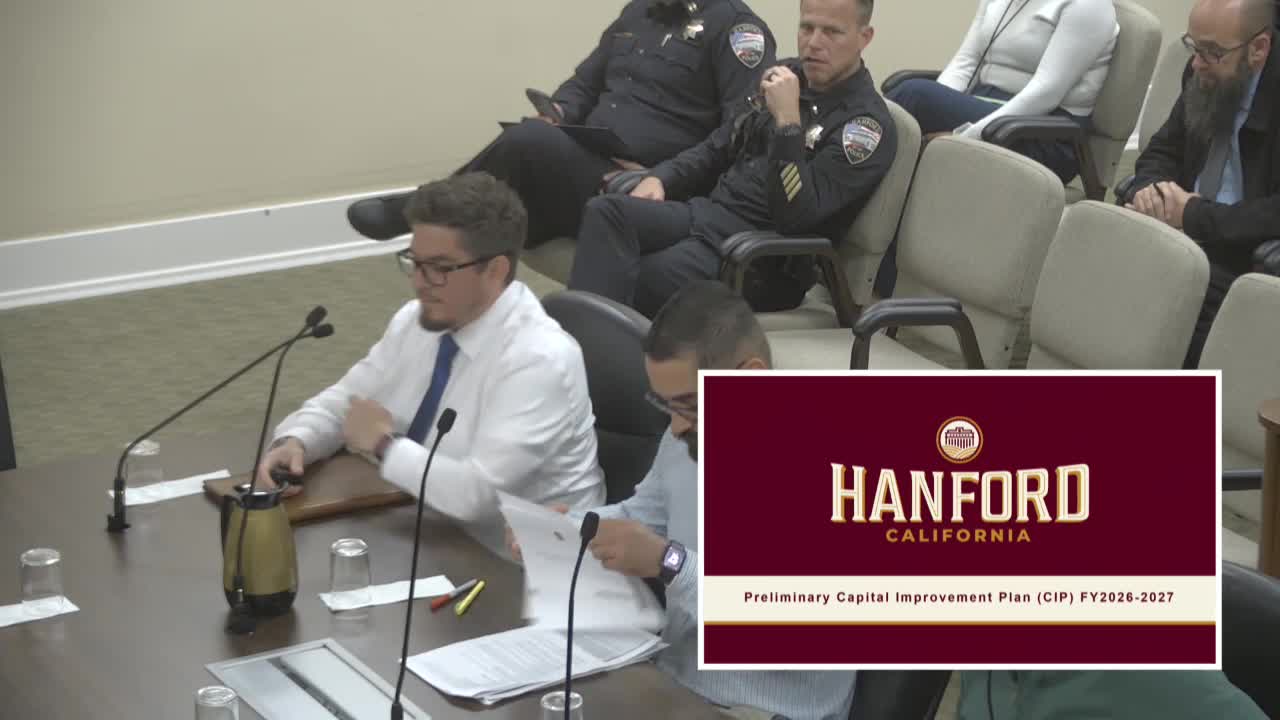
City of Hanford staff presented a preliminary capital improvement plan (CIP) showing roughly $460 million in identified projects over the next five years, asking the City Council for direction on which projects to prioritize for the two budgeted years, fiscal 2026 and 2027.
The presentation, led by Finance Director Chris Tavares and financial analyst Alejandro Salorio with engineering and utilities staff present, laid out projects across enterprise funds (water, wastewater, storm drain, refuse and airport), internal service funds (fleet, IT) and a small number of general‑fund projects. Staff emphasized that while the plan lists roughly half a billion dollars of needs, only the first two years are funded and available for appropriation now.
Why it matters: the CIP frames near‑term capital spending decisions and signals where the council may later need to consider rate or fee adjustments, grant applications, or Measure H allocations to avoid deteriorating fund balances.
Staff described the process and timing: this is phase one of CIP review for council (round 1), with round 2 scheduled for a later meeting before operating budget reviews in May and a planned June 3 public hearing for budget adoption. The presentation focused on enterprise and internal service funds for fiscal 2026–27 and noted many projects are maintenance or deferred‑maintenance items rather than brand‑new programs.
Key details from staff and council discussion: - Total needs and limits: staff said the CIP lists about $460 million of projects over five years but the city does not have funding for all items; only the first two years are budgeted and authorized for spending. - Wastewater: staff described wastewater projects (plant and collection system), saying most 2026–27 items are maintenance and were “fully funded” in their projection for the two‑year budget window. Staff reported an estimated positive ending fund balance for 2026 for wastewater, but council and staff noted projections can change and cautioned about cost escalation and timing of construction resources. - Storm drain: staff said the storm‑drain fund has significant needs—roughly $17.3 million of capital needs through 2030 with only about $4 million planned in the next two budget years—largely because the storm‑drain fee has been effectively frozen pending a future rate study and ballot measure. Staff added that China Alley utility replacement is coordinated with a RAISE grant mobility project but the RAISE grant would not fund storm‑drain work directly. - Impact fees and development reimbursements: staff described impact fee funds that pay for trunk utilities tied to development. A “development reimbursement” line estimates amounts due to developers who build required master‑plan infrastructure that the city later reimburses; staff said reimbursement agreements would be brought to council for approval before payments are made. - Water fund and meter upgrades: council discussed a roughly $16.56 million line item for a program to replace or upgrade water meters and metering equipment to improve billing and conservation data; staff said the program would help customer service and system monitoring. - Airport, building maintenance, fleet and IT: staff flagged negative or stressed projections in some funds (airport, building maintenance) and noted those items will be addressed in the operating budget review. Fleet reserves and equipment replacement appear under pressure; staff explained an internal‑service model where departments fund replacement through operating allocations to the reserve fund. - Basin 55: staff explained a proposed Basin 55 land‑acquisition line for a subregional basin in Mussel Slough that sits on private property with Fish & Wildlife jurisdiction; the line item reflects a possible purchase if negotiations and mitigation allow.
Council direction and next steps: council did not adopt a final CIP at this meeting but gave staff direction to return for round‑two review, and to present additional detail about general‑fund items, Measure H proposals already reviewed by the Measure H oversight board, and remaining transportation items. Staff said they will continue work on funding options (grants, impact fees, rate studies) and present more detailed project timing and estimates in a later session.
Funding context and caveats: staff repeatedly noted that many long‑range projects are “planning” only; spending requires future appropriations tied to budget adoption or carryovers. Council members pressed for clearer prioritization and asked staff to identify what can be delivered with current resources versus projects that require new revenue sources.
Ending: staff will return to council for a second CIP review and will present operating‑budget details and potential rate or fee actions in May. The CIP review continues to be iterative and will be refined before budget adoption in June.