Get Full Government Meeting Transcripts, Videos, & Alerts Forever!
Get email alerts on the General Plan Housing topic
No spam. Unsubscribe anytime.
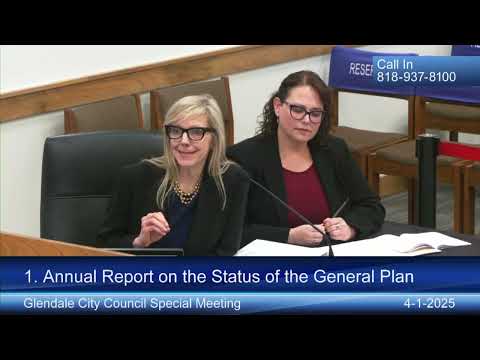
Glendale accepts annual progress report on general plan; staff outlines housing production and RHNA capacity
Summary
The Glendale Successor Agency accepted and filed the city's Annual Progress Report on the general plan and housing element on April 1. Staff reviewed updates to multiple general plan elements, housing production for the 2024 calendar year and next steps on outreach, ADU monitoring and state-level requirements including RHNA and SB 35.
Glendale Successor Agency members on April 1 voted to accept and file the city’s Annual Progress Report (APR) on the status of the general plan and housing element, a report staff said is required by state planning law.
Staff presented an overview of each general plan element and 2024 housing production, emphasizing that the APR is an informational filing. “Please note that this is only an informational report to city council and no decision or approval is required,” said Ilia Zamertaitis, Deputy Director of Community Development for Long Range Planning.
The APR summarizes work on the city’s 10 general plan elements, including required elements such as housing, land use, mobility (formerly circulation), noise, open space and conservation, and safety, and optional elements like community facilities, air quality, historic preservation and recreation. Staff reported ongoing comprehensive updates to the land use and mobility elements and a new environmental justice element, with public drafts expected for review this summer.
Teresa Santillena, Principal Planner for Long Range Planning, reviewed the housing data and state reporting requirements. “Each year by April 1, jurisdictions in California are required to submit the APR to the State,” she said. Staff said Glendale was allocated more than 13,000 units in the sixth cycle RHNA and must demonstrate capacity—through zoning and sites inventories—to accommodate the allocation; the city’s quantified objective identifies 5,510 new units as a more likely development scenario than the full RHNA allocation.
Staff reported permit and production figures for the current RHNA cycle and 2024 specifically: 305 building permits were issued for new units in 2024, and the city has achieved 1,930 permits toward the sixth-cycle RHNA so far. In 2024, staff reported 428 housing units were approved and 480 units were completed. Ownership-unit counts were small: nine ownership units in 2024 (nine in 2023 and eight in 2022). The housing element also includes more than 30 ongoing and new programs to preserve and produce affordable housing, including administration of Section 8 and other resident services, updates to the accessory dwelling unit (ADU) ordinance and direct financial assistance to nonprofit developers.
ADUs continue to be a significant source of housing production, staff said. The city said it has exceeded its ADU goal (59 permits per year) and has issued more than 200 ADU permits per year; staff is surveying ADU property owners to determine rents and whether some ADUs can be counted as lower-income units once data are verified. Until the survey yields data, ADUs are recorded in the APR as above-moderate income units when permit paperwork lacks rent information.
Staff also described several city-funded affordable projects that contributed to past production figures, including the 900 East Broadway project, the Piedmont senior housing conversion and a city-supported project near the 134 Freeway on Pacific Avenue. Private development also contributes affordable units through Glendale’s inclusionary housing requirement, which staff said requires 15% affordable units on projects with eight or more units or an in-lieu fee.
Councilmembers pressed staff on related policy and capacity questions. Councilmember Garpetian raised infrastructure and traffic concerns tied to the RHNA allocation, including a council-member calculation that a full buildout could add roughly 31,000 people (about 15% of the city’s population) and substantially increase vehicle trips and demand on streets and utilities. Garpetian urged continued state lobbying for funding and adjustments to RHNA numbers.
Staff said the city is engaged in legislative outreach. They noted that Senator Perez is working on a bill related to RHNA treatment and that staff has been meeting with the senator’s office and state housing staff to seek credits for past actions and to pursue more accurate, workable numbers. Councilmembers also discussed the state’s SB 35 ministerial streamlining law and the State’s “pro housing” designation; staff offered to return with more information if the council wants to pursue a pro-housing application.
On the question of optional elements—community facilities and air quality—staff said there is no formal recommendation at this time to delete or amend those elements and that any change would be brought back for council direction. Staff also proposed addressing community-facilities inventory needs as part of the parks/open-space and recreation update and promised to return after major element updates are further along.
After questions and comments, a councilmember moved to accept and file the APR; the motion carried in a recorded roll call. Staff emphasized that the APR itself is an informational filing used by the State Department of Housing and Community Development (HCD) to track housing production and that further policy decisions or general plan amendments would come to the council separately.
The council’s acceptance of the APR does not adopt new policy; staff listed next steps including public release of drafts for the land use, mobility and environmental justice elements in the summer, continued ADU affordability surveying, and further follow-up on RHNA advocacy and potential pro-housing actions.