Get Full Government Meeting Transcripts, Videos, & Alerts Forever!
Get email alerts on the Land Use topic
No spam. Unsubscribe anytime.
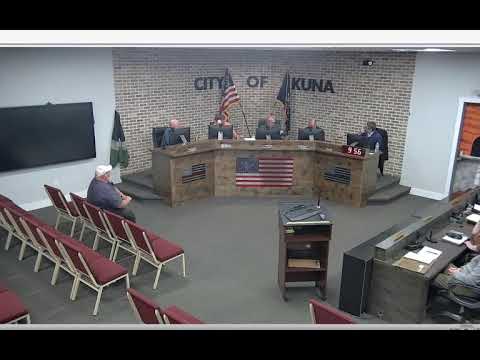
Kuna council approves rezone for Gemstone Technology Park after debate over traffic, water and school impacts
Summary
The Kuna City Council voted 3‑2 to approve a comprehensive plan map amendment and rezone that will allow a proposed 620‑acre data center campus, Gemstone Technology Park, to move forward with conditions to limit Locust Grove to secondary access and require a buffer and agency‑approved mitigation plans.
The Kuna City Council voted 3-2 to approve a comprehensive plan map amendment and rezone for a proposed data center campus called Gemstone Technology Park, a phased project the applicant says would occupy about 620 acres south of Kuna and be developed over roughly a decade.
The application by Diode Ventures (presented by attorney Heath Clark and project manager John Michael Hanley) seeks to change the site’s future land-use designation from agricultural to industrial and to rezone the property to an M-1 light industrial/manufacturing zone. The council approved the change with conditions that include a requirement that Locust Grove Road serve only as secondary/emergency access and that the applicant submit a landscape and maintenance plan for a northern buffer.
Why it matters: The project’s backers say it would generate a large construction payroll, hundreds of temporary jobs and about 100 permanent positions while adding substantial property-tax revenue and mitigation payments for local emergency services. Opponents — many of them neighbors along Locust Grove and Cloverdale roads — warned the council that construction traffic, long-term vehicle trips, groundwater and wastewater use, and strain on school capacity could harm the rural community if infrastructure upgrades are not guaranteed.
What the applicant told the council
Doug Hansen, Kuna planning and zoning director, opened the hearing by summarizing the request and noting staff’s finding that the application complies with Kuna City Code, Idaho Code and the previously approved Osprey Ridge development agreement.
Heath Clark, attorney for the applicant, told the council the project would be a single-user, low-intensity industrial campus that "will not connect to city water or sewer" and would instead provide on-site water and wastewater systems that must be permitted by state agencies. Clark said the campus would be phased over about 10 years and estimated 800 to 1,200 construction jobs during buildout and roughly 100 permanent jobs once operational. He said the applicant is negotiating upgrades with Idaho Power and has reached memoranda of understanding with local agencies addressing impacts.
John Michael Hanley, senior project manager for Diode Ventures, said the development team has performed groundwater temperature testing and is working with Idaho Power on interconnection studies and with the Ada County Highway District (ACHD) on traffic impact studies (TIS).
Mitigation and payments described by the applicant
Clark and Hanley described multiple mitigation commitments the applicant had negotiated or offered: a memorandum of agreement with Kuna School District for a $500,000 contribution (the district’s board voted to authorize the MOU in January 2025), proposed annual payments to the city for policing (described in presentations as roughly $10 million with a cost‑of‑living adjustment bringing that to about $12 million over time), and an estimated mitigation package for the rural fire district near $32 million, with approximately half of those payments front‑loaded to the first three years. Clark said the library district had indicated it did not expect additional operating impacts.
Council and public concerns
Residents who live along Locust Grove, Cloverdale and neighboring roads made up most of the public comment. Their top issues were:
- Traffic and safety: Several residents, including Shaylee Murray (3289 East Indian Trail Lane) and Omar Bernal (3327 S. Locust Grove), said Locust Grove is a narrow, rural road with a rail crossing and school bus stops and argued construction and operational traffic would overwhelm it. Multiple speakers asked that construction traffic be routed to Cloverdale/Barker and that Locust Grove be restricted to emergency access only.
- Water and wastewater: Speakers asked how groundwater rights would be affected and whether on‑site wastewater systems could contaminate aquifers. The applicant and project team said state agencies (Central District Health, Idaho DEQ and IDWR) must permit any on‑site systems and that converting agricultural groundwater rights through IDWR typically reduces allowable irrigation by about one‑third.
- Schools and community services: Hillary Lowe, a Kuna School District trustee, said the district appreciated the $500,000 MOU but asked the applicant and city to negotiate ongoing, proportional support to address long construction timelines and the likely multi‑year influx of workers and families.
- Power and rate impacts: Multiple commenters and council members raised concerns about Idaho Power’s available capacity and how large data-center loads would be added to the grid, and asked who ultimately pays for upgrades. The project team said the interconnection and transmission studies are underway with Idaho Power and that transmission upgrade costs would be borne by the developer; long‑term rate and generation decisions are regulated through the Public Utilities Commission.
Officials and agency positions
- Doug Hansen (planning & zoning director) told the council the property is subject to the Osprey Ridge development agreement (recorded June 23, 2008), which requires agency agreements to mitigate impacts and gives the applicant a clear entitlement path if they meet those conditions.
- T.J. Lawrence, speaking for the Kuna Rural Fire District, told the council the district has signed an MOU addressing fire impacts and that the payments offered in the mitigation package would allow the district to staff and equip a new station and purchase a ladder truck.
- The applicant said ACHD had accepted the TIS for operations; the ACHD review of the construction‑phase TIS remained in progress and the staff report included a condition requiring final ACHD approval of construction mitigation plans before work begins.
Council action and conditions
After several hours of public comment and applicant rebuttal, a motion to approve the comprehensive plan amendment and rezone passed 3‑2. Council members voting in favor noted the Osprey Ridge development agreement and the extensive MOUs the applicant had presented; members opposed voiced concerns about location, infrastructure and long‑term community impacts.
Conditions appended to the council approval (from staff recommendations and applicant commitments) include:
- Require ACHD approval of the construction‑phase traffic impact study and final traffic mitigation prior to issuance of construction permits. - Limit Locust Grove Road to secondary/emergency access only; primary construction and operational access to be routed to a main entrance (Barker/Cloverdale area) unless ACHD determines otherwise. - Require the applicant to submit a landscape and maintenance plan for the northern buffer area as part of design review. - Require final, signed MOUs with affected agencies (Kuna School District, Kuna Rural Fire District, Kuna Police Department or City of Kuna) prior to entitlement vesting or as stipulated in the development agreement conditions of approval.
What remains unresolved
- Construction‑phase traffic mitigation: ACHD review of the construction TIS was ongoing; the council included ACHD approval as a condition of final design and permitting.
- Water and wastewater permitting: The project team must obtain permits from Central District Health, Idaho DEQ and IDWR for on‑site water and wastewater systems; the council record notes those state approvals are required before facilities may operate.
- School funding: The Kuna School District accepted a $500,000 MOU but asked for additional, ongoing partnership given the scale and length of the construction period.
Ending
Council members split along concerns about location and long‑term impacts versus the property owners’ right to sell and a desire to add commercial tax base. The motion to approve the Gemstone Technology Park plan amendment and rezone passed 3‑2 with the conditions listed above; the applicant and city must complete outstanding agency agreements and ACHD approvals before construction permits are released.