Get Full Government Meeting Transcripts, Videos, & Alerts Forever!
Get email alerts on the Drone Operations topic
No spam. Unsubscribe anytime.
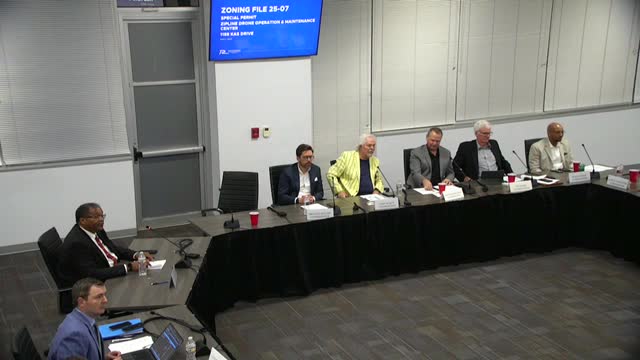
Plan commission approves special permit for Zipline operations and maintenance center in Richardson
Summary
The Richardson City Plan Commission unanimously approved a special permit allowing Zipline to operate a drone operations and maintenance center (DOMC) at 1155 Cass Drive, limited to ground‑based maintenance and a single docking station area described in the concept plan.
The Richardson City Plan Commission on Tuesday approved a special permit for a Zipline drone operations and maintenance center (DOMC) at 1155 Cass Drive and limited the use to the area shown on the submitted concept plan.
City planning staff explained that local governments are restricted to regulating ground‑based aspects of drone facilities; airspace and aircraft operations are overseen by the Federal Aviation Administration. The Collins Arapaho plan development (PD) previously was amended to allow a DOMC in the employment subdistrict by special permit, subject to standards that include locating ground‑mounted equipment to the rear or side of a building and limiting above‑roof equipment to 10 feet above the primary structure.
Zipline representatives told the commission the proposed site is a roughly 5‑acre lot with an 86,000‑square‑foot commercial building and that the company would occupy a single suite, not the entire structure. The application proposes one docking station pole—about 25 feet tall—placed in the building’s utility yard; the pole is shorter than the building, which staff said is about 35 feet tall. Zipline said the dock would have two docking positions at most and that drones ("Zips") would generally be transported to and from the DOMC by ground vehicles rather than flying into the site for maintenance.
Zipline operations manager Stephanie Cook told commissioners the company’s platform is fully autonomous and that docking tests at the DOMC would be limited to very short undocking/ redocking checks “one to two seconds” above the dock and would not routinely involve flights above the building. "Most of the maintenance is going to be happening inside of the hub," Cook said.
Staff noted the proposed DOMC location is about 1,700 feet from the nearest residential neighborhood, exceeding the PD’s 300‑foot minimum separation. The applicant included noise estimates for the docking/approach sequence of about 53–64 decibels, which staff compared to a quiet office or an indoor conversation. No public comments were listed in staff’s packet before the hearing.
During public comment, a local drone operator (Ken Herman of Skyeyes) and an FAA safety representative spoke in favor of the project, citing redundancy and safety measures in autonomous delivery systems and describing personal experience with fast medical deliveries in other jurisdictions. One member of the public who lives immediately behind the townhome site earlier in the meeting (Scott Bradshaw) had raised separate concerns about a different agenda item; no speakers opposed the DOMC at this hearing.
Commissioners asked whether future operational changes—such as flying Zips into and out of the DOMC instead of transporting them by truck—would require another permit. Planning staff noted that the special permit as drafted would limit the DOMC to Zipline and to the area shown on the concept plan; any expansion of use or changes to the approved area would require an amendment to the special permit. Commissioners also received technical answers from Zipline staff and a company customer‑support lead on communications, redundancy, and FAA oversight.
A motion to approve the special permit for the DOMC passed unanimously; the permit was approved with the limitations and conditions noted in the staff recommendation.