Get Full Government Meeting Transcripts, Videos, & Alerts Forever!
Get email alerts on the Air Quality topic
No spam. Unsubscribe anytime.
Redlands council tables response to South Coast AQMD rules after extended public debate
Summary
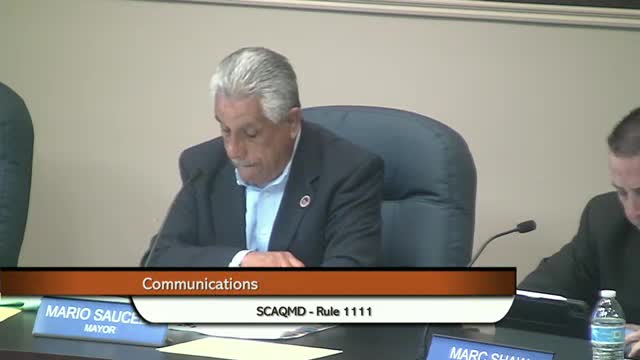
After more than an hour of public comment and council discussion, the Redlands City Council voted unanimously to table action on whether to send a letter opposing or supporting South Coast Air Quality Management District proposed Rule 1111 and proposed amendment Rule 1121, citing outstanding questions about costs, funding and grid capacity.
The Redlands City Council on April 1, 2025 voted to table consideration of a letter opposing the South Coast Air Quality Management District(South Coast AQMD) proposed Rule 1111 and proposed amendment Rule 1121, which aim to reduce NOx emissions from residential natural-gas furnaces and water heaters.
Councilmember Tejeda moved to table the item until after regional deliberations; the motion was seconded by Councilmember Barich and passed 5-0 (Barich, Tejeda, Davis, Mayor Pro Tem Shaw and Mayor Salcedo voting yes). The council indicated it will revisit the matter after other regional bodies, including the San Bernardino County Transportation Authority (SBCTA) / San Bernardino Council of Governments, have reviewed the revised proposals.
The item drew more than a dozen public commenters and several organizational representatives. Mike Krauss, assistant deputy executive officer in South Coast AQMD planning and rules division, told the council the agency has revised the approach and emphasized the proposal is not a ban on natural gas appliances: "our proposal now is not a natural gas ban, and it's not not a gas mandate." He said the rule framework includes nominal mitigation fees (he cited roughly $50 on a water heater) intended to fund incentive programs to help low-income households switch to electric alternatives.
Opponents of the rules emphasized up-front and distributional costs. Dale Broom and other residents told the council mitigation fees and required upgrades could impose substantial costs on households and raised concerns about whether promised incentive funding will be sustained. As Broom put it: "This is going to be a major cost shift... these type of upgrades that will need to take place in people's homes will cost a fortune."
Environmental and public-health advocates urged the council not to oppose the rules. Jennifer Cardenas, Sierra Club champion organizer, said the council's draft opposition letter was "inaccurate and outdated" and urged delay rather than opposition so the council can review the updated language and funding commitments. Andrea Velarde of the People's Collective for Environmental Justice and Vanessa Villanueva both argued the rules would improve local air quality and that mitigation fees would fund assistance for lower-income communities.
Representatives of the Building Decarbonization Coalition and other clean-energy groups said the rules provide incentives and manufacturer-focused compliance pathways and that electrification can deliver co-benefits such as cooling, indoor-air filtration and lower operating costs for many households. Yasi, a staff member at the Building Decarbonization Coalition, said panels and appliances often can be handled without large upgrades and noted labor and union endorsements for the rule.
Council discussion cited competing priorities: support for local climate and air-quality goals, concerns about affordability and questions about whether the regional electrical grid and incentive funding could support more rapid electrification. Mayor Pro Tem Shaw said the council had been "moving the city in the right direction" on sustainability but warned that signing an opposition letter now could "put us on the wrong side of history"; other members said they wanted more information about SBCTA discussions, the timeline for AQMD adoption (AQMD staff told the council the board vote had been moved to June) and the availability of state or federal incentive dollars.
The council directed staff and members to follow regional hearings and to return the item after SBCTA / regional deliberations and any new AQMD action. The formal motion was to table the agenda item pending an appropriate regional meeting, and the council recorded no further formal action on the rules that evening.
Ending: The councilwill revisit the matter after staff confirms the updated AQMD schedule and the outcomes of regional bodies' reviews; no letter will be sent until the item returns to a future council meeting.