Get Full Government Meeting Transcripts, Videos, & Alerts Forever!
Get email alerts on the Land Use Trees topic
No spam. Unsubscribe anytime.
Madera commercial plan continued after debate over tree removals and fill
Summary
Developers seeking to clear and fill two commercial parcels of the Madera PUD on U.S. 1 asked the Planning & Zoning Board to continue review after residents raised tree‑removal, remediation and traffic concerns; the board agreed to rehear the application June 3.
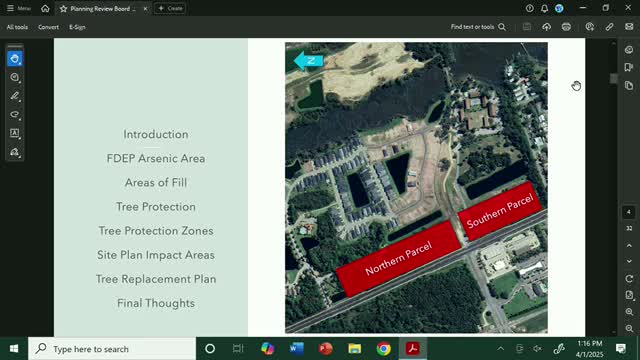
The Planning & Zoning Board on April 1 continued an application from Ponce Commercial (Madera) to remove trees, place fill and clear land for commercial development on two parcels along U.S. 1, and to review associated remediation plans.
The continuance gives the applicant time to supply additional materials requested by staff — including clearer grading, mitigation and contract details — and to meet with staff about inconsistencies in materials submitted late to the city. The board set the next hearing date for June 3, 2025.
Why it matters: The parcels are part of the larger Madera master plan and lie immediately adjacent to the Tennis Village and other residential neighborhoods. Residents and condo associations urged the board to require stronger protections for significant live oaks and to preserve canopy and wildlife habitat. Developers and counsel said much of the site requires arsenic sampling and remediation because of historic golf‑course pesticide use, and said bulk remediation and filling are needed to make utility and roadway infrastructure buildable.
Developers, engineers and residents debated where remediation and fill will be required, whether preservation wells/tree wells can save significant live oaks and how many trees would be removed. Applicant representatives said some parcels already have prospective users under contract and argued they must do bulk remediation and grading to “get shovel‑ready” pads; residents said heavy equipment and clearing appeared to be occurring before approvals and urged the city to inspect the site.
Board members pressed for: (1) an overlay showing proposed building footprints, grading and the exact drip lines/Tree Protection Zones for all specimen trees; (2) documentation of which lots are under contract to which end users and the firmness of those contracts (binder deposits, refundable vs. nonrefundable status); (3) more robust tree mitigation details including sizes (caliper) and planting locations; and (4) clearer stormwater and arsenic‑sampling plans from the St. Johns River Water Management District and Florida DEP records. Several board members asked for evidence that individual significant trees could not be saved by adjusting building footprints or parking and urged the applicant to show any attempts to redesign around specimen live oaks.
Public comment: More than a dozen residents spoke at the meeting, many representing Tennis Village and surrounding neighborhoods. Speakers said they support sensible commercial uses but objected to the scale of tree loss — residents said 333 trees were listed on applicant tables with 14 identified as “significant” — and worried about noise, lighting, traffic signal design on U.S. 1 and loss of bird and wildlife habitat. Several letters from residents and a condominium HOA asked the board to continue to allow neighbors to review plans.
What the board did: The board voted unanimously to continue the application to the June 3 meeting and asked staff to collect missing or inconsistent materials at least 10 days before that meeting so the packet can be reviewed by members. The board recommended that the applicants provide a consolidated file with the tree survey, arborist report, proposed building footprints, grading/existing elevations and a reconciliation table listing preserved vs. removed trees and mitigation credits.
What happens next: The applicant said it will meet staff, revise plans, and return with a complete package as requested; the board will rehear the item June 3. The City’s St. Johns River Water Management District permit and FDLP remediation steps remain relevant to final approvals.