Get Full Government Meeting Transcripts, Videos, & Alerts Forever!
Get email alerts on the Budget Planning topic
No spam. Unsubscribe anytime.
Ellis County adopts FY2026 budget calendar; officials flag pending state legislation that could cut mid-point revenue
Summary
The Commissioners Court approved the fiscal year 2026 budget calendar and heard staff warn that pending state legislation could prevent collection of the voter-approval midpoint rate and reduce local revenue by roughly $3.1 million compared with last year.
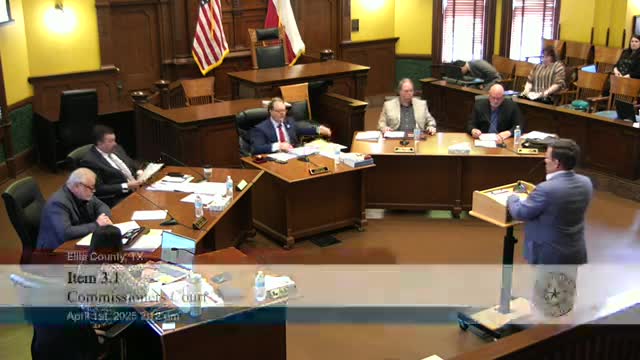
Ellis County Commissioners Court approved the fiscal year 2026 budget calendar April 1, setting a schedule of department deadlines, budget workshops and public hearings while staff warned that pending state legislation could alter the county's revenue-collection options.
Ryan Garrett, the county's chief of staff, presented the proposed calendar. Key dates include distribution of budget packets to departments on April 15, department responses due May 20, budget workshops beginning in May and an anticipated file date for the proposed budget of August 11 with a public hearing scheduled Aug. 19. The court approved the calendar and removed tentative highlight notations, authorizing staff to publish the schedule.
Garrett and the County Judge told commissioners they are tracking legislation in the Texas Legislature, including a bill from Senator Bettencourt's office that could prohibit counties from using a midpoint or "voter approval" revenue-collection rate without a 66 2/3 percent voter approval. County staff estimated the county collected roughly $3.1 million last year by using the midpoint between the no-new-revenue rate and the voter-approval tax rate; if the legislation passes it could reduce available revenue compared with current practice.
"Depending on that legislation, that would not allow us to take a midpoint rate, which could cost us here locally," the County Judge said. Staff said the legislature is expected to advance discussions before May 15, which is shortly before the county's budget hearings and could provide clarity.
Why it matters: The budget calendar sets the internal and public schedule for FY2026 budget preparation and hearings. Potential changes to the state law governing how local governments compute voter-approval rates would affect tax rate decisions and available revenues.
What’s next: The court adopted the calendar and directed staff to proceed with the timeline; staff will report legislative developments and adjust budget planning if required.