Get Full Government Meeting Transcripts, Videos, & Alerts Forever!
Get email alerts on the Bike Infrastructure topic
No spam. Unsubscribe anytime.
Heavy public outcry after mayor orders removal of Austin Street protected bike barriers
Summary
Hundreds of residents, cyclists and public-safety personnel told council removing concrete protections from Austin Street will reduce safety for cyclists, pedestrians and some vulnerable road users; others said debris and operational issues justify reexamination.
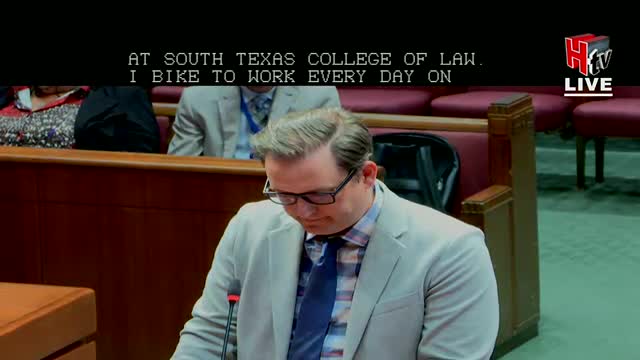
The Houston City Council heard strongly divided testimony April 1 after the mayor ordered removal of concrete barriers from the Austin Street protected bike lane, prompting sustained public comment from cyclists, residents and first responders about safety, debris and neighborhood impacts.
Supporters of protected lanes said the barriers provide a safe, continuous corridor for commuters and vulnerable pedestrians. “That lane and its physical protection saved my life,” said Derek Finchem, a Midtown resident who described a 2021 crash in which raised barriers slowed a vehicle that otherwise struck him head on. “Please restore the barriers,” Finchem told the council.
Cyclists and urban-transportation advocates argued removal exposed hundreds of regular users — commuters, students, and people using mobility devices — to risk. Several speakers, including medical professionals and organizers, said the lane enables non-drivers to access jobs, health care and city amenities and that protected lanes reduce injuries and hospital visits.
Neighbors and some business and resident speakers said the two-way protected configuration created service and safety problems in narrow blocks: parked cars, delivery vehicles blocking the curb, bike “swarms” late at night, and obstacles such as trash cans and debris that accumulate in protected lanes. Multiple residents and a representative for Magnificat Ministries urged council to restore order for emergency access and loading zones.
First responders’ safety concerns were raised repeatedly. Marcus Esteban read a statement attributed to the captain at Fire Station 7 saying two-way bike lanes plus parked cars created a narrow path for the station’s apparatus and complicated turning and routine checks, and that firefighters had raised concerns to city officials since 2020.
Speakers pointed to the city’s 2017 bike plan and national guidance from NACTO (National Association of City Transportation Officials) in support of protected corridors when they are built to the appropriate context. Others asked the council to consider alternate engineering solutions—shared-use paths, curb-separated lanes with maintained curb cuts, or jersey barriers—rather than painted lanes.
Council members acknowledged the depth of public feeling and called for more transparent data on crash frequency, maintenance costs and enforcement. Several members requested crash and cost data and asked that city staff produce a community-specific plan that balances parking, deliveries, fire and emergency access, and cyclist safety.
No immediate ordinance vote was taken; the matter prompted calls for further study, data-driven decisions and community engagement before permanent changes are approved.
Ending
Council members asked the administration for crash and maintenance data and for a community engagement plan before proceeding with permanent changes to bike infrastructure on Austin Street.