Get Full Government Meeting Transcripts, Videos, & Alerts Forever!
Get email alerts on the Park Safety topic
No spam. Unsubscribe anytime.
Parks department and APD outline steps to curb vehicle burglaries; cameras deployed at five sites
Summary
Parks and Recreation and Austin Police Department officials told the committee they have increased coordinated patrols, added temporary security cameras at five park locations this summer, and continue outreach campaigns to reduce vehicle burglaries in a small set of Austin parks.
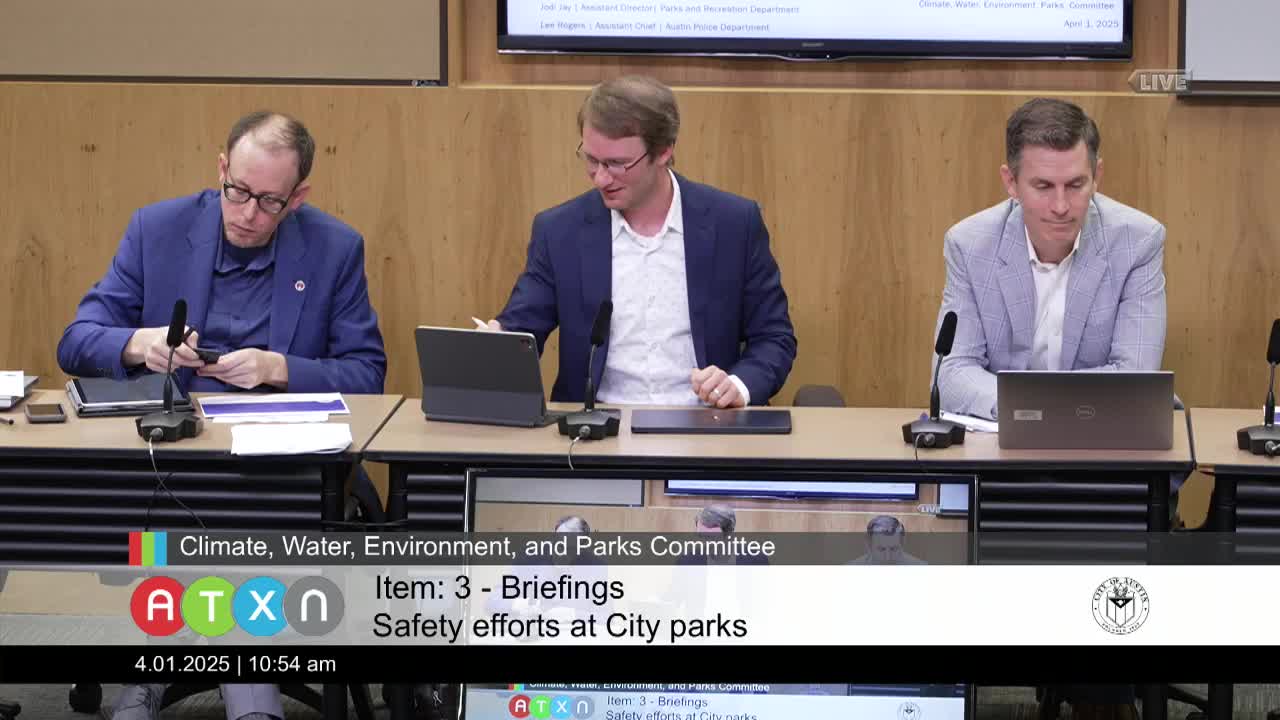
Jody (Assistant Director, Parks and Recreation), Amanda Ross (Division Manager, Natural Resources), and Assistant Chief Rogers of the Austin Police Department briefed the Climate, Water, Environment and Parks Committee on park safety measures and coordinated efforts to reduce vehicle burglaries.
Amanda Ross described Parks operations and said the department manages more than 20,000 acres and over 300 parks. “We have only 24 [park rangers], but they do work seven days a week,” Ross said, noting ranger duties include visitor assistance, voluntary compliance outreach and focused directed patrols. She said rangers do not carry firearms but may carry pepper spray.
Ross and Parks staff said the department is completing a city‑funded safety audit (with Austin Parks Foundation support) and will use its recommendations to prioritize infrastructure and signage changes. Parks said it will deploy temporary, live‑view security cameras at five park locations for the busy summer season; Parks estimated the current summer deployment budget is about $250,000 and that footage is retained for approximately 60 days. APD staff have access to the video for investigations.
Assistant Chief Rogers said vehicle burglaries are the department’s most frequent property crime in parks. “This is our biggest property crime issue, hands down across the city,” Rogers said, adding that 90% of vehicle burglaries occur in about 16 of the city’s 355 parks, with heavy concentrations at Bull Creek, Mount Bonnell, Saint Edward’s Park, and Zilker Park. Rogers described a multi‑pronged strategy: targeted enforcement operations, partner‑led signage and education campaigns ("Take Lock Hide"), rotating camera deployments, bait‑vehicle operations, mounted patrols, and closer coordination with prosecutors for stronger deterrence.
Rogers and park staff said staffing constraints limit some approaches: APD noted it previously had more officers in parks before 2020 and is seeking to rebuild specialized teams, mounted units and district representative staffing as hiring allows. For longer‑term infrastructure, APD and Parks discussed the need for a transfer station to enable more electrified refuse operations; Parks said land search and acquisition for such facilities could take about a year and development another three to four years, but that the timing may align with landfill contract cycles.
Committee members asked about trail speed limits, placement of limestone barriers to block illegal vehicle access, the cameras’ legal use in evidence, and whether lower‑cost trail or game cameras could supplement deployments. Parks and APD said cameras have been used in investigations and that staff will follow up with additional detail on camera procurement, evidence use, and the full safety audit when available.
The committee heard that the department plans to continue combining Crime Prevention Through Environmental Design (CPTED) measures, parks maintenance, ranger outreach, and APD enforcement to reduce incidents in top locations.