Get Full Government Meeting Transcripts, Videos, & Alerts Forever!
Get email alerts on the Climate Policy topic
No spam. Unsubscribe anytime.
Office of Climate Action and Resilience releases two‑year implementation program with 46 actions, prioritizes 36 projects
Summary
City staff released a public two‑year Climate Implementation Program tied to the 2021 Climate Equity Plan, identifying 46 actions and a 36‑project near‑term subset that staff say could avoid or reduce about 2.3 million metric tons of greenhouse gases by 2040 if implemented and maintained.
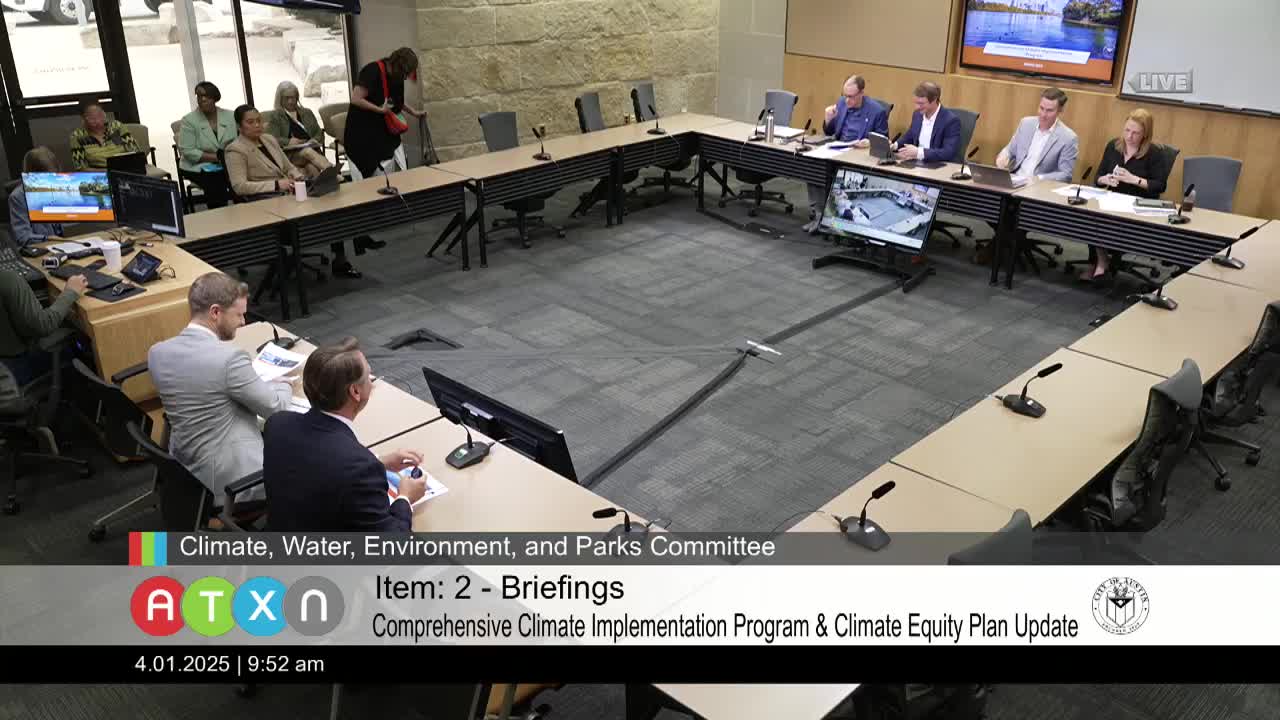
Zach Palmer, director of the Office of Climate Action and Resilience, and Braden Latham Jones, the office's climate program manager, presented a public, interactive two‑year Climate Implementation Program intended to prioritize near‑term projects that advance Austin’s Climate Equity Plan.
"This is really the next step in the implementation of the climate equity plan," Palmer said, summarizing a cross‑departmental effort that draws on the Environmental Investment Plan and a prioritization tool adapted from C40. Braden Latham Jones said staff screened several hundred possible actions and used an Action Selection and Prioritization tool to weigh greenhouse‑gas reduction potential, feasibility, and co‑benefits with an equity focus.
Staff described the program as two linked pieces: a programmatic/organizational alignment (a new cross‑departmental Climate Action Team and quarterly briefings for transparency and accountability) and a two‑year implementation plan. The office published an interactive website listing 46 actions across the Climate Equity Plan’s five sections (sustainable buildings; transportation and land use; transportation electrification; food and product consumption; and natural systems). Of those, staff highlighted a 36‑project subset intended for implementation over 2025–2027.
Palmer and Braden said the analysis estimates those projects, if implemented and maintained as modeled, would avoid or reduce about 2.3 million metric tons of greenhouse gas emissions between now and 2040. Staff also reported a cost‑per‑ton metric, a 15‑year greenhouse‑gas reduction modeling window, and funding‑status flags that identify potential sources (general fund, enterprise, bond, grant) and whether items are unfunded, partially funded or fully funded.
Director Palmer emphasized the dashboard’s filterable features: projects can be sorted by greenhouse‑gas reductions, cost‑effectiveness (cost per ton), or co‑benefits such as health or workforce development. He said foundational actions — such as EV needs assessments or green‑infrastructure plans — do not directly quantify emission reductions but are essential to unlocking other projects.
Committee members asked for more granularity on co‑benefit scoring, partial funding status, and additional memos to clarify what should be considered bond‑eligible for upcoming capital decisions. Palmer and staff agreed to follow up with more detailed memos and to provide quarterly implementation briefings to the council.
The office said the program will be updated biannually, beginning with a 2027 refresh, and will continue to be refined based on departmental engagement and additional cost and grant details.