Get Full Government Meeting Transcripts, Videos, & Alerts Forever!
Get email alerts on the Workforce Recruitment topic
No spam. Unsubscribe anytime.
Austin Water reports lower vacancy rate, expands training and youth workforce pilot
Summary
Austin Water officials told the Climate, Water, Environment and Parks Committee the utility reduced its vacancy rate substantially since 2023, is centralizing operational training, and is piloting an eight‑week paid program to prepare high school seniors and young adults for entry‑level water operator licensure.
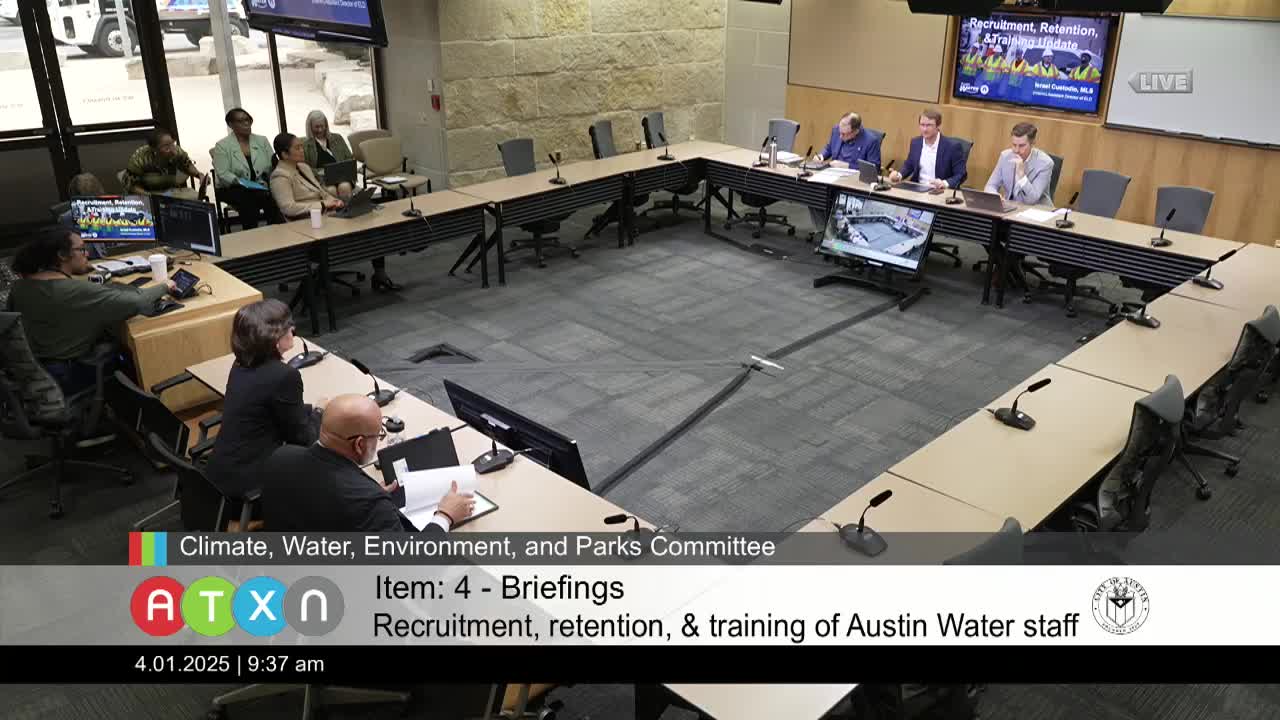
Shay Rawls Rolston, director of Austin Water, and Israel Custodio, acting assistant director of employee and leadership development, told the Climate, Water, Environment and Parks Committee that the utility has reduced its vacancy rate and is investing in training and a youth workforce pilot.
"I became director in January of 2023," Shay Rawls Rolston said, describing follow‑up work after an external UT review of Austin Water that recommended changes to recruitment, retention and training. Israel Custodio said Austin Water is “an organization of 1,400 plus and we're looking to fill about 118 more positions this year.” Custodio reported a vacancy rate of about 8.3%, and said that represents a reduction of more than 40% since 2023.
Officials described measures the utility has taken. Austin Water consolidated training programs into a new operational training division with onboarding modules and technical job‑skills and licensure training designed to improve retention and promotion pathways. Custodio described onboarding that uses knowledge‑transfer modules derived from best practices at treatment plants; the department has converted those into a formal onboarding curriculum and reported multiple cohorts completing the program. Officials said longstanding technical training (confined space, excavation, respiratory protection) and in‑house licensure training continue to support promotions and certification renewals.
The department identified several hard‑to‑fill roles — industrial electricians and instrumentation and control technicians — and said competitiveness of pay and the unique, utility‑specific skill set are key barriers. The utility is piloting a hiring pathway that offers temporary positions to applicants who meet a minimum score on occupational tests, gives six months of on‑the‑job training, then allows retesting and interview for full‑time placement.
Austin Water also described a workforce development pilot in collaboration with Texas AEWA and the SETH program: an eight‑week paid training aimed at graduating high‑school seniors (minimum 18–19 years old) and other young adults to prepare them to test for the entry‑level D water license. Officials said the pilot sought roughly 20 participants but had already received more than 100 applications.
Committee members asked for further data on reasons for resignations, where Austin Water is seeing transfers and retirements, and specific vacancy rates at treatment plants. Director Rawls Rolston reported Ulrich treatment plant has one vacancy, Davis has six and Hancock has one; she credited the new training program for improved retention at treatment plants.
Austin Water officials said they will continue to report back to council as the training programs scale and the pilot moves toward June recruitment and testing.