Get Full Government Meeting Transcripts, Videos, & Alerts Forever!
Get email alerts on the Campo 2050 Rpt topic
No spam. Unsubscribe anytime.
Austin UTC urges CAMPO to revise 2050 regional plan, votes unanimous recommendation
Summary
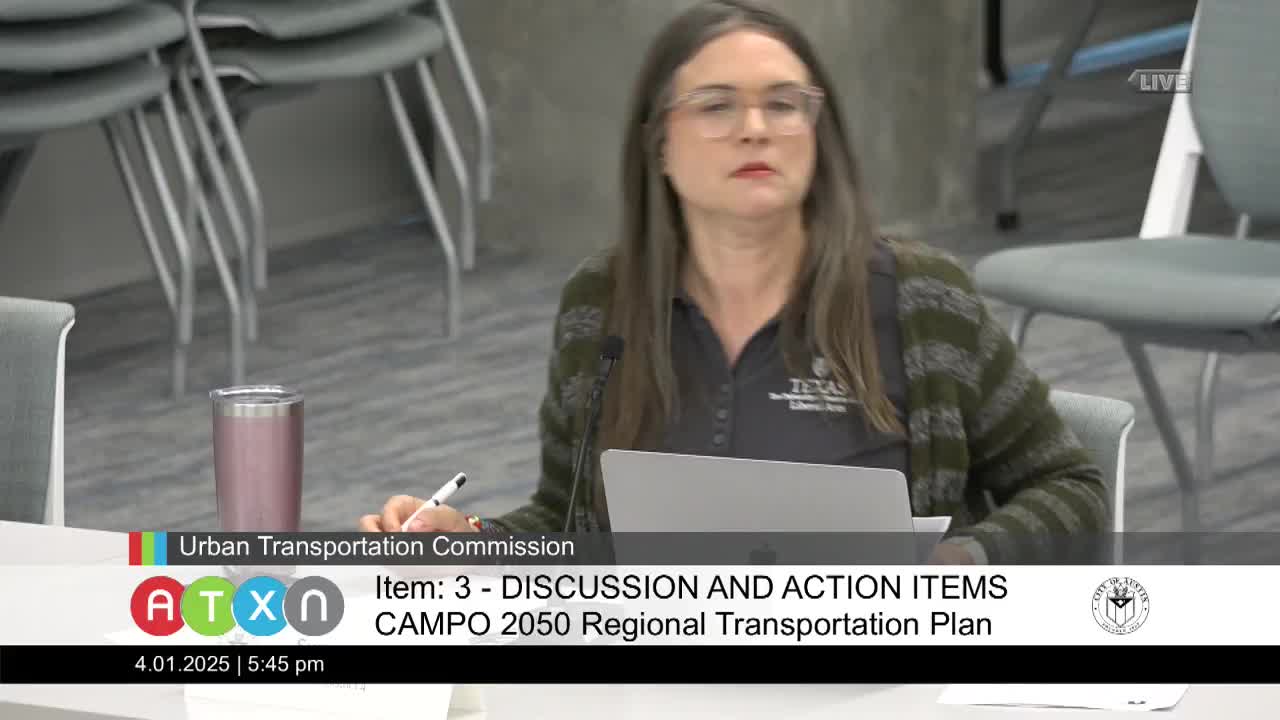
The City of Austin Urban Transportation Commission voted unanimously on April 1 to send formal recommendations to CAMPO asking for stronger commitments to safety, transit and active transportation, more transparency in demographic modeling, and removal or reduction of specific highway expansions in the draft 2050 RTP.
The City of Austin Urban Transportation Commission voted unanimously on April 1 to send a formal set of recommendations to the Capital Area Metropolitan Planning Organization (CAMPO) about the agency’s draft 2050 Regional Transportation Plan (RTP). The commission asked CAMPO to prioritize safety, transit and active transportation, make demographic and modeling inputs public, account for induced demand in travel models and to remove or reduce certain highway expansions cited in the draft plan.
In a motion moved by Chair Susan Summers and adopted after discussion and an amendment, the commission recommended that CAMPO prioritize projects that improve safety for all users, prioritize funding for public transit and active transportation, deprioritize projects that increase vehicle capacity, use scenario planning and improve traffic demand models so induced demand is reflected, and require CAMPO to share all demographic forecast data and modeling methods used in the RTP process.
The commission also specifically recommended that the proposed MoPac (MoPac/Loop 1) South expansion be removed from the CAMPO 2050 RTP or be limited to no more than one additional lane in each direction, consistent with a letter from Austin City Council member Ann Kitchen (referred to in the motion as a follow-up from council) and requested that the I‑183 expansion described in the draft RTP be removed. Commissioners cited safety goals, greenhouse gas and vehicle‑miles‑traveled concerns, and a recent finding that discretionary regional funds in prior cycles largely favored highway expansion.
What commissioners discussed City staff member Cole Kitten (Division Manager, Systems Development Division, Transportation and Public Works) gave an overview of the draft CAMPO 2050 RTP. Kitten summarized the plan’s scope: a roughly $67.5 billion fiscally constrained project list over the plan horizon, 611 constrained projects and 401 illustrative (unfunded) projects, and a project composition that CAMPO displays as roughly 54% roadway, 24% active transportation and 18% transit once constrained projects are considered. Kitten said the City of Austin submitted a prioritized project list and noted the city’s constrained submission included a high share of active-transportation “complete street” projects using a local forecast of $4.2 billion in local funding over the plan horizon.
Public comment and staff concerns Miriam Schoenfeld of Rethink35 urged commissioners to press CAMPO for updates to its project scoring methodology, more transparency on demographic forecasts and for stronger emphasis on transit and active transportation at the regional level. Schoenfeld warned that discretionary regional funding in past rounds largely favored highway expansion and said CAMPO’s scoring and modeling — unchanged since 2017 in some respects — did not allow the plan’s goals to translate into funding decisions.
Kitten and commissioners discussed how projects are counted, how CAMPO classifies “constrained” versus “illustrative” projects, and how the city’s constrained submission emphasized active-transportation projects. Kitten said the city intends to perform more advanced planning and cost estimation before the 2026 bond program so that projects are closer to “shovel-ready” when presented for a ballot.
Motion and amendment Chair Susan Summers moved that the commission approve the written recommendation included in the meeting packet; commissioners debated, proposed clarifying edits, and Commissioner Reuben Brooks moved a narrow wording amendment to clarify a sentence about whether CAMPO used UrbanSim for demographic forecasting. Commissioners approved that amendment by voice/hand vote. The final recommendation, as amended, was adopted unanimously by commissioners present and will be submitted as the UTC’s formal public comment to CAMPO before the April 15 public‑comment deadline.
Why it matters CAMPO is the federally recognized metropolitan planning organization for the Austin region; projects in the RTP are eligible for federal and other discretionary funds. In the draft 2050 plan, staff modeled regionwide travel demand and built a constrained list that the commission said needs clearer documentation so that regional decisions align with stated safety, climate and equity goals.
Next steps Summers said the UTC will submit the recommendation to CAMPO as formal public comment by the April 15 deadline. Kitten and city staff offered to continue coordinating with CAMPO and to return to the commission with additional information about corridor-level spending and about city priorities for the 2026 bond process.