Get Full Government Meeting Transcripts, Videos, & Alerts Forever!
Get email alerts on the Committee Votes Roundup topic
No spam. Unsubscribe anytime.
Committee advances multiple local-governance and alcohol bills in single session; overview of votes
Summary
The committee advanced a package of local-governance and alcohol-related bills by voice vote, moving measures on private-club rules, craft-beer retail limits, municipal governance cleanups and county-municipal coordination to the next stage of the legislative process.
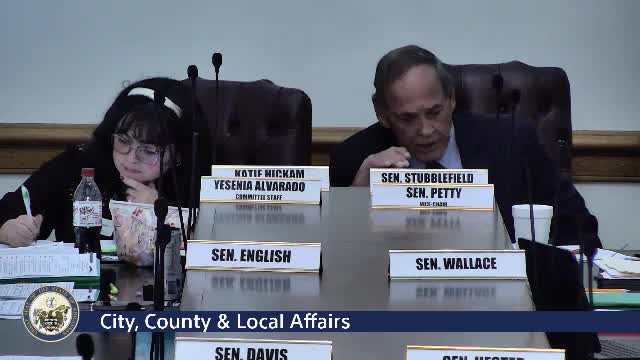
The Senate City, County & Local Affairs Committee advanced a series of bills during the session with brief sponsor presentations and limited debate. The items below summarize each bill that received a formal motion and committee vote during the hearing record.
Votes at a glance (committee action recorded in hearing):
- Senate Bill 523 (private-club nonprofit requirement): Sponsor Representative Carol Dobby explained the bill would remove the requirement that businesses form a nonprofit and wait one year before operating a private club in a dry county; committee voted to “do pass.”
- Craft-beer retailing bill (sponsor: Senator Scott Flippo): The measure would raise the alcohol-by-volume threshold for beer sales in grocery and convenience stores from 5% to a capped 10% so many craft beers could be sold outside liquor stores. Industry witnesses included retailers and convenience-store representatives who supported expanding sales; independent liquor-store representatives opposed the bill on competitive and safety grounds. The committee voted to do pass.
- House Bill 1618 (city attorney vacancy/municipal cleanup): Senator Steve Crow carried a cleanup bill to standardize procedures for filling city attorney vacancies for cities under 50,000 and to clarify sharing of legal services for smaller towns; the committee voted to pass.
- House Bill 1645 (menus/advertising exception for private-club restaurants in dry counties): Representative Matt Brown said the bill would clarify that placing a menu on a restaurant website or Facebook page does not constitute forbidden advertising for private-club restaurants operating in dry counties; committee voted to do pass.
- House Bill 1455 (private clubs purchasing from wholesalers): Sponsor Joshua Bryant said the bill allows private clubs additional purchase options — direct purchases from a wholesaler or small brewery — with statutory restrictions described in testimony; committee voted to pass.
- House Bill 1789 (municipal ID restrictions): The committee adopted a technical amendment and voted to pass (covered in detail in separate article).
- Senate Bill 525 (incorporation procedures for communities straddling two counties): Senator Mark Johnson's bill would revert petition-signature thresholds and shift hearings to the Secretary of State when a proposed incorporation crosses county lines; committee voted to pass as amended.
- Senate Bill 553 (municipal treasurer training): Sponsored for Senator Dave Wallace, the bill requires certain municipal treasurers to complete eight hours of training; committee voted to pass.
- Senate Bills 571 and 574 (county-owned facilities and municipal services): Senator Perry presented both bills clarifying county-owned building jurisdiction and access to municipal services when counties meet health requirements and pay improvement costs; both bills passed on voice votes.
- Talent recruitment grant mechanism (sponsor described as county/local representatives): The committee approved a bill establishing a mechanism for a local talent-recruitment grant program (no state funding included in the bill text); committee voted to pass.
For several of these items the hearing record shows voice votes and “aye”/“nay” calls without roll-call tallies. The committee did not record named vote tallies in the transcript for these motions.
What the committee did not pass: The earlier-discussed electronic concealed-handgun permit bill (House Bill 1686) failed in committee.
Provenance: Each item above is introduced at the point in the transcript where the sponsor presented the bill and concludes at the recorded committee voice vote. Individual topic introductions and finishes are documented in the hearing record for each bill.