Get Full Government Meeting Transcripts, Videos, & Alerts Forever!
Get email alerts on the Ballot Fiscal Impact topic
No spam. Unsubscribe anytime.
Senate committee approves requirement for concise fiscal-impact summaries on ballot measures
Summary
The Senate State Agencies & Governmental Affairs Committee voted to require a brief fiscal-impact statement prepared by the Department of Finance and Administration (DFNA) for initiated and referred constitutional amendments, after debate over the statute's scope and a public witness opposed to the measure.
Little Rock — The Senate State Agencies & Governmental Affairs Committee voted to advance House Bill 16 37, a measure requiring the Department of Finance and Administration (DFNA) to prepare a short fiscal-impact statement to be shown to voters when an initiated or referred constitutional amendment is certified for the ballot.
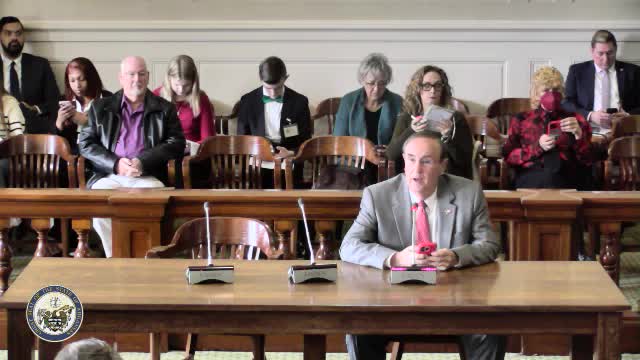
Sponsor Senator Blake Johnson told the committee the bill would require DFNA to produce a “fiscal impact” summary limited to 100 words, plus 100 additional words per affected revenue source, and to identify which taxes or funding sources the measure would affect. “The fiscal impact should not exceed 100 words plus 100 additional words per revenue source that's impacted by the fiscal impact statement,” Johnson said during his presentation.
Supporters said the change would give voters helpful cost information at the ballot box; opponents warned the requirement could mislead voters if DFNA’s estimates are static and do not include longer-term economic effects. Senator Payton asked whether the fiscal impact should reflect full finance costs of bond issues or just principal; Johnson said DFNA could separate those issues but noted that some measures may not be constitutional amendments and therefore would not be covered by this bill.
Attorney and committee members debated whether the attorney general should refer citizen initiatives to DFNA for analysis. A public witness, Kwame Abdul Bey, campaign manager for For Our Kids BQC, urged defeat unless the bill was amended: he said the draft gave the attorney general discretion to decide whether a citizen-initiated measure needs a fiscal statement and that putting the statements directly on ballots could increase printing costs and confuse voters. “We thought that as it was written, it was a good idea, but it needed some amendments,” Abdul Bey said. He suggested posting the fiscal statement on a Secretary of State website rather than on the ballot itself to allow for counter-arguments to appear alongside the DFNA summary.
Committee members also discussed DFNA’s current “static” scoring and whether the department has the resources to produce more dynamic economic estimates. Senator Tucker said static numbers can mislead voters who do not have legislative experience interpreting fiscal notes, and other members said DFNA has improved its practices but that the bill would create a baseline of information for voters.
After debate, Senator Sullivan moved to pass the bill; Senator Peyton seconded. Senator Johnson closed by urging members to provide voters with the same information legislators receive when considering fiscal effects. The committee then recessed for a roll call. The recorded roll call in committee showed the following votes: Senator Clark — yes; Senator Hammer — yes; Senator Sullivan — yes; Senator Tucker — no; Senator King — yes; Senator Dotsen — yes; Senator Peyton — no. With five ayes the motion passed and the bill advanced out of committee.
Why it matters: The bill changes what information a voter may see on the ballot for constitutional measures, directing DFNA to summarize estimated fiscal effects and funding sources in a short format. Supporters say it improves transparency; critics warned it could oversimplify complex fiscal dynamics and suggested alternatives such as online posting with space for rebuttals.
Next steps: The bill will move to the Senate calendar for further consideration.