Get AI Briefings, Transcripts & Alerts on Local & National Government Meetings — Forever.
Committee advances bill to legalize and regulate kratom; proponents cite harm‑reduction and product‑safety safeguards
Summary
The committee passed legislation to legalize and regulate kratom products in Arkansas, with proponents urging regulation (registration, independent certificates of analysis, GMP, age limits) to prevent adulterated products and support harm‑reduction; multiple witnesses testified in favor and no opposition was recorded on the transcript.
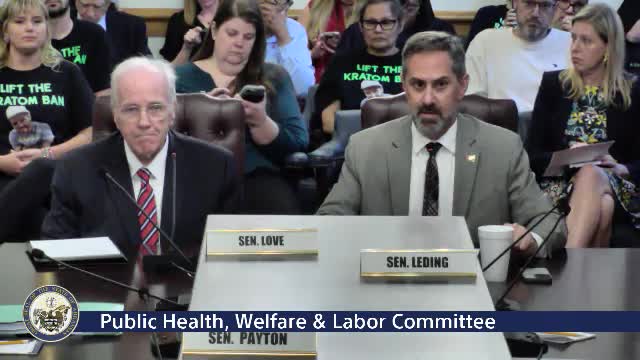
The Senate Public Health, Welfare and Labor Committee passed legislation to legalize and regulate kratom in the state after proponents described a regulatory framework intended to keep adulterated products off the market and to preserve access for people who say kratom helped them with opioid withdrawal.
Several witnesses spoke in favor. Greg Liddings (state senator, District 30) and Matt Caddo (senior fellow on public policy, American Freedom Association) introduced testimony supporting the bill. A longer presentation was given by a witness identified in the record as "Mr. Haddow," who provided a chronology of federal and international agency actions and argued against scheduling kratom as a controlled substance. Haddow told the committee that the U.S. Food and Drug Administration had at one point recommended scheduling and that later reviews and federal actions undercut that recommendation. He said, "The FDA's position today is that kratom appears to be well tolerated at all dose levels," and that deaths attributed to kratom were associated with polydrug use or adulterated products. He argued the statutory/regulatory approach used in other states requires that kratom products be registered, carry a certificate of analysis from an independent laboratory, meet good‑manufacturing‑practice standards, be free from contaminants and adulterants, carry proper labeling and be age‑restricted.
Haddow and other proponents cited a range of state examples and said 14 states had enacted similar regulatory frameworks. The transcript records motions for "immediate consideration" followed by committee voice votes; the chair announced the bill passed: "All those in favor say aye. And opposed? Ayes have it. The bill passes." The transcript shows proponents offered to provide video testimonials and pointed to veterans and law enforcement officials among supporters, but it contains no recorded opposition or roll-call vote.
The bill text or committee record, as captured in the transcript, does not include precise statutory citations for the regulatory requirements or the exact labeling and testing standards that would be required; proponents cited model approaches used in other states and federal agency activity as context.