Get Full Government Meeting Transcripts, Videos, & Alerts Forever!
Get email alerts on the Aprn Delegation topic
No spam. Unsubscribe anytime.
APRN delegation bill pulled for revision after lawmakers raise supervision and scope questions
Summary
House Bill 1131, which would allow advanced practice registered nurses to delegate certain nursing tasks to unlicensed staff, was pulled from committee consideration pending clarification on supervision, phlebotomy and limits on delegated tasks.
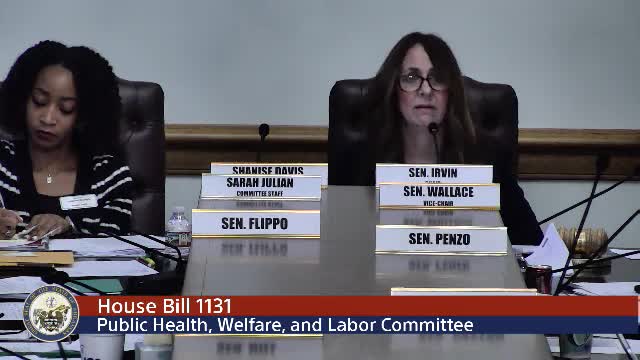
House Bill 1131, a proposal to permit advanced practice registered nurses (APRNs) to delegate a range of nursing tasks to unlicensed medical staff, was discussed at length and then pulled from consideration by the Senate Public Health, Welfare and Labor Committee pending revisions.
Representative Penzo (house sponsor) and Representative Aaron Pilkington described the bill as modeled on a 2009 statute that gave physicians similar delegation authority. Supporters said the change is intended to reduce delays in patient care by allowing APRNs to delegate routine tasks that currently require the APRN to stop a patient visit and perform the task themselves.
Committee members pressed for specifics about on-site supervision and the limits of delegation. Senator Peyton asked whether delegated tasks could be performed when the APRN was off-site, and Representative Pilkington and others said delegation in clinic telehealth contexts had been allowed under prior physician-centered law but should be clearly defined. Senators also raised concerns about including “phlebotomy activities” and whether a delegated individual would need formal certification.
Scott Smith of the Arkansas Medical Society explained that physicians currently delegate a limited, defined group of tasks to trained medical assistants, that the physician retains liability, and that some medical assistants hold certification programs (for example at Arkansas Tech). Still, members asked for explicit language to ensure supervision and scope limits are clear in statute. The committee chair agreed to pull the bill down and work with stakeholders to clarify the on-site/telehealth supervision question and any necessary training or certification requirements.
No final committee vote was recorded on HB 1131; the bill was taken down for amendment and further review.
Why it matters: The bill would change who may perform routine clinical tasks in outpatient settings; lawmakers worried broad “without limitation” language could allow delegation beyond appropriate limits without explicit safeguards. Lawmakers requested clearer statutory language about supervision, training, and types of delegated tasks before proceeding.
Next steps: Sponsors will work with stakeholders and the health department to clarify language and return the measure to committee with specific supervision/certification language.