Get Full Government Meeting Transcripts, Videos, & Alerts Forever!
Get email alerts on the Cannabis Policy topic
No spam. Unsubscribe anytime.
Senate advances omnibus cannabis bill after series of amendments expanding access, testing fixes and event rules
Summary
Senate File 2,370, the omnibus cannabis policy bill, was amended and recommended to pass by the Senate Commerce and Consumer Protection Committee on April 1 after several hours of testimony and multiple adopted amendments.
Senate File 2,370, the omnibus cannabis policy bill, was amended and recommended to pass by the Senate Commerce and Consumer Protection Committee on April 1 after several hours of testimony and multiple adopted amendments.
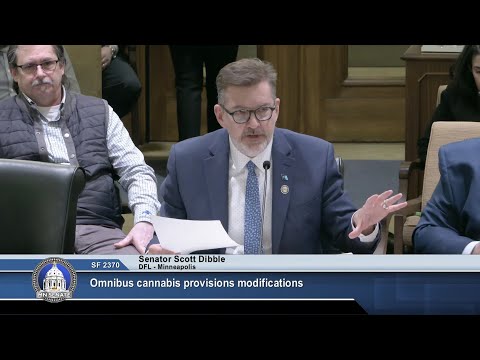
The bill, carried by Senator Dibble, combines five agency bills and a separate proposal on low‑potency THC beverages. Committee members adopted an author’s A1 “delete everything” amendment that incorporated the five bills plus the beverage provisions, then approved further technical and policy amendments that the committee said reflect ongoing interchamber negotiations.
Why it matters: The package makes multiple regulatory changes across Minnesota’s nascent adult‑use and medical cannabis frameworks, including labeling and testing fixes intended to help businesses operate across state lines, adjustments to how products are served and tracked at cannabis events, and clarifications that affect patient access inside health care facilities.
Key changes and discussion
Labeling and interstate sales: The committee adopted language (in the A1/A1‑related text) that lets manufacturers treat a 10‑milligram hemp beverage as a single 10 mg serving per container rather than two 5 mg servings. Industry witness Glenn McElfresh, who identified himself as co‑founder of PLIFT and a member of the Hemp Beverage Alliance, told the committee this is primarily a labeling change to allow Minnesota products to be sold in other states with single‑serving rules. “The only way for a brand to work around this issue is to significantly invest in packaging materials or launch in a new market without their top selling 10 milligram drinks,” McElfresh said. He testified the change keeps the “spirit of the law that caps THC beverages at no more than 10 milligrams of THC per can” while aligning Minnesota labels with other states.
Event sampling and youth protections: The committee adopted an A8 amendment to allow licensed cannabis event organizers to distribute samples under conditions modeled on established alcoholic beverage sampling events and technical guidance from the Office of Cannabis Management (OCM). Josh Wilkins Simon, an event operator and retailer, said Minnesota’s cannabis events have been 21+ and “we’ve had over 10,000 attendees. Haven’t had any medical issues, no security issues.” OCM interim director Eric Taubel told senators his office recommended requiring event tracking through the statewide monitoring system and restricting events to 21‑plus spaces so samples can be reconciled to inventory and so diversion risk is reduced.
Access inside health facilities: The committee added an A6 amendment to expand the types of products that patients in assisted‑living and long‑term care settings may access, including low‑potency hemp edibles and hemp‑derived topicals. Senator Rasmussen and others expressed concern that long‑term care providers and hospital associations had not been fully consulted before the amendment was adopted; Senator Dibble and others said the change originated from testimony in Health and Human Services and pledged to continue outreach. Taubel characterized the amendment as a “product category addition rather than a category of patient addition.”
Visiting medical patients: The committee approved an A7 amendment to let people enrolled in out‑of‑state medical cannabis programs access medical cannabis while visiting Minnesota by presenting their home‑state enrollment credentials.
Medical program operational fixes: The bill includes technical changes the OCM said resolve practical issues inside the medical program. One example adopted in amendments lets facility employees attach patient‑specific labels following a pharmacist or consultant remote consultation so a virtual consultation is meaningful even when the pharmacist is not physically present to affix a label. Lawmakers also retained language limiting disciplinary action by occupational boards from relying solely on a patient’s registry enrollment or a positive test result, clarifying that enforcement still can act where impairment or dangerous behavior is shown.
Municipal liquor and cannabis stores: An amendment (A3) was adopted to allow municipal liquor stores currently selling low‑potency hemp beverages to hold separate municipal cannabis retail licenses so they can continue selling low‑potency hemp beverages through existing liquor‑store channels while also operating a separate municipal cannabis outlet.
Process and next steps: Senator Dibble noted the bill will continue to move through committee and to the floor, and he said elements not yet heard in Judiciary will be debated there. At the end of the hearing the committee voted to recommend Senate File 2,370, as amended, to general orders.
What supporters and advocates said: Testimony showed competing priorities. Industry witnesses urged fixes to labeling and testing that they said would allow Minnesota businesses to compete nationally and protect small and equity businesses. Patient and policy advocates asked the Senate to adopt additional House provisions to protect visiting patients, maintain treatment continuity and expand equity pathways. OCM said it had provided technical assistance and urged the Legislature to give the office tools to track samples and enforce safety measures.
What remains unresolved: Multiple senators asked that stakeholders not present be consulted further — specifically, long‑term care and hospital representatives on the assisted‑living language — and said amendments entered late in the process required more conversation. Senator Rasmussen said she was not prepared to vote at several points because “the details matter” and some providers had not weighed in. Senator Dibble and OCM committed to additional stakeholder engagement as the package moves to other committees and the floor.
Outcome: The committee adopted multiple amendments by voice vote and approved a motion that Senate File 2,370, as amended, be recommended to pass and sent to general orders.
Ending note: Committee members emphasized the package is a work in progress and that the Senate and House remain out of alignment on several provisions; both lawmakers and OCM said subsequent committee stops would shape the final statutory language.