Get Full Government Meeting Transcripts, Videos, & Alerts Forever!
Get email alerts on the Tax Increment Financing topic
No spam. Unsubscribe anytime.
House Tax Committee hears a slate of local TIF bills; lays over measures to extend and repurpose tax-increment tools
Summary
The Minnesota House Committee on Taxes on April 1 heard multiple local and special-law TIF proposals — ranging from extensions for gravel-mine remediation in Maple Grove to downtown office-to-housing conversions in Minneapolis and St. Paul — and laid over each measure for possible inclusion in the 2025 tax omnibus.
The Minnesota House Committee on Taxes on April 1 heard a series of local tax-increment financing (TIF) proposals from cities across the state and laid over each bill for possible inclusion in the 2025 tax omnibus. The hearing covered requests to extend district timelines, allow TIF for redevelopment of underused downtown office buildings, permit land-value-based increment calculations for conversions to housing, and broaden pooled TIF transfers into local affordable-housing trust funds.
Why it matters: Local governments use TIF to pay upfront redevelopment costs by capturing future property tax growth in a defined area. The committee’s review focused on where state-level exceptions or clarifications are needed so cities can convert older commercial properties to housing, support industrial growth, or finish complex redevelopment projects without immediately reducing other local taxing jurisdictions’ revenue.
Key proposals and testimony
- House File 160 (Maple Grove): Representative Elise Bonner presented a request to extend a Maple Grove TIF district tied to a long-planned gravel-mining redevelopment. Mayor Mark Stephenson, Mayor of Maple Grove, said the proposal would extend the district’s term to 25 years and extend the district’s five-year rule to 13 years to support remediation and soil correction for roughly a 2,000-acre former gravel-mining area and to sustain industrial development that proponents say has produced substantial industrial space and jobs in recent years.
- House File 512 (Plymouth): Representative Cleburne described authorizing up to two redevelopment districts in Plymouth City Center to support central roadway redesign, regional stormwater ponding, and a public parking ramp intended to support future bus rapid transit and affordable-housing opportunities. Mayor Jeff Washoe, Mayor of Plymouth, testified in support.
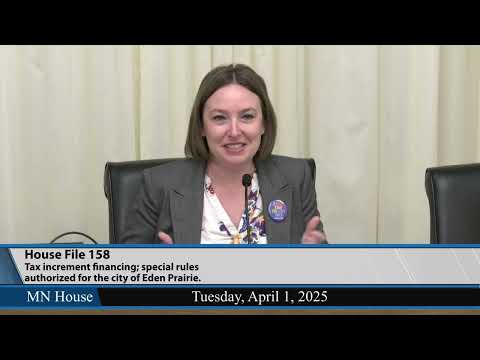
- House File 158 (Eden Prairie): Representative Katiza Watoon presented language to allow up to two redevelopment districts for Eden Prairie Center (the region’s large shopping mall). Dave Lindahl, Eden Prairie’s economic development manager, said the mall contains about 1,400,000 square feet, four department stores and roughly 2,400 jobs, and that inline retail visitation has declined from about 12 million annual visits in the mall’s peak to 7–8 million, reducing assessed value and complicating redevelopment. The city seeks an exemption from the usual “blight” finding to permit redevelopment TIF for conversion to mixed uses.
- House File 157 (Maplewood): Representative Fisher and City Manager Mike Sabol described a request tied to Maplewood Mall area redevelopment. Testimony said long-term decline at the mall’s north end has left anchors vacant and that TIF flexibility is needed to support redevelopment, entrepreneurship and local markets serving immigrant and other community developers.
- House File 1746 (Oakdale): Representative Lilly and John Stark, Oakdale’s special projects manager, described the Tanner’s Lake project, a roughly $44,000,000 redevelopment including 126 apartment units and 12 townhomes. The city said the project is nearly complete but seeks a timeline extension as a margin of error to avoid losing eligibility when small technical issues remain.
- House File 1159 (statewide/local law change; affordable housing trust funds): Chair Joakim (author of HF 1159) carried a bill to expand tools that allow cities to transfer unobligated TIF increment into local affordable-housing trust funds. Karen Barton, Community Development Director for the City of St. Louis Park, said a 2021 pilot allowed three cities to pool almost $9 million of otherwise-unobligated TIF into local trust funds; St. Louis Park said it accessed nearly $5 million to support more than 420 affordable units locally, including 45 units at 30% of area median income (AMI). The committee adopted an A1 amendment adding an income-averaging option to enable deeper affordability (units below 60% AMI) while improving project feasibility; Chair Joaquin offered the amendment and the committee adopted it by voice vote.
- House File 2585 / House File 2574 / House File 2839 / House File 2839 (Minneapolis and St. Paul downtown conversion authorities): Representatives Hollins, Jones and others presented related special-law proposals limiting geographic scope to Minneapolis and St. Paul to allow TIF for adaptive reuse of underused or vacant downtown commercial buildings. City witnesses (Nicole Newton, St. Paul Planning and Economic Development; Councilmember Katie Cashman and Matthew Hendricks, Minneapolis) said high downtown office vacancy and declines in commercial market values are preventing conversions to housing under current calculation rules because converting a commercial building to residential often reduces the taxable-rate base and so generates little or no increment under existing formulas. The bills would allow the auditor to use land value as the original net tax capacity for qualifying parcels, permit noncontiguous parcels to be combined, and set time-limited authority for creation of districts in downtown boundaries. Proponents said the change makes conversion economics feasible and could jump-start downtown residential populations and surrounding economic activity; opponents and some members raised concerns about precedent and impacts on other local taxing jurisdictions.
- House File 338 (Greater Minnesota housing / timeline extensions): Representative Scrabba presented a Greater Minnesota-focused bill to extend timing rules (for example, lengthening certain 5- and 6-year enrollment rules) and to allow housing TIF districts where market conditions would otherwise prevent needed workforce or market-rate housing. Eric Simonson of the Coalition of Greater Minnesota Cities testified that construction and rent markets in many rural communities do not support new housing without local or state subsidy and that longer windows and additional flexibility are required to complete projects.
Votes at a glance
- Approval of committee minutes for 03/27/2025: motion carried; minutes adopted. - A1 amendment to House File 1159 (income averaging / affordable-housing trust funds): adopted by voice vote (motion carries; no roll-call tally provided). - All local and special-law bills presented (House Files 160, 512, 158, 157, 1746, 1159 as amended, 2585, 2839, 2574, 2839 duplicate/related filing, 338): motions to lay each bill over for possible inclusion in the 2025 tax omnibus were renewed and carried; each bill was laid over (postponed for inclusion consideration).
Committee discussion and concerns
Committee members repeatedly emphasized that TIF is a constrained state tool because capturing future increment reduces the tax base available to other local taxing jurisdictions. Members asked for careful scrutiny of geographic scope, duration, and the amount of captured increment. Questions focused on:
- Valuation mechanics: witnesses explained that converting commercial property to residential often lowers the formal tax rate base (commercial vs. residential tax capacity rates), which can eliminate any increment under current rules; using land value as the base is intended to overcome that math so conversions can produce usable increment.
- Distributional effects: members asked how much downtown tax capacity is already in TIF, how much new capture these bills might generate, and how that could shift tax burdens across property taxpayers if not carefully limited.
- Public safety and market demand: several members said revitalization depends on broader downtown recovery work (safety, activation, employers and amenities) alongside financing tools.
What the committee decided
The committee did not approve final bills; instead, it laid over each bill for possible inclusion in a future omnibus tax package, and it adopted an amendment expanding income-averaging authority for housing-related TIF transfers into affordable-housing trust funds.
Next steps
Bills laid over will be considered for inclusion in the committee’s omnibus tax bill. Committee staff and city witnesses indicated they will provide additional data on city-specific TIF usage, the amount of tax capacity currently in TIF, and demonstration materials showing how land-value base calculations would change increment capture in specific conversion scenarios.
Ending note
Committee members and city officials agreed on the policy stakes: cities seek tools to convert underused commercial space to housing and finish long-running redevelopment projects, while legislators pressed for guardrails to protect other local taxpayers and to ensure TIF is used judiciously.