Get Full Government Meeting Transcripts, Videos, & Alerts Forever!
Get email alerts on the State Auditor Budget topic
No spam. Unsubscribe anytime.
State auditor urges modest operating boost to protect audits as staff shortages grow
Summary
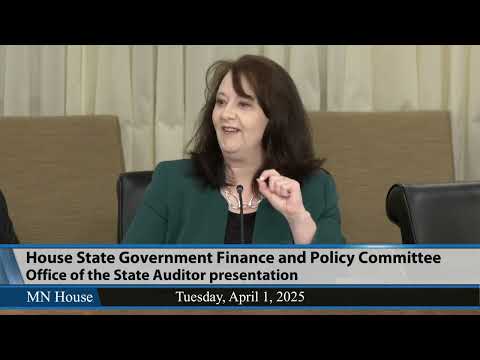
State Auditor Julie Blaha told the House State Government Finance and Policy Committee the Office of the State Auditor needs a $486,000 operating adjustment for the 2025–27 biennium to protect 14.5 positions amid a national public-finance staffing shortage and to maintain services to local governments.
State Auditor Julie Blaha told the House State Government Finance and Policy Committee on April 1 that the Office of the State Auditor (OSA) needs an operating adjustment of $486,000 in the coming biennium to protect 14.5 positions and to sustain oversight services to local governments.
Blaha said the OSA oversees roughly $40,000,000,000 in local government activity and has recently taken on the statewide single audit of federal funds. "We oversee about $40,000,000,000 in local government activity," she said, and noted the office met the statewide single-audit deadline the day before the hearing.
The request, presented by Blaha and Matt Lindeman, the auditor's finance director, is framed as a retention and capacity measure: about 85% of the office's budget pays staff salaries and benefits, so personnel changes drive costs. Lindeman told the committee the net cost of the operating adjustment would be $486,000 for the biennium and "would protect 14.5 positions." He said most audit fees are charged to local governments based on actual audit costs and that the OSA's overall budget represents a very small fraction of the state budget.
Why it matters
Blaha told lawmakers the request is in part a response to a national staffing trend: she cited estimates that a large share of certified public accountants are eligible to retire and said the OSA needs to widen the hiring pipeline. "We're going to need to look at a variety of things to deliver again the oversight you all deserve while dealing with this workforce shift," she said, describing plans for in‑house training, IT auditors, and expanded use of data tools.
Details of the proposal and office changes
Blaha described a series of recent and proposed changes at the OSA: adding a township specialist to help small townships with reporting; hiring two special investigators to handle a sharply increased volume of investigation requests; adding IT staff and a chief information officer; and creating an Audit and Reporting Group (ARG) that brings public- and private-sector auditors together to build tools and coordinate oversight. Blaha said the OSA has started building dashboards for compliance checks and has improved the CTAS (City/Town Accounting System) used by many small governments, including stronger encryption.
On efficiency, Blaha said an external efficiency review and a successful peer review reduced findings and identified lower-cost ways to do audits; some unspent funds will be returned to the General Fund. Lindeman said audit fees are based on actual hours charged and that the office has not raised fees for roughly three years; he warned higher staff pay will increase costs charged to local governments, though "not as high as the private sector."
Committee questions and follow up
Committee members asked how much a typical audit cost would rise for a small city; Blaha said the office is still calculating that impact and offered to follow up with a letter. Representatives also asked about paid family leave, CTAS and dashboard adoption, and vacancies; Blaha said the office already provides equivalent leave benefits under existing contracts and has fewer vacancies than earlier but still needs to refill recently reposted investigator positions.
Ending
Blaha closed by inviting further questions and offering to provide follow-up information to the committee. The committee did not take an immediate vote on the auditor's request; lawmakers said they will consider the OSA operating adjustment as they develop finance bill language.