Get Full Government Meeting Transcripts, Videos, & Alerts Forever!
Get email alerts on the Education Policy topic
No spam. Unsubscribe anytime.
House education committee reviews DE1 minibus bill; no formal action taken
Summary
The Minnesota House Education Policy Committee reviewed the DE1 omnibus ("minibus") education bill on April 1, 2025, receiving a staff walk-through and public testimony but taking no formal votes; the committee will resume consideration April 2 under Chair Jordan.
The Minnesota House Education Policy Committee reviewed the DE1 omnibus ("minibus") education bill on April 1, 2025, receiving a staff walk-through of the amendment and public testimony but taking no formal votes on the measure. Committee leaders said procedural action on the DE1 amendment will be delayed until the committee reconvenes under Chair Jordan on April 2.
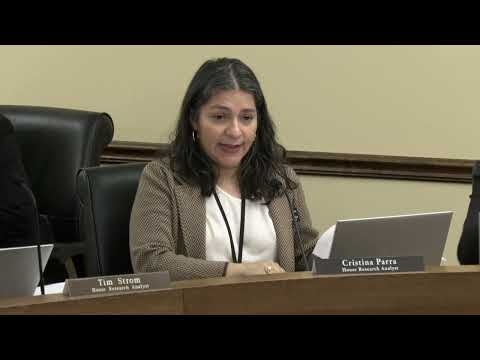
Nonpartisan staff member Ms. Parra reviewed the bill article by article, summarizing changes that would: make charter schools and charter school students eligible for postsecondary enrollment options (PSEO) and require postsecondary institutions to notify a pupil's school if the pupil withdraws from a course; expand the approval term for adult basic education (ABE) programs from five to six years; rename and make permanent a short-call emergency substitute teacher program with adjustments to pay and assignment length; delay kindergarten fall-assessment compliance by one year; authorize the Minnesota Math Corps to use evidence-based instruction for foundational math skills; allow certain P-TECH programs to be adopted by school boards without prior commissioner approval when no appropriation is involved; establish a process to file complaints with the Department of Education over violations of federal special education law; update school health rules to refer to “epinephrine delivery systems” (to include inhaled products) and require the Department of Health to provide standing orders for distribution; and change multiple reporting, data and Office of Inspector General (OIG) provisions related to investigation authority, record access and safeguards.
Adosh Oodi, director of government relations for the Minnesota Department of Education (MDE), testified in support of many provisions and asked the committee to consider additional MDE proposals. "The commissioner does send his apologies to the committee that he was not able to provide these comments today," Oodi said, and he thanked members for including provisions that align with the governor's proposals, including expanded PSEO access, the six-year ABE approval period, codifying parents' rights for students with individualized education programs and enhancements to the OIG.
Kalika Rogers, representing young people the organization works with statewide, urged the committee to include House File 2023 or otherwise ensure that opioid recognition, training and naloxone administration are included in state health standards for schools. "This is a life saving issue," Rogers said, describing students' personal experiences with opioid loss and the group's bipartisan support.
Several committee members spoke in favor of including naloxone training and stronger school health standards. Representative Biermann said broadly that naloxone training in schools could help students recognize overdoses and administer life-saving treatment. Representative Pell described personal and constituent losses to overdoses and urged education-based prevention and response training. Committee chairs and members repeatedly praised bipartisan work on the minibus bill and noted that certain health-related provisions, including a standalone bill on overdose education and health standards, are scheduled for fuller consideration the following day.
Members emphasized that no formal committee action was taken on the DE1 amendment during the April 1 meeting. Representative Falconer moved approval of the minutes from the March 26 meeting; the chair called for voice votes and approved the minutes before the DE1 presentation. Committee leaders said consideration of the DE1 amendment will resume April 2 under Chair Jordan.
The DE1 amendment as presented would affect charter school access to PSEO, online instruction definitions, substitute teacher licensing and pay rules, special education complaint procedures and OIG authorities, among other matters. Many provisions hinge on later executive or rulemaking steps (for example, standing orders for epinephrine distribution or criteria for evidence-based instruction) or on available appropriations (for P-TECH grants), and committee members asked staff and agency witnesses to continue working on implementation details.
The committee adjourned with the expectation of resuming DE1 consideration the next day; committee leadership said several items not included in the minibus were intentionally being carried as separate bills for fuller debate.
Minutes approval (procedural): Representative Falconer moved approval of the March 26, 2025 minutes; the chair called the voice vote and the ayes prevailed. No other formal votes or final actions on the DE1 amendment were recorded on April 1.