Get Full Government Meeting Transcripts, Videos, & Alerts Forever!
Get email alerts on the Juvenile Justice topic
No spam. Unsubscribe anytime.
City says juvenile detention census has fallen; leaders highlight community alternatives and trade programs
Summary
DHS and juvenile justice staff told council the city has reduced the population at the juvenile justice center and described new community‑based diversion programs and vocational training options for youth.
Philadelphia City Council pressed Department of Human Services officials about the Juvenile Justice Services Center (PJJC) census and the city’s use of community‑based alternatives during a budget hearing.
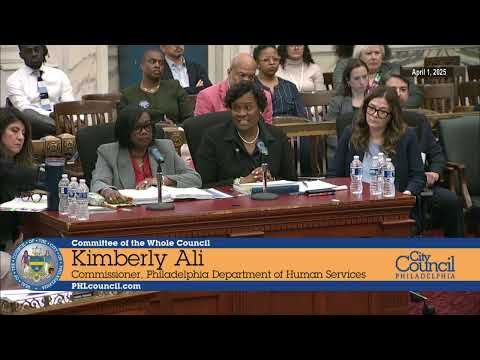
Kimberly Ali, commissioner of the Department of Human Services, reiterated the city’s long‑term goal of reducing placements and described the recent PJJC census and state placement relationship. “Our state license capacity is a 84 young people,” Ali said. She told council that when she last testified the PJJC census was 93, and said, “I am happy to report today we are at 132.” In the same exchange she also said the center had been “consistently below the license capacity of a 84 since June of 2024.” Later in the hearing DHS staff cited a PJJC census figure of 32 in a separate update; the transcript shows those different figures were reported at different moments during questioning.
Council members asked for more detail about how the city is expanding pre‑ and post‑arrest diversion options and community alternatives to detention. Gary Williams, deputy commissioner for juvenile justice services, described the city’s use of a national JDAI (Juvenile Detention Alternatives Initiative) model and a full‑time JDAI coordinator who works with DHS and probation to “look at data to make informed decisions about expanding alternative to detention as well as community based programming.”
Williams and other witnesses described several community programs: a vocational “youth build” program in South Philadelphia that pays stipends and includes community work components; the Philadelphia Technician Trade Institute (PTTI), which operates a satellite campus at a juvenile justice service center offering up to seven trade programs (carpentry, electrician, pipe fitting among them); and a broader set of community evening resource centers (CERCs) and evening reporting centers that judges can order instead of detention.
Williams gave participation and outcome details for new programs: PTTI began work in March of the prior year and had served 131 young people to date, of which 89 completed the program and 28 obtained part‑ or full‑time employment. DHS said intensive prevention services serve about 5,000 young people annually and CERCs reported thousands of visits across FY24 and FY25 reporting periods.
On the question of out‑of‑state placements, DHS officials told council that “we do not have any young people placed in Texas,” addressing a council member’s stated opposition to sending youth to distant facilities.
Why it matters: Council members sought clarity on a frequently criticized area — rates of youth detention and the city’s approach to alternatives — and pressed for data linking programs to outcomes and recidivism.
What council requested: Staff were asked to provide further data on admissions, discharges, demographics, capacity and program outcomes for council review; DHS said it is finalizing drafts of utilization and demographic reports and will provide additional detail.
Ending note: Officials said the city intends to expand and evaluate community‑based alternatives and vocational programs but also acknowledged limits: decisions about arrest, charging and detention involve multiple agencies including police, probation and the district attorney’s office.