Get Full Government Meeting Transcripts, Videos, & Alerts Forever!
Get email alerts on the Workforce Development topic
No spam. Unsubscribe anytime.
CAO presents FY26 budget priorities, outlines City College for Municipal Employment and consolidation of workforce functions
Summary
Council President Johnson convened the public hearing on the FY26 budget; CAO Camille Duchasse said proposed funding will expand workforce development, service-design and administrative controls across departments.
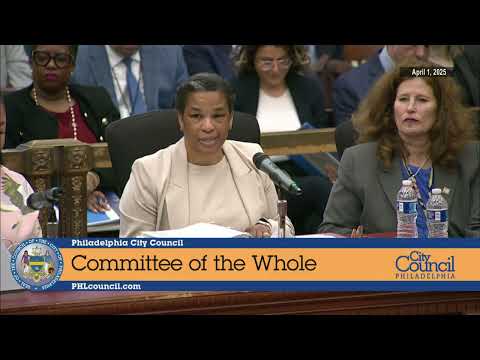
Council President Johnson convened the Committee of the Whole public hearing on the fiscal 2026 proposed operating and capital budgets and related tax and fee ordinances, and the chief administrative officer outlined how the CAO’s FY26 request supports workforce development, service delivery and administrative modernization.
“The FY26 budget for the Office of the CAO is critical to fulfilling the promise of our office and realizing the efficiency, innovation, and transformation necessary to make Philadelphia the safest, cleanest, and greenest big city in the nation,” CAO Camille Duchasse told council members. She described investments in workforce development, the City College for Municipal Employment (CCME), accessibility programs and a proposed internal control and optimization unit.
The CAO and CCME framed several priorities as enterprise-wide functions that support many departments. Carol DeFries, executive director of CCME, said the administration intends CCME to be “a first in the nation workforce model” and to coordinate training across the city’s departments and external partners. DeFries said CCME’s early cohorts and partnerships with Community College of Philadelphia and others will be used to connect residents to municipal jobs and “create clear pathways to municipal careers that offer family sustaining wages.”
Council members pressed the administration on why the Office of Workforce Development (formerly in Commerce) will be consolidated under the CAO. Duchasse and DeFries said the shift is intended to centralize and coordinate workforce activity across departments, reduce duplication of external partner outreach, and link internal city hiring with external workforce programs. “There were a lot of great work...that if coordinated, I think would have improved outcomes,” Duchasse said.
Majority Leader Gilmore Richardson pushed back on legal and code questions, noting Philadelphia Code Chapter 18-600 assigns certain workforce duties to Commerce leadership. Richardson said the move raises a statutory question and asked the administration to obtain an official legal response. Duchasse said Commerce leadership remains a close partner and that the change was intended to improve coordination, and she agreed the city solicitor should provide a formal explanation for the reorganization.
CCME enrollment and early placement activity were described in the hearing. DeFries said the initial fall cohort included about 74 enrollees; CCME reported about 76 people enrolled in the spring across four career-pathway programs (technology, business administration, healthcare, and skilled trades), with different program timelines and an expectation that roughly 20 students will complete this semester. DeFries said three participants had fully completed their programs as of the hearing and that CCME intends to provide bridge and remedial coursework through Community College of Philadelphia when needed for credit-bearing programs.
Council members asked for more information on program outcomes and placements. Duchasse and DeFries said CCME will work with council and departments to provide placement data and to align training investments to department hiring needs.
Duchasse also described technology and data investments requested in the FY26 CAO budget, including $300,000 for software to support workforce and service-delivery tracking and the continued use of platforms such as Qualtrics for employee engagement and Quick Base and Envisio for process digitization and project tracking.
Why it matters: The CAO’s proposal aims to align workforce training, hiring and internal administrative tools across the city’s departments. Council members sought clarity on legal authority for the organizational change and asked for additional data on CCME outcomes, vacant positions, and how $10 million the administration referenced for external workforce investments will be allocated.
Looking ahead: Council members requested follow-up materials, including (1) a legal opinion or city solicitors’ response about the transfer of workforce functions, (2) updated CCME enrollment and placement statistics, and (3) details on the CAO’s proposed internal control and optimization unit and the $300,000 software request.