Get Full Government Meeting Transcripts, Videos, & Alerts Forever!
Get email alerts on the Parole Policy topic
No spam. Unsubscribe anytime.
Committee advances amended bill adding geriatric parole criteria and risk-assessment requirement
Summary
The committee approved an amended version of Senate Bill 181 to expand parole categories to include geriatric parole, set eligibility criteria and require risk assessments in certain long-term cases; funding for implementation was referenced as coming from the JRA.
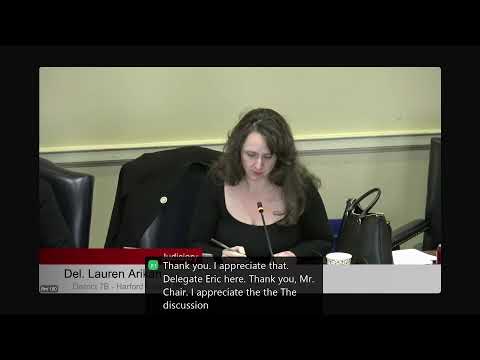
The House Judiciary Committee voted favorably, as amended, on Senate Bill 181 on March 26, 2025. The vice chair explained the amendment adds geriatric parole to the statute alongside medical parole and sets eligibility criteria, and the committee adopted the amendment and then reported the bill favorably.
Why it matters: the amendment changes parole eligibility and adds procedural requirements for review, including a risk-assessment requirement for certain long-term sentences and an ongoing reporting obligation of names by the Department (DPSCS) to the parole board, which affects how parole petitions from older incarcerated people will be processed.
What the amendment does: The vice chair described the key elements: the amendment expands parole categories to include both medical and geriatric parole; it sets geriatric eligibility at age 65 with at least 20 years served and a three-year period free of Category 1A infractions. For people who have been incarcerated on a sentence of 40 years or more, the amendment requires a risk assessment prior to parole consideration. The amendment also requires ongoing provision of qualifying names by the Department of Public Safety and Correctional Services (DPSCS) to the parole authority, and the vice chair said implementation funding would be drawn from the JRA (as stated in the transcript).
Committee discussion: Delegate Taylor asked whether the risk-assessment requirement was newly extended beyond life sentences; the vice chair clarified that previously the parole commission’s policy required risk assessments for life sentences and that the amendment extends required risk assessments to those serving terms of 40 years or more. No further changes to the amendment were recorded, and the chamber voted to adopt the amendment and then to report the bill favorably as amended.
Outcome: The committee adopted the amendment and moved SB181 favorably as amended.
What remains unclear from the transcript: The transcript records that funding to carry out the obligations would come from the JRA, but does not provide a dollar amount or implementation timeline beyond the statutory requirements placed on the parole process.
Next steps: The bill will proceed to the House floor in its amended form for further consideration.