Get Full Government Meeting Transcripts, Videos, & Alerts Forever!
Get email alerts on the Insurance Mitigation topic
No spam. Unsubscribe anytime.
Senate panel orders study of insurer incentives, community mitigation to address wildfire insurance crisis
Summary
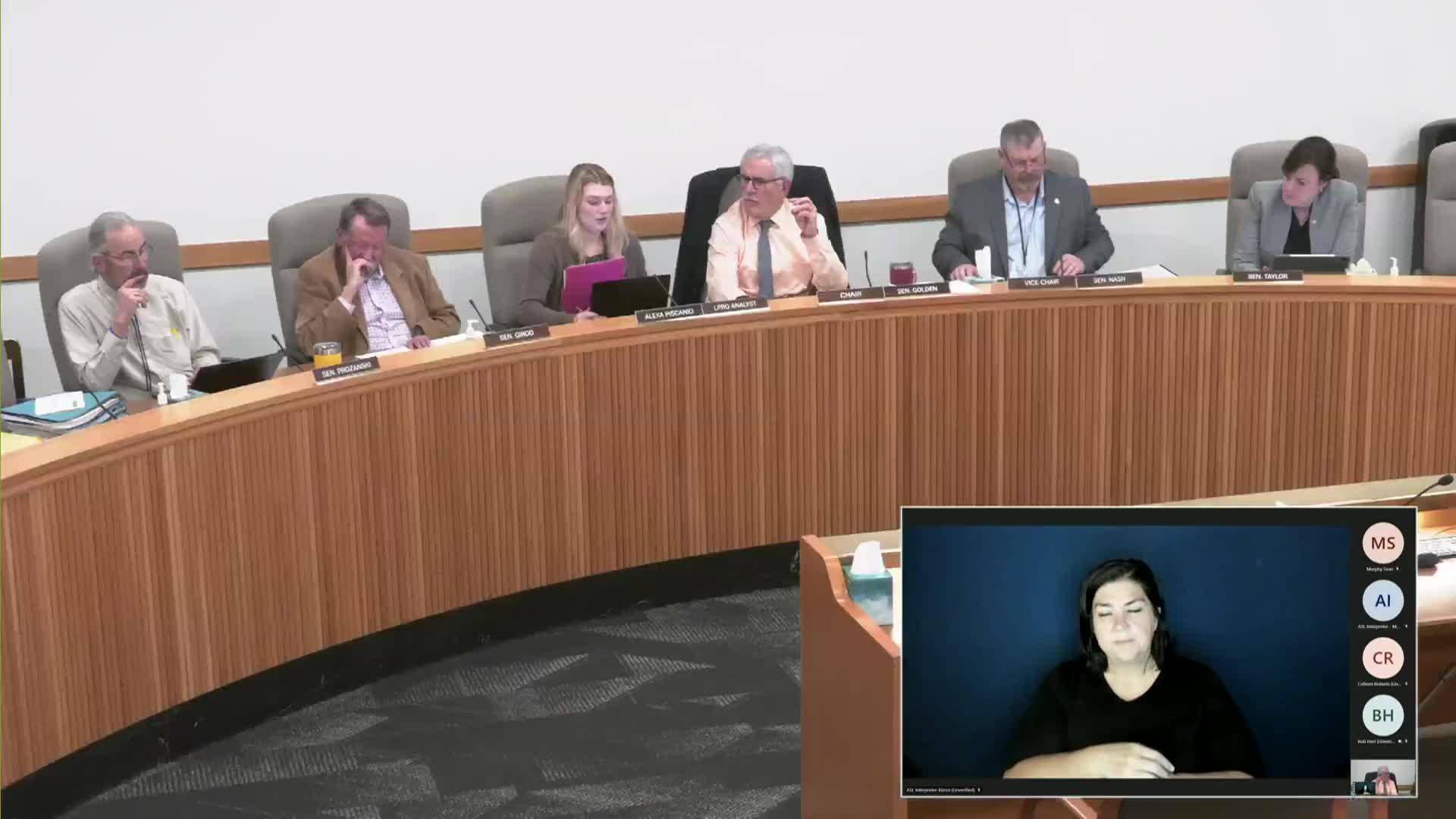
The Senate Committee on Natural Resources and Wildfire on April 1, 2025, held a public hearing on the dash‑1 amendment to Senate Bill 85, which directs DCBS and the State Fire Marshal to evaluate insurer incentives and community mitigation strategies and to report recommendations by Feb. 2, 2026.
The Senate Committee on Natural Resources and Wildfire on April 1, 2025, opened a public hearing on Senate Bill 85 (dash‑1), which tasks the Department of Consumer and Business Services (DCBS) and the Oregon State Fire Marshal (OSFM), in consultation with the Department of Forestry and insurance industry representatives, to evaluate community‑based wildfire risk mitigation strategies and how insurers factor mitigation into underwriting and rating.
Under the dash‑1 amendment, DCBS and OSFM must submit a report by Feb. 2, 2026, to the State Wildfire Programs Director, the Wildfire Programs Advisory Council, and interim legislative committees. The report must include recommendations for legislative changes, incentives or discounts insurers could offer, and information from major insurers on how they incorporate mitigation actions into underwriting and rating. The bill sunsets Jan. 2, 2027, and declares an emergency on passage.
Andrew Stolfi, DCBS Director and State Insurance Commissioner, told the committee that Senate Bill 82 (2023) already requires insurers to consider mitigation measures in underwriting plans but does not force insurers to assign discounts without actuarial support. Stolfi said the dash‑1 amendment formalizes ongoing work with the fire marshal, Department of Forestry and insurers to “push the science forward” so insurers can recognize mitigation activities such as defensible space and home hardening in their pricing.
State Fire Marshal Mariana Ruiz Temple said the dash‑1 amendment fits within the state’s Community Wildfire Risk Reduction framework and the advisory group that coordinates OSFM, ODF, DCBS and other agencies. Ruiz Temple described an intent to “build a ladder” of resilience measures — from Firewise/NFPA community practices through more robust certification — and said a pilot with the Insurance Institute for Business & Home Safety (IBHS) could yield usable findings in roughly a year to 18 months.
Committee members and witnesses discussed two persistent policy tensions: (1) whether incentives should be offered for individual property actions (for example, defensible space or a Class A roof) or whether incentives must reflect a combination of property‑level and community‑level mitigation to meaningfully change insurer risk assessments; and (2) how to verify mitigation actions for insurers (inspection, certification, or other proof) and who pays for verification.
Senator Golden noted constituents often ask for a simple statutory requirement that insurers must give discounts for specific mitigation actions; DCBS Director Stolfi and other witnesses advised that no state currently requires insurers to offer a discount without actuarial support and that a statutory mandate could prompt insurers to withdraw from a market. Stolfi advised the committee the law should continue to create a framework for insurers to consider mitigation while the state and industry build the data and pilots needed to support concrete discounts.
Committee members asked practical questions about verification mechanisms, how incremental property upgrades could be recognized, and how communities with dense tree cover can achieve measurable gains without requiring landowners to remove trees. Witnesses described IBHS’s “wildfire prepared home” and related standards as emerging tools: a homeowner can complete a slate of mitigation activities and obtain an inspection/certification that could be presented to an insurer, though insurers are not required by current law to grant a discount without actuarial justification.
Jim Macaulay and Jim McCauley (League of Oregon Cities) voiced support for the framework and characterized the bill as a patient, iterative approach that aims to scale mitigation up to the community level over time. The committee closed the hearing on SB 85 with no immediate committee vote; staff and agencies were asked to continue work and submit the required report by the statutory deadline.