Get Full Government Meeting Transcripts, Videos, & Alerts Forever!
Get email alerts on the Budget Advocacy Commission topic
No spam. Unsubscribe anytime.
Subcommittee Hears Budget Request for Oregon Advocacy Commission’s Office; Public Testimony Urges Increased Funding
Summary
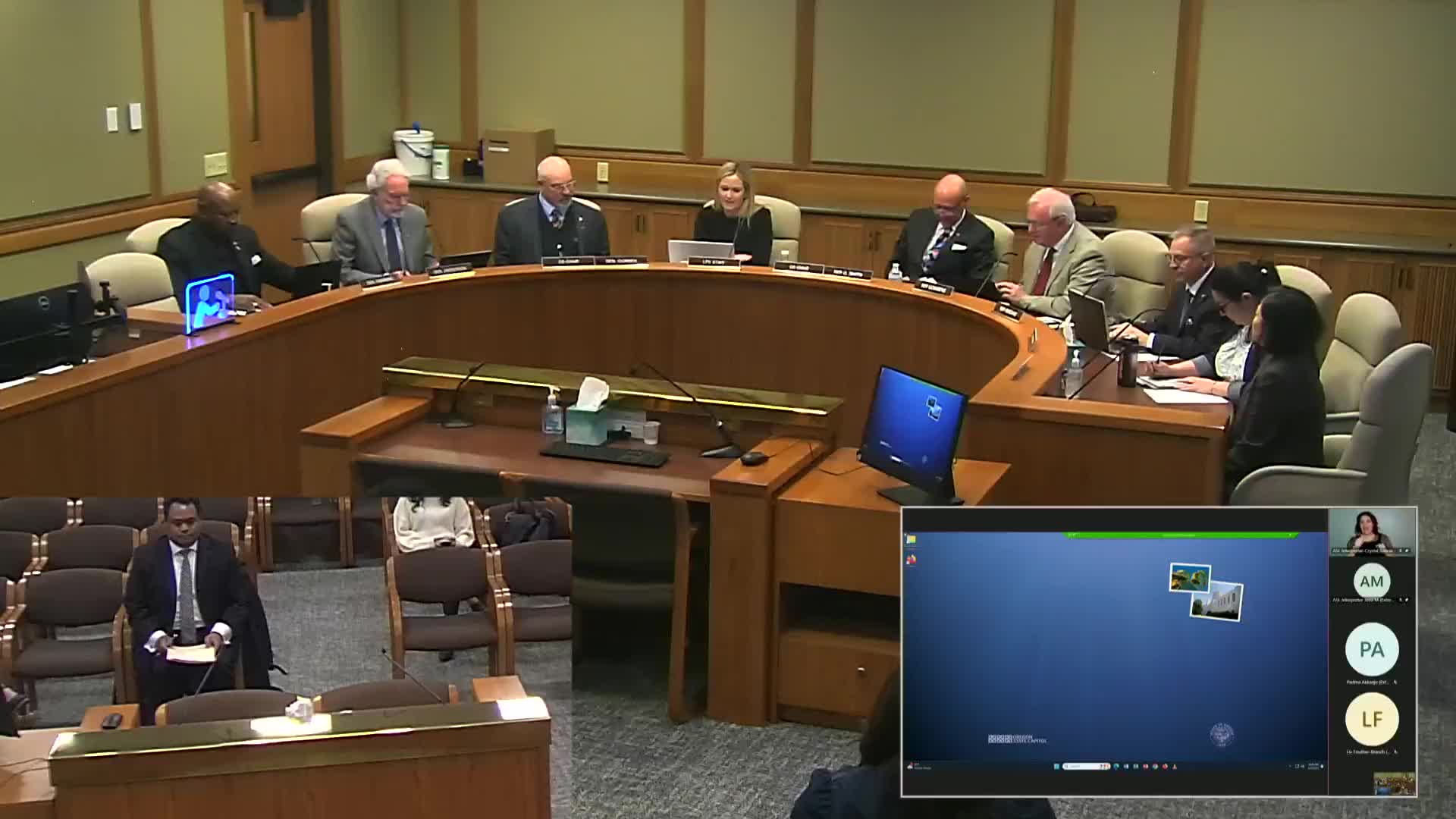
The General Government Subcommittee opened a public hearing April 1 on Senate Bill 5501, the governor—s recommended appropriation for the Oregon Advocacy Commission—s Office, where agency staff and commissioners described ongoing work and called for more permanent resources to sustain statewide equity efforts.
The General Government Subcommittee opened a public hearing April 1 on Senate Bill 5501, the governor—s recommended appropriation for the Oregon Advocacy Commission—s Office (OACO). Agency staff described OACO—s role supporting four state advocacy commissions and the staff and limited-duration positions needed to finish work directed by prior legislation.
The hearing centered on the agency—s mission and workload, the remaining work under House Bill 4052 (2022) and its extension under House Bill 2925 (2023), and a policy option to fund three limited-duration positions through June 30, 2026. Dr. Kyle Myers, operations and policy analyst at the Oregon Advocacy Commission—s Office, told the committee, "The mission of the Oregon Advocacy Commission's office or OACO is to provide the administrative support for the statutory work of the four Oregon advocacy commissions," and summarized the commissions— statutory duties and recent projects.
Why this matters: OACO provides administrative support for the Oregon Commission on Asian and Pacific Islander Affairs (OCAPIA), the Oregon Commission on Black Affairs (OCBA), the Oregon Commission on Hispanic Affairs (OCHA), and the Oregon Commission for Women (OCFW). Committee members and public witnesses said the office—s work—data modernization, language access, coordinating a joint domestic-violence subcommittee and convening affinity-group task forces—affects statewide equity efforts and relies on a small permanent staff.
Agency overview and budget details: Jason Tremblay of the Department of Administrative Services Chief Financial Office reviewed the governor—s recommendation, which generally funds the agency at current service levels and includes funding for three full-time limited-duration positions to complete the HB 4052/HB 2925 assignment. Tremblay said 84% of the agency—s recommended budget is for personal services and staffing, and the three limited-duration positions will phase out on 2026-06-30 when the assignment is due to be completed. The agency reported its 2023'025 biennium budget was $2,248,000.
Staffing and workload: Dr. Myers said the agency has four permanent full-time staff (an executive director position, an operations and policy analyst, a public affairs specialist, and an executive support specialist) and three limited-duration staff (one team lead and two project facilitators) assigned to complete HB 4052 work. She told the committee the limited-duration staff nearly doubled agency capacity for the 2023-25 biennium and that the governor—s recommended budget would return the office to four permanent positions after the limited positions phase out.
Work under HB 4052/HB 2925: The committee heard that HB 4052 (2022) directed OACO to convene affinity-group task forces to develop recommendations addressing health inequities. HB 2925 (2023) extended the deadline to June 30, 2026. OACO said Phase 1 included over 18 community meetings with 32 task-force members and produced an interim report (November 2023) compiling more than 100 recommendations. Phase 2 refined recommendations through agency briefings and three thematic focus groups (health care, education, community safety) that co-developed 10 legislative concepts. The office described a final implementation phase focused on tools, knowledge transfer and continued engagement to meet the 2026 deadline.
Data modernization and disaggregation: OCAPIA—s data modernization subcommittee was highlighted as an example of commissions working on data disaggregation to ensure policies and funding address specific community needs. Multiple legislators and public witnesses raised concerns about grouping large and diverse populations (for example, "Asian and Pacific Islander") and urged continued disaggregation and culturally specific outreach.
Public testimony and requests for follow-up: Two community commissioners testified in support of SB 5501. Padma Karaju, a commissioner on the Oregon Commission on Asian Pacific Islander Affairs, said, "I am here to express my strong support for SB 5501," and urged sustained funding for OACO—s community engagement and data work. A commissioner who identified herself as Liz Folder Bench of the Oregon Commission on Black Affairs told the committee, "The passage of SB 5501 is a moral imperative," and described chronic underfunding that she said limits statewide outreach and policy work. Multiple legislators also voiced support: Senator Manning said, "I think that is very clear where I stand in support of the advocacy commission," and other members pressed for detailed follow-ups on donations, how commission funds are used, and options to bolster permanent staffing.
Other legislative items discussed: Kyle Myers noted a 2025 legislative concept (listed in materials as "Senate Bill 790") to rename the agency head—s classification from "administrator" to "executive director," aligning the title with other enterprise agency heads; OACO said there was no projected fiscal impact associated with that measure.
Follow-up and committee process: Committee members asked OACO staff to provide written follow-ups on several points, including the status of specific policy concepts developed from the task forces, the details and amounts of donations and sponsorships received by each commission, clarification on KPM (key performance measure) survey targets and responses, and whether some topics raised by commissioners (for example, shooting violence data, missing and murdered Indigenous women, and trafficking concerns) had been discussed in commission meetings. Dr. Myers said she would supply written responses where she could not answer on the record.
Outcome: The subcommittee held the public hearing and took testimony; no vote or formal appropriation occurred at the hearing. The hearing record will inform the committee as it considers the governor—s budget and any policy packages affecting the Oregon Advocacy Commission—s Office. The committee noted an informational hearing on April 2 for the state treasurer—s appropriation bill.
Ending: Supporters and members of the commissions urged the legislature to increase sustained funding for the office to maintain statewide engagement, finish HB 4052/HB 2925 work by mid-2026, and strengthen data and language-access efforts that commission members said are critical to reaching underrepresented communities.