Get Full Government Meeting Transcripts, Videos, & Alerts Forever!
Get email alerts on the School Facilities And Sports Sex Classification topic
No spam. Unsubscribe anytime.
Committee rejects bill to require sex-at-birth classification for school teams and facilities
Summary
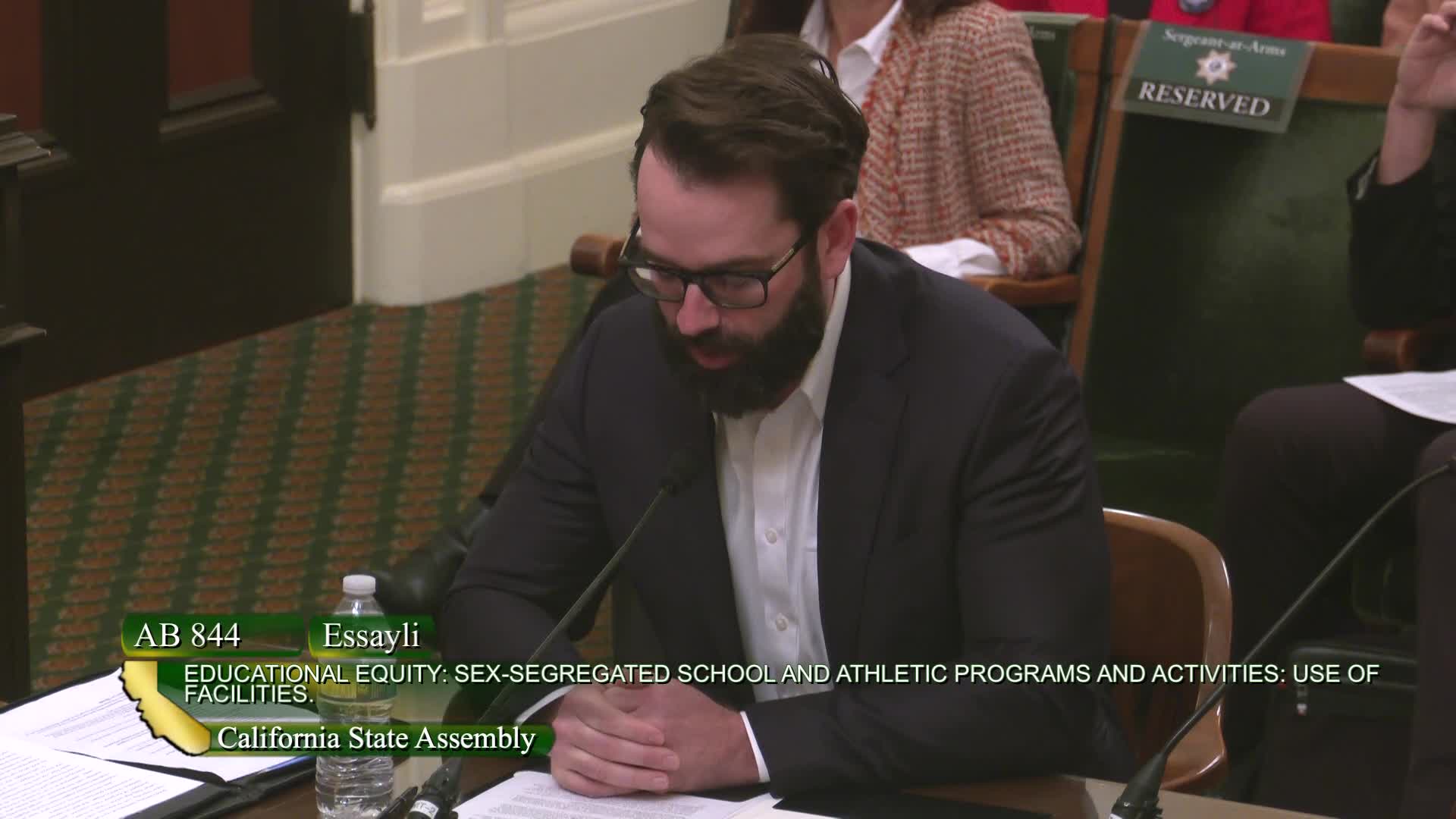
The committee heard AB 844 on April 1, 2025. The bill, which would have required participation in sex-segregated school programs and use of facilities to be based on a pupil's sex assigned at birth, failed to advance after testimony for and against and a 2-6 committee vote with one abstention.
SACRAMENTO — The Assembly Arts, Entertainment, Sports and Tourism Committee on April 1, 2025, declined to advance Assembly Bill 844, which sought to require that participation in sex-segregated school programs, athletic teams and the use of school facilities (bathrooms, locker rooms, showers, and overnight accommodations) be determined by a pupil’s sex assigned at birth.
Assemblymember Rosalia presented AB 844 to the committee, arguing that Education Code section 221.5 and related guidance had required schools to permit students to participate based on gender identity, and that California’s policy put districts at legal risk under federal Title IX and could jeopardize billions in federal K–12 funding. The author and supporters said the measure would restore sex-based classification for sports and facilities and would not require invasive testing beyond documentary proof such as a birth certificate.
Supporters included political commentator Matt Walsh, who told the committee that "a man who claims he is a woman is still not a woman," and student Taylor Starling, who said she had been removed from her varsity cross-country spot after a male transfer was allowed to compete on the girls’ team. Starling described training and sacrifices for a varsity position and said she was replaced after the transfer did not meet the same practice requirements.
Opponents included educators, medical professionals, civil-rights groups and parents who argued AB 844 would harm transgender students, increase bullying and reduce access to school athletics and facilities for vulnerable youth. Dr. Emily Mitchell, chair of the California Community College LGBTQ+ advisory committee, testified that California policies allowing transgender students to use facilities consistent with their gender identity "have been working for years" and warned that the bill would likely increase harassment and safety risks for all students.
Technical and legal witnesses debated Title IX and whether federal guidance or litigation could place California school funding at risk. One technical witness described an active investigation by the U.S. Department of Education into CIF policies and cited a legislative-analyst estimate of roughly $8 billion in federal K–12 funding that could be implicated. Equality California and other groups urged the committee to consider existing California nondiscrimination protections and pending federal litigation.
Committee members offered sharply differing views. Some members framed the bill as a matter of fairness in sports and privacy in facilities; others emphasized the constitutional and civil-rights implications of singling out a protected class. After discussion the committee took a roll-call vote; a motion to pass AB 844 failed on the floor with a tally of 2 yes, 6 no, and 1 recorded abstention. The clerk held the roll open for absent members, and the matter did not advance.