Get Full Government Meeting Transcripts, Videos, & Alerts Forever!
Get email alerts on the School Sports Transgender Policy topic
No spam. Unsubscribe anytime.
Assembly committee rejects proposal to restrict transgender girls from girls' high school sports
Summary
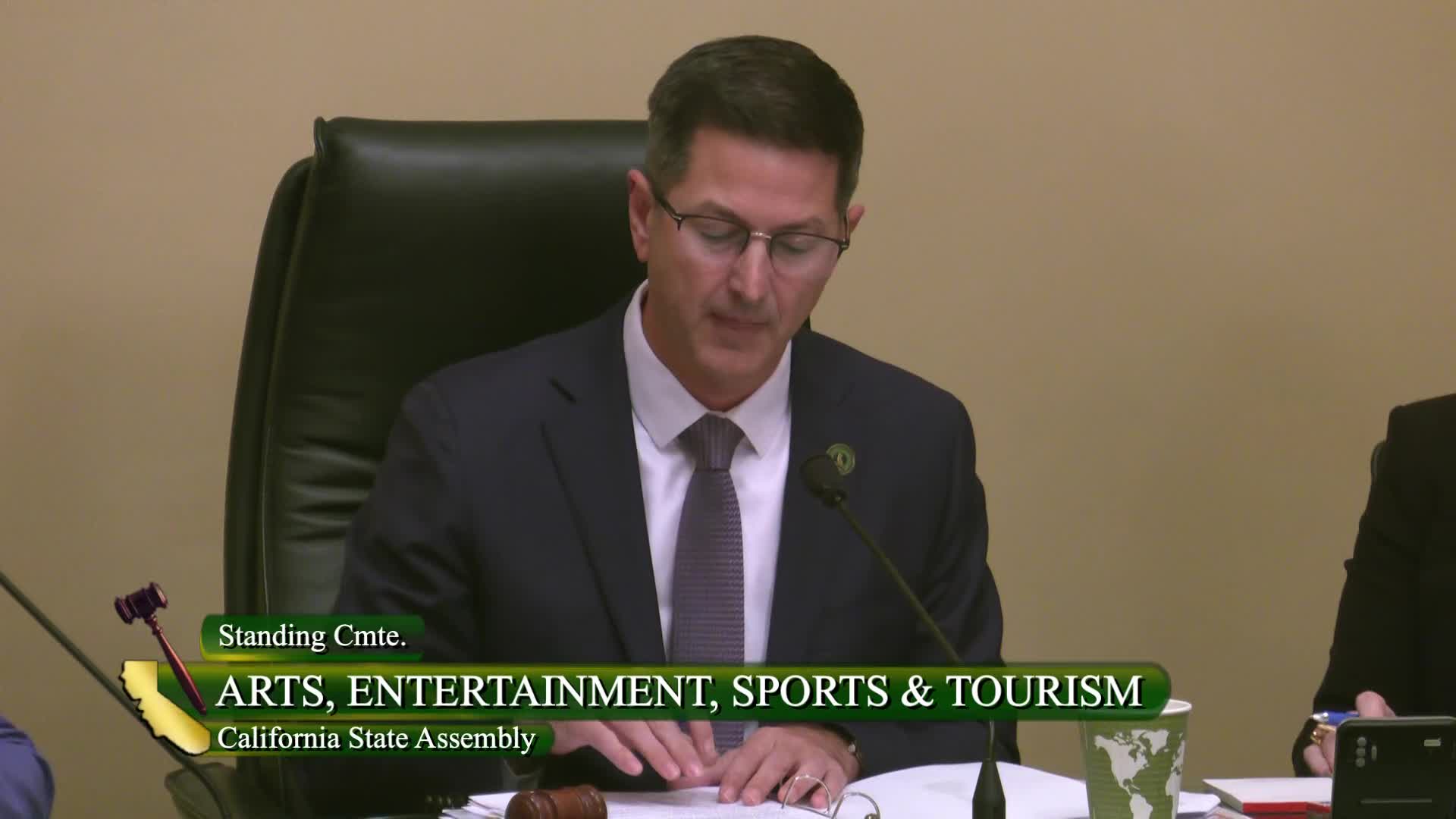
The California Assembly Arts, Entertainment, Sports and Tourism Committee on April 1, 2025, declined to advance AB 89, a bill that would have required the California Interscholastic Federation to limit girls' high school sports to biological females. The measure failed after public testimony for and against and a 2-7 committee vote.
SACRAMENTO — The California Assembly Arts, Entertainment, Sports and Tourism Committee on April 1, 2025, voted down Assembly Bill 89, a measure that would have required the California Interscholastic Federation (CIF) to align high school girls athletics with competitors’ sex assigned at birth.
The bill's author, Assemblymember Sanchez, opened the hearing by saying the measure was about "fairness, safety, and integrity in girls competitive high school athletics," and asked members to listen to young women and parents who, she said, were losing opportunities and scholarships. Sanchez described several out-of-state examples of biological males winning girls' events and cited concerns about physical injuries.
The bill drew sharply divided testimony. Supporters included high school athletes and parent groups who said girls were losing roster spots and championship opportunities. One witness, identifying herself only as Jaden, said her dream of competing at the California State Track and Field Championship was at risk because "a biological male who is currently ranked first place for both long jump and triple jump is allowed to compete in the girls category." Jaden added, "We are not asking for special treatment. We are asking for a fair playing field."
Opponents included parents, medical and sports experts, and civil-rights organizations who said the bill would harm transgender students and could increase harassment. Nicole Peterson, who identified herself as the mother of two teens including a transgender child, said enforcement could "require girls to answer invasive personal questions or undergo physical inspections" and would invite "harassment and bullying." Dr. Rhiannon Mulligan, a sociologist and former collegiate athlete, testified there is no evidence that transgender girls are systematically displacing cisgender girls for scholarships and cautioned against reducing athletic performance to simple, inherited traits.
Committee members debated legal and policy implications during deliberations. Witnesses cited federal law and sporting bodies in making contrasting claims about how common transgender participation is and whether federal funding could be at risk. Assemblymember Sanchez and some supporters argued the CIF must be required to follow sex-based classification; other members, including Chair Ward and Speaker Rivas, warned that the bill risked discrimination, could prompt invasive enforcement practices seen elsewhere, and would not address broader issues such as funding and harassment affecting girls' sports.
A motion to pass the bill out of the committee was moved by the vice chair and seconded by Assemblymember Gonzales. On the roll call the measure failed, 2 yes to 7 no. The committee adopted its rules earlier in the hearing before taking testimony.
The hearing included extensive public comment from dozens of speakers for and against the bill. Supporters repeatedly framed AB 89 as protecting girls' opportunities and safety; opponents said the bill would stigmatize and endanger transgender students and questioned the factual basis for the proposal.
AB 89 did not advance out of committee. The committee record for the bill includes written submissions and a large public comment record that the secretary will add to the official file of the Assembly.