Get Full Government Meeting Transcripts, Videos, & Alerts Forever!
Get email alerts on the Workforce Equity topic
No spam. Unsubscribe anytime.
Multnomah County briefs commissioners on WESP implementation, sets metrics and timeline
Summary
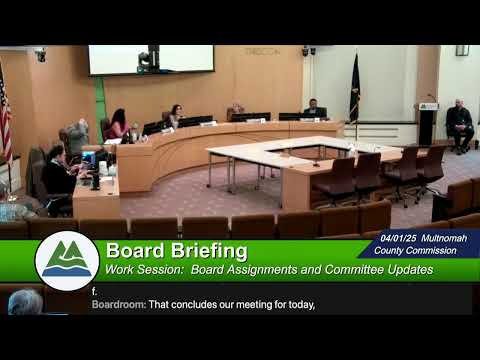
Multnomah County’s Office of Diversity and Equity (ODE) updated the Multnomah County Board of Commissioners on April 1 about the implementation progress for the county’s renewed 2024–2028 Workforce Equity Strategic Plan (WESP).
Multnomah County’s Office of Diversity and Equity (ODE) updated the Multnomah County Board of Commissioners on April 1 about the implementation progress for the county’s renewed 2024–2028 Workforce Equity Strategic Plan (WESP).
The briefing outlined completed implementation steps from Phase 1, the creation of an implementation committee and a countywide data consortium, near-term benchmarks for department toolkits and culturally specific training contracts, and a timeline that puts initial departmental implementation starting in July and a first year evaluation of outcomes in mid-2026.
The WESP renewal process ran from June 2023 to February 2024 and the board gave final approval in March 2024. Joy Fowler, the county’s chief diversity and equity officer, told commissioners the renewal engaged managers, subject-matter experts, employee resource groups and frontline staff and produced seven initiative areas for implementation: accountability, infrastructure, retention, training, data, evaluation and policy/standard practice. "For the record, my name is Joy Fowler. I serve as the county's chief diversity and equity officer," Fowler told the board.
ODE described Phase 1 as focused on infrastructure and evaluation tasks that would enable later, measurable work by departments. Veronica (Ronny) Cano, senior research evaluation analyst for ODE, said the implementation committee’s work was to translate high-level benchmarks into concrete, sequenced implementation steps. "The benchmark is that family dish that everybody loves but nobody actually knows how to make. So we are creating the recipe for that dish," Cano said, summarizing the committee’s approach to breaking benchmarks into actionable steps.
Cano said the committee completed implementation steps for eight benchmarks (out of 13 total Phase 1 benchmarks; four were already in progress or complete). Examples discussed in the briefing included implementing recommendations from a 2022 conflict-resolution gap analysis, conducting countywide representative manager interviews to identify training and development needs, evaluating wellness offerings to increase culturally specific services, and developing local contracts with Native American trainers. ODE cited one retention benchmark that produced an 11-step implementation plan, beginning with creation of an advisory group of employees of color to draft interview questions and ending with central HR collaboration to respond to findings.
ODE also described a newly formed WESP data consortium made up of research analysts, data analysts and HR analysts from across county departments. The consortium’s charge is to determine which implementation steps are viable for numeric metrics, which are process-capture items, and where current departmental data collection can be adapted rather than rebuilt. Cano said the consortium identified potential numeric measures for conflict-resolution training (for example: number of employees trained, number of managers trained, number of HR staff trained, and number of trainings held), while acknowledging not every identified metric will be feasible to adopt immediately.
Teresa Kelly, deputy director of ODE, read brief testimonials from implementation committee members to the board. One committee member recommended ongoing prioritization and funding for WESP to sustain the work: "I strongly recommend that the county board consider ongoing prioritization and funding of this essential plan to ensure we are able to continue to strive to be an employer of choice," Kelly read.
Board members asked how WESP work aligns with other county efforts. ODE said it coordinates with the county auditor’s equity audit and with broader strategic planning led by other staff to avoid duplicative or siloed efforts. Commissioners also asked about the impact of recent budget reductions; ODE said it is tracking budget effects informally across the implementation committee, raising concerns to the chair as they emerge, and that central HR has been engaged to help identify and close gaps.
On timeline and reporting, ODE said implementation steps will be available to departments and that departmental rollout is expected to begin in July. The office proposed annual evaluation after the first fiscal year of implementation, with a first full report and evaluation targeted for mid-2026, and said it can provide quarterly updates to the board in the interim.
Next steps listed in the briefing include finalizing metrics with the data consortium, creating a departmental implementation toolkit, continuing Phase 2 planning, developing a countywide data collection mapping system, and ongoing communication to the board and the organization. ODE also noted links to the implementation matrices and benchmarks are available on the county’s internal site for board members and staff.
The presentation did not include any formal board actions or votes; commissioners received the update and asked follow-up questions about budgeting, timelines, and data measures.