Get Full Government Meeting Transcripts, Videos, & Alerts Forever!
Get email alerts on the Municipal Budget topic
No spam. Unsubscribe anytime.
Mayor Hopkins proposes $338.1 million budget, seeks 2.57% tax-levy increase to boost schools
Summary
At a special Cranston City Council meeting, Mayor Hopkins introduced a budget prioritizing school funding with a proposed $2.279 million increase in the city contribution and a 2.57% tax-levy increase, while noting losses in state aid and reaffirmed municipal bond ratings.
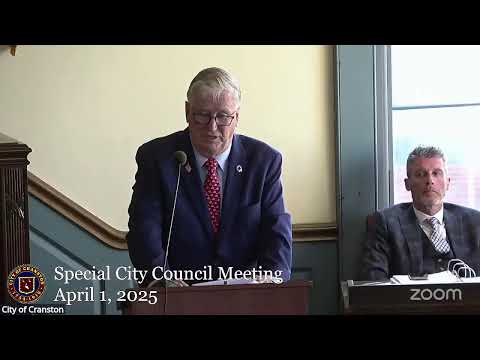
Cranston Mayor Hopkins delivered the city’s operating and capital budget message Wednesday night, proposing a $338.1 million overall budget for the fiscal year beginning July 1, 2025, and asking the council to approve a 2.57% tax-levy increase largely to support the school department.
“I am once again very proud to report that the city of Cranston is fiscally strong,” Mayor Hopkins said, announcing a plan that he described as prioritizing school funding while holding city-side spending to a “no frills” level. He said the proposed budget increases the city’s contribution to the school department by $2,279,000 and that state school aid is expected to increase by roughly $5,100,000 (about 6.73%).
The mayor framed the proposal as fiscally prudent and school-focused. He said the residential tax rate would rise to $13.96 per $1,000 of assessed value from $13.61, and the commercial/industrial rate would move to $20.94 from $20.42. Using the city’s stated average home value of $347,600, the mayor estimated the typical household tax increase at about $122.
Why it matters: Cranston’s budget choices affect local services, school operations and taxpayer bills. Hopkins said the administration is directing resources to long-term school building investments and infrastructure such as roads, bridges and stormwater projects. He emphasized maintaining public safety and recreational services while addressing capital needs for fire stations and school facilities approved by voters in recent bond measures.
Key details and context
- Priorities: The mayor described the budget as focusing on schools and children; he said about 55% of total spending is on the school side while roughly 45% is city-side. He called the city-side budget “austere” and said department heads would be directed to manage within those limits while meeting expected service levels.
- Revenue and aid: Hopkins told the council that Cranston has lost more than $2.7 million in state aid due to improved fiscal metrics, and that payment-in-lieu-of-taxes (PILOT) contributions tied to state-owned properties have dropped by about $1.6 million over three years as state projects changed property use. He said American Rescue Plan (ARPA) funds were used as a bridge during COVID and that the administration has planned to move away from dependence on one-time federal funds.
- Bond ratings and fiscal posture: The mayor said the city’s bond ratings were reaffirmed, citing Fitch and similar ratings from Moody’s and Standard & Poor’s, and described Cranston as fiscally strong but facing ongoing challenges such as rising employee health and pension costs and unmet state funding for schools.
- Taxes and charter limits: Hopkins noted the City Charter caps tax-levy increases at 3% year over year and said his proposed 2.57% levy increase is within that limit.
Public process and next steps
Council President Marino introduced the budget message under the agenda items referencing the operating budget, capital budget, and related ordinances and resolutions (pursuant to City Charter Sections 6.03 and 6.11). The council scheduled finance committee meetings for April 8 (initial introduction at 6:00 p.m., finance committee at 6:15 p.m., Cranston East Auditorium) and April 12 and invited public attendance. Budget ordinances and resolutions will be referred to committee as indicated on the agenda for subsequent hearings and votes.
Meeting outcome
A procedural motion to adjourn was made and seconded at the end of the special meeting; the council approved the motion by voice vote (“Ayes have it”).
Quotes
“I am once again very proud to report that the city of Cranston is fiscally strong,” Mayor Hopkins said. He added, “Today, the greatest fiscal challenge that we face is inadequate state funding of our schools.”
What the city did not decide tonight
No formal votes were taken on the operating budget, capital budget, tax levy ordinances, or salary schedules at the special meeting; those items were introduced and referred to committee. Specific ordinance text, committee recommendations and final vote tallies will be recorded at subsequent public hearings and council meetings.