Get Full Government Meeting Transcripts, Videos, & Alerts Forever!
Get email alerts on the Parking And Accessibility topic
No spam. Unsubscribe anytime.
Holyoke councilor, disabilities commission seek streamlined process to remove unused handicap parking signs
Summary
Councilor Israel Rivera and the Holyoke Commission on Disability discussed an ordinance rewrite to create a tracked renewal process, a searchable list of issued spaces and multilingual communications so unused handicap signs can be removed more efficiently.
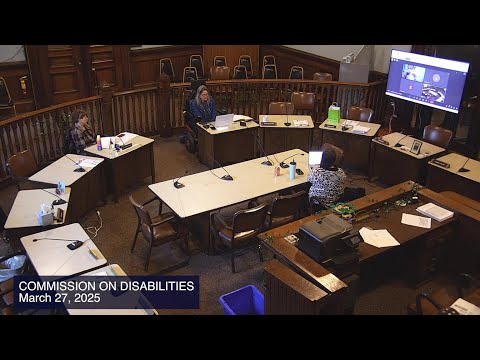
Councilor Israel Rivera met with the Holyoke Commission on Disability on March 27 to discuss an ordinance update that would make it easier to remove unused or misplaced handicap parking signs.
The commission and Rivera said the current system relies on individual applicants and the city clerk’s office without a centralized, routinely updated list of issued curbside handicap spaces. Rivera said the proposal — filed originally by Councilors Carmen Ocasio and Dave Bartley — would create a list of currently issued spaces, set a renewal cadence and clarify who is responsible for tracking applications and removals.
Why it matters: Commission members and Rivera said a clearer administrative process would help the city remove unused signs, reduce wrongful blocking of curb space and make enforcement and budgeting more predictable for the clerk’s office and Department of Public Works.
Rivera told the commission the ordinance committee wants to collaborate with the Commission on Disability and the clerk’s office to develop a workable system. He suggested the process should place the onus on permit holders to renew when notified, and discussed a practical time horizon for creating a back-file, suggesting a start point of three to five years for compiling prior approvals.
Commission member Betty Larabee, a long-serving member, asked whether the revised application and notice language should be translated: she noted the application is only in English while clerk correspondence is bilingual. Larabee also asked whether records of sign removals should be reflected in the council’s ordinance records.
Kelly Curran, Holyoke’s ADA officer, said translations are feasible through the city’s paid translators or in partnership with the school department, and emphasized the need to confirm clerk capacity before assigning new duties such as outreach and list maintenance.
Members discussed renewal intervals (suggestions ranged from one year to five years) and agreed the commission should draft a short “bullet list” of practical questions and policy choices (renewal interval, lookback window, translation needs, who maintains the list) to send to the clerk’s office and the ordinance committee. Rivera said he would take the commission’s recommendations back to ordinance and work to have legal language ready by June.
The commission agreed to convene follow-up meetings, produce the bullet list and coordinate with the city clerk’s office to determine the clerk’s capacity and any additional cost. Rivera said if the work requires extra staff time, the ordinance committee would consider seeking budget resources with a documented cost estimate.
Members noted practical constraints: high-density neighborhoods such as South Holyoke have acute parking shortages, and commissioners said any policy must balance protecting curbside accessibility while avoiding unused reserved spaces where they are scarce. Larabee and other members suggested involving the city engineer and DPW as the group develops criteria for where spaces can be located or limited in dense areas.
Next steps included the commission drafting its list of questions and recommendations, Rivera following up with the clerk’s office about capacity and translation, and returning to the commission or ordinance committee with proposed legal language by June.