Get Full Government Meeting Transcripts, Videos, & Alerts Forever!
Get email alerts on the Transportation Airports topic
No spam. Unsubscribe anytime.
Norfolk planners briefed on airport master plan, $350 million terminal program and ALP approvals
Summary
Airport representative Anthony Rondo told the Planning Commission the Norfolk International Airport has an FAA- and state-approved airport layout plan and a master-plan update that enables a $350 million terminal program, intersection work with a $17.2 million federal grant, a consolidated rental car facility and closure of a crosswind runway. The
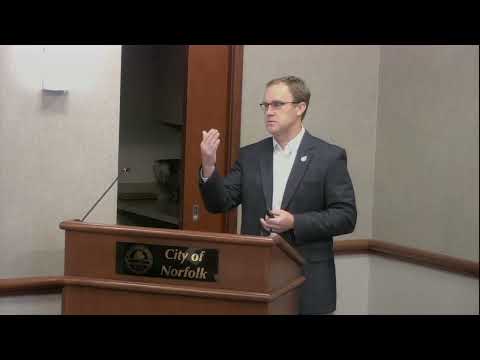
Anthony Rondo, an airport representative, told the Norfolk Planning Commission that the Norfolk International Airport’s master plan update and its airport layout plan (ALP) are complete and that several projects tied to that ALP are moving into design and early construction phases.
Rondo said the ALP and master-plan approvals are necessary to secure further project approvals and funding and to keep airport projects on schedule. “Currently, we serve 45 nonstop destinations, and we'll be 46 when we start to Cancun, but that's gonna be in 2026,” Rondo said. He presented passenger and capacity figures and a list of projects the airport plans to pursue under the approved ALP.
The master plan and ALP matter to the city because staff told commissioners the Planning Commission must recommend a resolution for City Council to adopt the master plan so zoning and other city approvals can align with the airport’s plan. “There is an action for resolution that will need to be taken to adopt the master plan for the airport in order to ensure that we're in alignment with the zoning regulations,” Planning staff member Mr. Landau told the commission.
Key projects Rondo described included:
- A terminal modernization program he described as a “total program cost” of $350,000,000, covering terminal additions, a consolidated checkpoint, baggage inspection consolidation and concessions work planned in phases with an overall completion targeted around 2028.
- A main-intersection redesign at the Robin Hood/airport entrance, a signalized four-leg intersection intended to replace an offset intersection. Rondo said the project was budgeted at $26,000,000 and that the airport received $17,200,000 from the Infrastructure Investment and Jobs Act toward that work.
- A consolidated rental car facility on the former surface return lot, designed to more than double on-site ready-vehicle capacity, shorten shuttle trips and provide on-site fueling, cleaning and maintenance. Rondo said design is underway and that the airport hopes to start construction in March and complete the work by 2027.
- Permanent closure and removal of runway/taxiway pavement for crosswind runway 1432. Rondo said the crosswind runway had been on airport plans for decades but was lightly used; closing it will create roughly 15 acres of developable land on each side of Robin Hood Road.
Rondo also described smaller enabling projects such as enlarging an observation lot and reconfiguring rideshare and taxi queuing. He emphasized the growth in airline seats and passengers: “we surpassed 500,000 total passengers for the first time ever,” he said, and added that the airport expects to exceed 5,000,000 passengers this year.
On approvals and conditions, Rondo said the ALP and associated NEPA documentation have been reviewed by the Federal Aviation Administration and the state Department of Aviation, and that any work moving forward still requires FAA sign-offs and the appropriate level of NEPA. He noted that some ALP items have been under the plan for decades and that the FAA and roughly 14 internal FAA review divisions examine changes before signoff.
Commissioners asked whether construction would affect travelers; one commissioner asked whether construction would cause delays. Rondo said routine travel times were not expected to be materially affected, though “you will probably hit an extra light cycle” at the intersection during construction and the multi-phased terminal work will extend inconvenience over time.
Planning staff and the commission discussed zoning implications. Planning staff said the airport district is a unique zoning district that will require text amendments if the commission forwards a recommendation and City Council adopts the master plan. “The zoning that regulates the land where the airport and all the operations are linked to it is located. It's a unique zoning district,” a planning staff member said, noting subsequent ordinance changes will likely be needed to align the airport plan with permitted uses and standards.
No formal vote or City Council action was recorded at the meeting. The commission was shown printed and digital copies of the ALP and the full master-plan appendices and was told staff would print and distribute final public-hearing drafts shortly. The next step described by staff and the presenter is for the Planning Commission to recommend a resolution to City Council; Council action would be required to adopt the master plan and enable zoning text amendments and related approvals.