Get Full Government Meeting Transcripts, Videos, & Alerts Forever!
Get email alerts on the Pharmacy Benefit Managers topic
No spam. Unsubscribe anytime.
Committee advances amendment to require copay assistance count toward patient cost-sharing; PBMs urge caution
Summary
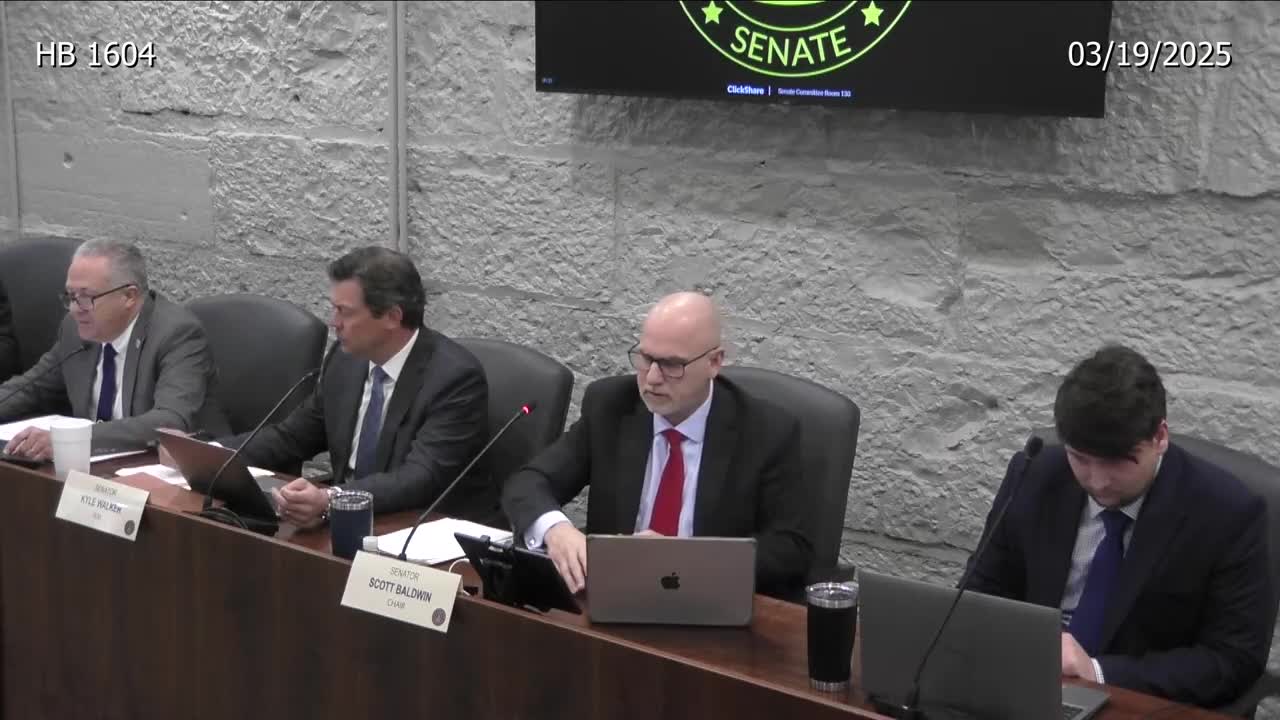
The Senate Insurance Committee on Tuesday advanced an amended version of House Bill 1604 that would require PBMs and insurers to count payments from drug manufacturers and charities toward patients’ deductibles and out‑of‑pocket limits for narrowly defined prescription categories.
The Senate Insurance Committee on Tuesday advanced an amended version of House Bill 1604 that would require pharmacy benefit managers (PBMs) and insurers to count manufacturer and charitable payments toward a patient’s deductible and out‑of‑pocket maximum for narrowly defined prescription categories.
Representative Daniel Smoltz, the amendment sponsor, told the committee the change "would, require PBMs and insurers to include shared payments from manufacturers and charitable organizations." He said the amendment includes an ERISA exclusion and “guardrails” limiting the measure to life‑saving drugs, drugs that manage chronic conditions and instances where no generic is available.
Supporters said the amendment targets patients with expensive, non‑generic therapies who face high upfront costs under high‑deductible plans. Vanessa Flora, who testified as a hemophilia patient and caregiver, said those programs are essential for her family: “Factor is very expensive. There are no generic options for hemophilia treatment. Our family's current cost per factor is 1,500,000.0 per year for 3 people just to keep us from bleeding,” she said, and told senators that copay assistance is often the only way families can afford ongoing therapy.
Patient advocates argued that copay assistance prevents treatment abandonment and downstream emergency care. George Huntley, CEO of the Diabetes Patient Advocacy Coalition, described how high point‑of‑sale costs force some patients to ration medicine and said the amendment would “reinstate that lifeline” for people with no alternative medications.
PBM representatives and insurer groups testified against parts of the amendment. Philip Cristo Fanelli, representing the Pharmaceutical Care Management Association, said the provision risks undermining formulary management, which PBMs use to steer patients toward lower‑cost therapeutic options. “Formulary management, is a key tool that PBMs use to control costs for healthcare consumers,” he told the committee, arguing that manufacturer coupons can incentivize selection of higher‑priced drugs and that the costs will ultimately be borne by plan sponsors and employers.
Cristo Fanelli also said the amendment broadens the statutory definition of a PBM and could capture unintended entities under licensure rules. Joey Fox of the Indiana Association of Health Plans urged lawmakers to work with plans on the bill’s transparency provisions; he suggested using member portals to display negotiated rates alongside estimated patient out‑of‑pocket exposure.
Committee members pressed both sides on empirical evidence. Representative Smoltz pointed to a May 2023 AIDS Institute study and said 16 states have enacted similar restrictions, and he asked PBM testimony about whether those laws caused premium increases. Cristo Fanelli disputed the sponsor’s reading of the evidence and warned of potential long‑run cost impacts; he also pointed to Medicare Part D’s federal prohibition on manufacturer coupons as an example of the government curbing such programs because of projected costs.
After reopening testimony to hear from patient groups and industry representatives, the committee voted on the amendment and the bill. The roll call recorded six ayes and one no; the committee reported the amended bill to the Senate floor 6–1.
The bill, and its amendment, exclude ERISA‑governed plans and include precise language restricting the benefit to three narrow categories of drugs, according to the sponsor. Committee discussion left several unresolved technical issues: how the rule will interact with existing PBM contracts and rebate structures, how stateside regulators will verify manufacturer payments count toward patient balances, and the scope of the bill’s definitions for PBMs.
Senators said they wanted additional work on implementation details before floor debate. The sponsor and industry representatives agreed to continue negotiations on transparency language for negotiated rates and to supply additional studies the committee requested.
Votes at a glance: On the amendment and as reported, the committee roll call recorded the following votes: Randolph (yes); Cadore (yes); Walker (yes); Gaskell (no); Schmidt (aye); Freeman (excused); Carrasco (aye); Baldwin (chair, aye). The committee reported the bill to the floor, 6–1.
The bill will go next to the full Senate for consideration; committee members asked staff to circulate suggested technical fixes and to work with stakeholders on contract‑definition and disclosure questions.