Get Full Government Meeting Transcripts, Videos, & Alerts Forever!
Get email alerts on the Education Code Cleanup topic
No spam. Unsubscribe anytime.
Committee reviews House Bill 1002 to repeal duplicative education code, shift nonfederal trainings to local control
Summary
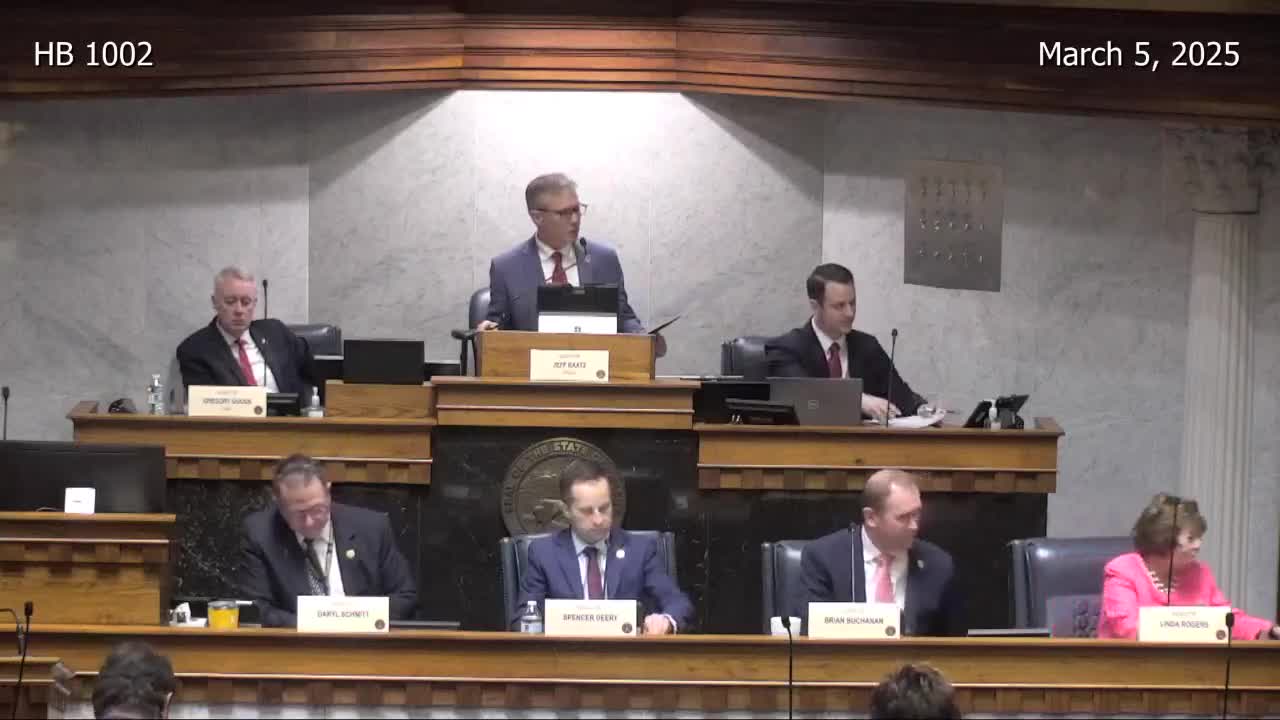
At a hearing of the Senate Education and Career Development Committee, Representative Bob Behning presented House Bill 1002, a broad cleanup of Indiana Code Title 20 that would repeal unfunded line items, remove duplicative or permissive "may" provisions and shift many non‑federal training requirements to local school corporations.
At a hearing of the Senate Education and Career Development Committee, Representative Bob Behning presented House Bill 1002, a broad cleanup of Indiana Code Title 20 that would repeal unfunded line items, remove duplicative or permissive "may" provisions and shift many non‑federal training requirements to local school corporations.
The bill’s sponsor, House Representative Bob Behning, said the measure aims to simplify statutes and return decisionmaking to local officials. "If you may do it, I don't need to tell you that you may do it," Behning told the committee, describing the project as an effort to eliminate unnecessary statutory language. He said the bill repeals roughly 35,000 words in Title 20 and removes advisory boards that have not been active in recent years, citing the career and technical education advisory board as an example that "has not met, I think, in 4 or 5 years."
Supporters from multiple education organizations told the committee the bill would reduce administrative burden. Cindy Long, assistant executive director of the Indiana Association of School Principals, said the measure’s flexibility on timing and frequency of required trainings would help local leaders tailor professional development to local needs. Lisa Tansel, general counsel for the Indiana School Boards Association, described specific deleted provisions her group supported, including removing an outdated cap on remediation spending and repealing prescriptive language on committees for opening bids.
Labor groups and some witnesses urged caution. Sally Sloan of the American Federation of Teachers Indiana said HB 1002 would remove existing qualifications for the secretary of education—currently including an advanced degree and five years of public education leadership experience—and would eliminate a two‑year Indiana residency requirement prior to appointment. "Qualifications such as those required for the secretary of education provide ... an assurance of effective leadership and credibility," Sloan said, adding AFT Indiana opposes the bill as written.
Committee members pressed the sponsor on several points. Senator JD Ford asked whether the secretary would be required to live in Indiana during tenure; Behning said the bill removes the residency requirement and that current practice generally results in the governor selecting candidates who live or will reside in the state. Senator Kodura and others sought clarifications on charter school provisions and on whether asset‑disposition and reporting requirements for closing charter schools remain—Behning pointed the committee to merged code sections, including references to Indiana Code 20‑24‑3‑3 (cessation of operation of a charter school) and 20‑24‑7‑9 (charter revocation and termination), which he said remain the controlling code provisions.
No final committee vote on HB 1002 was recorded in the transcript. Representative Behning told senators he viewed the bill as the first of a multiyear code‑revision effort and invited further input.
The committee scheduled further consideration; no funding decisions or final enactments were made at the hearing.