Get Full Government Meeting Transcripts, Videos, & Alerts Forever!
Get email alerts on the Property Tax Reform topic
No spam. Unsubscribe anytime.
Indiana Ways and Means hears wide-ranging testimony on Senate Bill 1; lawmakers, data show tradeoffs between homeowner relief and local services
Summary
Senate Bill 1 drew long presentations from the bill sponsor and state fiscal staff and more than three hours of public comment on Feb. 11 before the House Ways and Means Committee, revealing a central trade‑off: homeowners’ short‑term relief versus the revenue local governments use to fund police, fire, roads and schools.
Senate Bill 1 drew more than four hours of focused presentation and a long public-comment period before the House Ways and Means Committee on Feb. 11, exposing a central tension in Indiana tax policy: whether to freeze local property-tax growth to give homeowners predictable bills now, or preserve locally controlled revenue that funds police, fire, transit and schools.
Backers of SB 1 described a recent run-up in home assessments and urged limits to future automatic increases. “As of 01/01/2025, there's $54,000,000,000 of debt that is owed by local units of government,” Sen. Travis Holdman told the committee, raising the broader fiscal concern behind several provisions of the bill. Holdman — the Senate sponsor of the measure — outlined changes including a cap on the Maximum Levy Growth Quotient (MLGQ) for several years, expanded transparency tools, limits on some excess-levy appeals and a new process for taxpayer referenda.
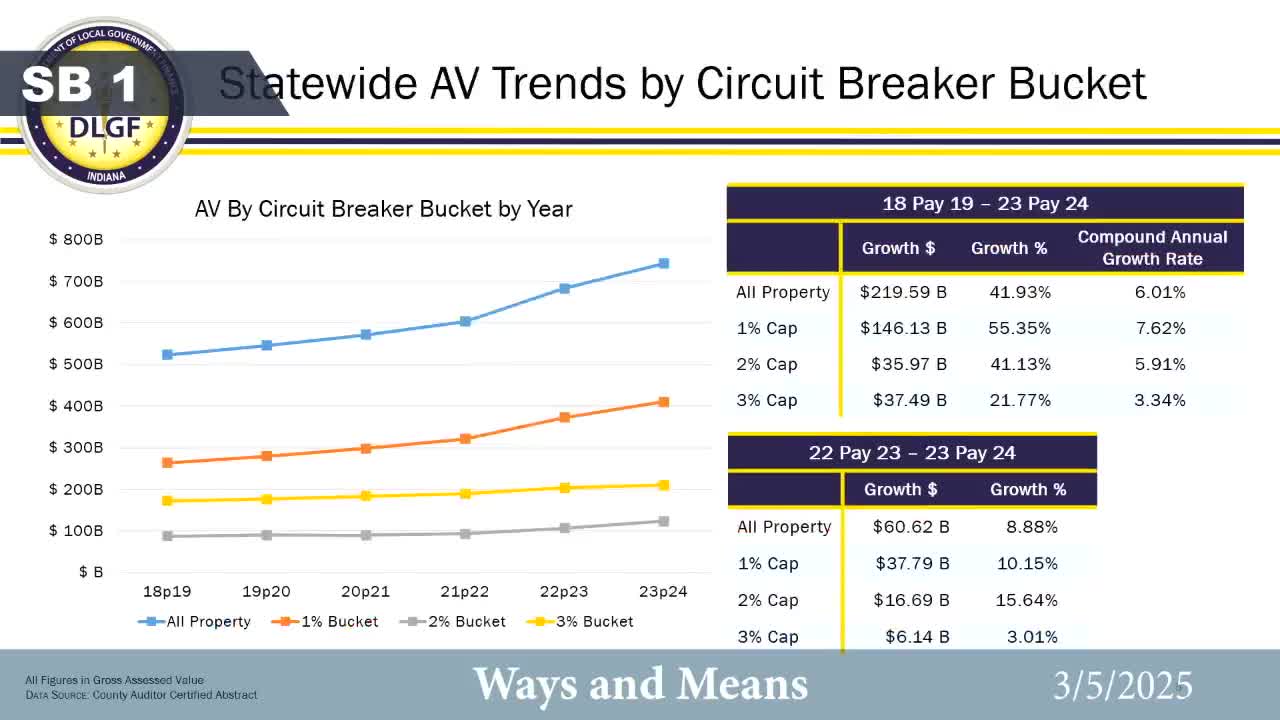
The Department of Local Government Finance presented statewide data intended as a factual baseline. “it is more this is just the data and the facts. It is not in the policy side,” Jamie Bolser, the agency’s deputy commissioner and chief of staff, told the panel as staff walked lawmakers through six years of valuation, levy and levy-outside-the-control calculations. The department’s slides showed large rises in home values concentrated in the 1% constitutional tax bucket and sharper growth in levies outside of MLGQ controls — particularly traditional debt and voter-approved referenda.
Advocates for the governor’s plan again framed the debate as homeowner relief. Jason Johnson, deputy chief of staff for Gov. Eric J. Braun, told the committee: “Addressing homeowner bills remains the governor's top priority.” Supporters highlighted provisions to expand homestead and veteran deductions, a temporary “flatline” on MLGQ, and new credit or deferral programs for qualifying taxpayers.
But local officials, school leaders and service providers warned of immediate, tangible consequences if the bill’s revenue limits are enacted. County commissioners, township trustees and city mayors described how much of municipal and county general-fund budgets are spent on public safety, courts, sanitation and other protections that rely on property-tax levies. Knox County Commissioner Kelly Streeter said her county’s general fund budget is already driven mostly by judicial and law-enforcement costs and that cuts would force service reductions and hiring freezes.
Education executives likewise said the bill would squeeze schools that are already stretched. “For the example of Danville Community Schools,” Dr. Tracy Schafer, superintendent and representative of a coalition of growing suburban districts, told lawmakers, “an LSA run on the amended Senate Bill 1 shows the operations levy would be negatively impacted by approximately 6% in year 1, 12% in year 2 and 16% in year 3 — a $1.4 million hit for one district.” At the same time, several superintendents and school-board members asked the committee for more options to manage growth — including phased referenda and clearer borrowing tools — rather than an across-the-board freeze.
Lawmakers asked data questions repeatedly. Representatives pressed agency staff for county-level breakdowns and for detail on how different assessment methods (sales/value/income approaches) affected various property types. DLGF staff said statewide figures mask large county-to-county differences and offered to provide more granular reports.
Committee discussion also touched recurring issues highlighted by multiple speakers: (1) the role of the MLGQ as a growth-control mechanism; (2) how voter-approved levies and debt lie outside that control and therefore still grow more quickly; (3) whether shared relief should be targeted at low-income, elderly or first‑time buyers via credits or deferral and (4) how to avoid a short-term “windfall” that would let a taxing unit collect more after a referendum if assessments spike.
What happened next: no votes were taken in the committee. Chairman Thad A. Thompson announced he plans to bring a committee draft together and present it for another hearing; he said the aim is to post an updated package for public review before the next session date. Committee members from both parties repeatedly asked for more precise county-by-county modeling before moving a bill to the floor.
Why it matters: the debate exemplifies the trade-off in modern state tax policy. Freezing growth can help homeowners (and may be politically popular) but can shift costs to other revenue sources or force local services to shrink in ways that affect public safety, transportation and schools. The committee’s task is to translate high-level goals — predictability for taxpayers, protection for vulnerable homeowners and support for core local services — into a package of rules and offsetting revenues that local governments can implement.
What’s next: Chairman Thompson said a revised package will be posted for committee review and that public hearings will continue. Lawmakers on the panel asked for a county-level fiscal model from DLGF and flagged the need to weigh temporary relief programs for seniors and low‑income homeowners alongside structural changes to the MLGQ and referendum rules.