Get Full Government Meeting Transcripts, Videos, & Alerts Forever!
Get email alerts on the Long Haul Water Pipelines topic
No spam. Unsubscribe anytime.
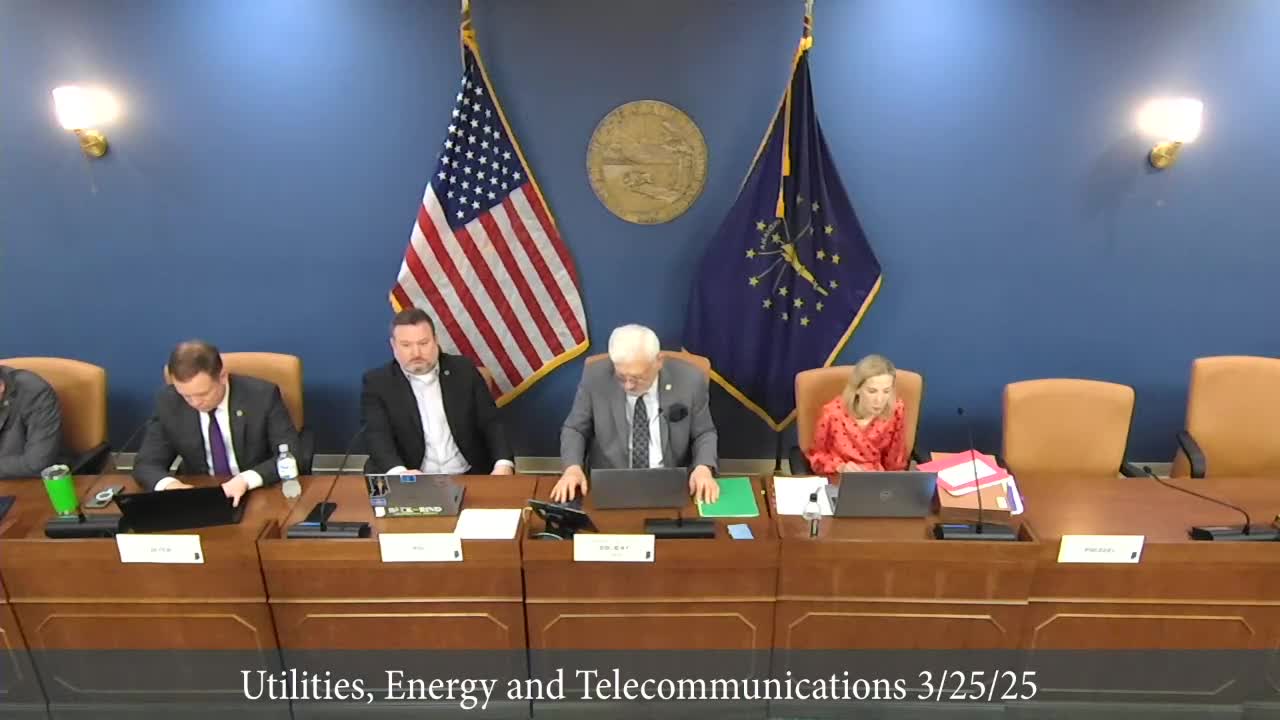
Committee defeats amendment requiring 80% reimbursement by long‑haul pipeline users; SB 4 advances
Summary
The Utilities, Energy and Telecommunications Committee voted down Amendment 6 — which would have required long‑haul water pipeline users to reimburse 80% of construction costs — and then advanced the amended Senate Bill 4 after debate about cost allocation and the Indiana Utility Regulatory Commission(IURC) role.
The Utilities, Energy and Telecommunications Committee considered Senate Bill 4 on long‑haul surface water transfers and rejected Amendment 6, which would have required primary long‑haul pipeline users to reimburse 80% of construction costs. The committee then advanced the bill on a subsequent roll call with 12 members recorded voting yes.
Senate Bill 4 creates a Certificate of Public Convenience and Necessity (CPCN) process for long‑haul water pipelines and establishes cost‑recovery provisions for utilities that build such infrastructure. The amendment offered by Representative Matt Pierce (D‑District 61) would have defined a "long‑haul water pipeline user," excluded incidental customers from that definition, required the CPCN application to identify users and include financial assurances, and made cost recovery contingent on an 80% reimbursement commitment from those primary users.
The change mattered because members worried about who ultimately bears the cost of expensive, long‑distance water projects if the primary user takes less service than anticipated or a project fails to proceed. Representative Matt Pierce said the amendment mirrored protections adopted in recent electric‑sector legislation (referred to in committee as "1007") and was intended to ensure the entity creating the need for the pipeline would bear most of the cost. "So amendment number 6 attempts to follow‑up on our discussion ... I attempted to take the concept of policies that appear to be a consensus within the house from the electric generation side and plug it into this bill in relating to the long haul water pipeline," Pierce said.
Senator Cook, sponsor of SB 4, urged the committee to oppose the amendment. He said the water context can involve regional groups of customers rather than a single user and warned that a statutory 80% requirement could tie utilities' hands to protect ratepayers. "I do think it has some unintended consequences. And so for that reason, would ask you to consider opposing that language," Cook said.
Technical staff from the Indiana Utility Regulatory Commission (IURC) told the committee the commission and water utilities already have tools and rate‑making latitude to allocate costs to the appropriate customer class or by special contract. Luke Wilson of the IURC summarized the agency's view: "Their current understanding right now is that we have the rate making latitude to sort of handle this. ... That industrial cost would then be assigned to that industrial class of users to pay off because it's a cost associated with serving an industrial customer." Wilson also described two cost‑recovery pathways the IURC applies: an annual review of incurred costs or a deferred review after project completion, with the commission assessing whether costs were reasonable, necessary and prudent before allowing recovery.
Committee members discussed a hypothetical example of a large industrial user (a chip factory) needing more than 10,000,000 gallons per day and potentially requiring a pipeline routed tens of miles. Pierce and others pressed for a statutory mechanism to make the primary user responsible for most project costs; Cook and IURC staff said existing CPCN and rate‑making procedures provide avenues to allocate costs and to deny recovery for imprudent spending. During questioning, IURC staff referenced past proceedings in which the commission had disallowed or limited cost recovery when costs were not shown to be prudent, naming Edwardsport (an electric example) as one prominent instance.
The committee held a roll call on Amendment 6. Members recorded as voting no included Representative Saladin, Representative Paul, Representative Culp, Representative Devon, Representative Jeter, and Representative Morris; two members were recorded as excused. Four members — including Representative Pierce and Representative Hamilton — recorded votes in favor. The chair announced the amendment was defeated, "7‑4. The amendment is defeated."
After brief additional remarks endorsing the CPCN framework in SB 4, the committee took a second roll call on the bill as amended and advanced it with 12 members recorded as voting yes. The bill will proceed according to legislative schedule.
The committee's debate centered on balancing two goals: protecting general ratepayers from costs driven by a single large user, and preserving regulatory and contracting flexibility for utilities and the IURC to structure cost allocation (including customer classes or special contracts). No final statutory language beyond the committee's recorded actions was adopted in this hearing.
The Utilities, Energy and Telecommunications Committee will meet again next Tuesday for further business.