Get Full Government Meeting Transcripts, Videos, & Alerts Forever!
Get email alerts on the Gifted And Talented topic
No spam. Unsubscribe anytime.
Educators and students urge legislature to keep gifted program funding at $15 million
Summary
Advocates, teachers and students told the School Funding Subcommittee the state'funded gifted and talented grant is critical for identifying high'ability K—2 students and providing specialized curriculum, professional development and evaluation. Speakers asked lawmakers to restore and hold funding at $15 million.
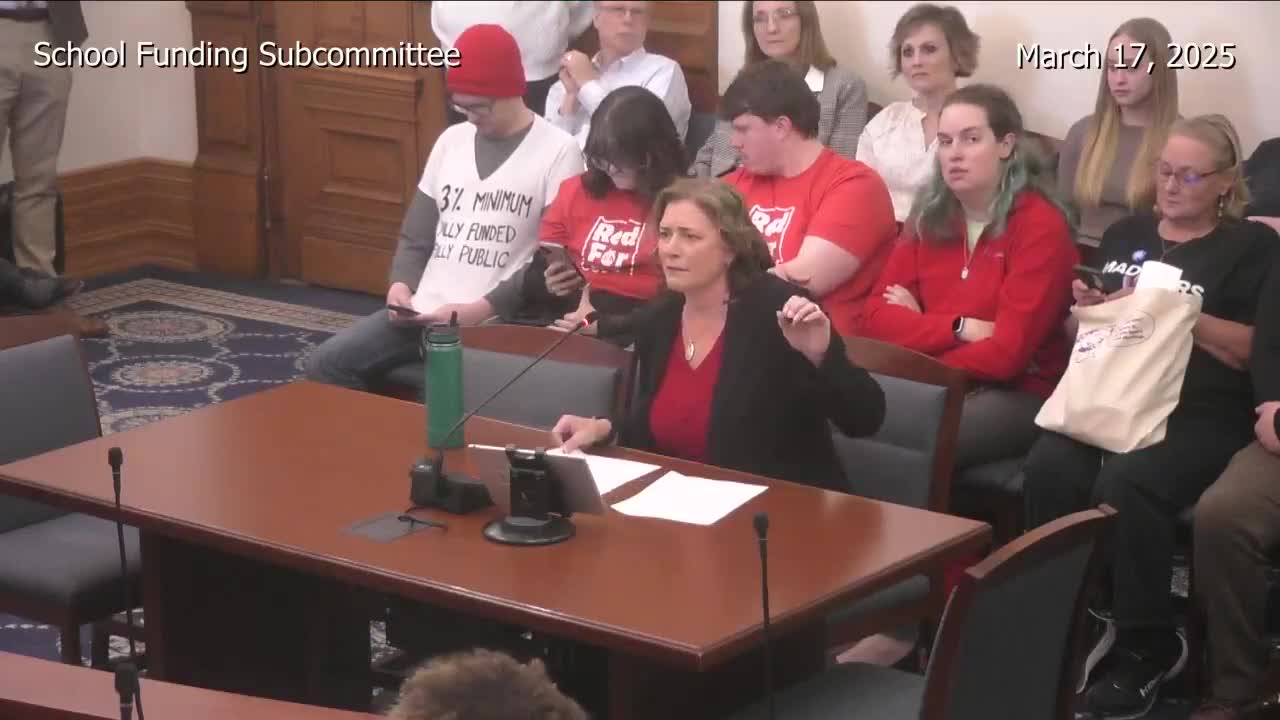
Indiana'based advocates, teachers and students told the Senate School Funding Subcommittee on March 17 that state funding for gifted and talented education is essential to identify high'ability learners and to deliver appropriately differentiated instruction.
Julie Klusas Gasper, executive director of the Indiana Association for the Gifted, told the panel Indiana is one of 15 states with a funded gifted program and described the law that requires identification and services in all public and charter schools. "In 02/2007, the Indiana General Assembly passed a bill that required all schools to have gifted programs," she said, and asked the subcommittee to keep the line item at $15,000,000 after noting the governor's budget had proposed $13 million and the House restored $15 million.
Gasper and classroom teachers described four types of activity that the grant funds: universal identification (including screeners), professional development for teachers, differentiated curriculum, and program evaluation. "Identification requires us to look at students based on both ability and achievement," Gasper said, adding that universal testing is expensive but essential to find students who otherwise would be missed. Teachers and parents said universal screening helps identify students from low'income and underrepresented groups.
Students and teachers described outcomes they attribute to the program. Adeline Davis, a junior at Southport High School who has been in high ability services since kindergarten, said early access to advanced work helped her pursue aviation coursework at the Central Nine Career Center. Kim Jovitch, high ability coordinator for Perry Township Schools, said her district screens three cohorts (kindergarten, second grade and fifth grade) and currently serves 1,748 identified students.
Parents and local teachers emphasized the role of professional development. "With the professional development I have had through our high ability funding over the last 20 years, I can design curriculum that is not harder but deeper and more complex," said Nina Bowman, a teacher with two decades of experience.
Speakers asked the subcommittee to preserve standing program rules they said represent a national model. They provided data points to the panel: advocates said about 130,000 students statewide are identified as high ability; they said the 2007 appropriation (adjusted for inflation) would be closer to $20 million today, and that the 2023 appropriation was $15 million.
No formal action was taken by the subcommittee during the session reported in the transcript. Testimony concluded with committee members thanking witnesses for the information and offering to follow up on data requests.