Get Full Government Meeting Transcripts, Videos, & Alerts Forever!
Get email alerts on the Childcare Ratios Workforce topic
No spam. Unsubscribe anytime.
Committee reviews broad childcare bill on ratios, workforce pipelines, microcenters and employer tax credit
Summary
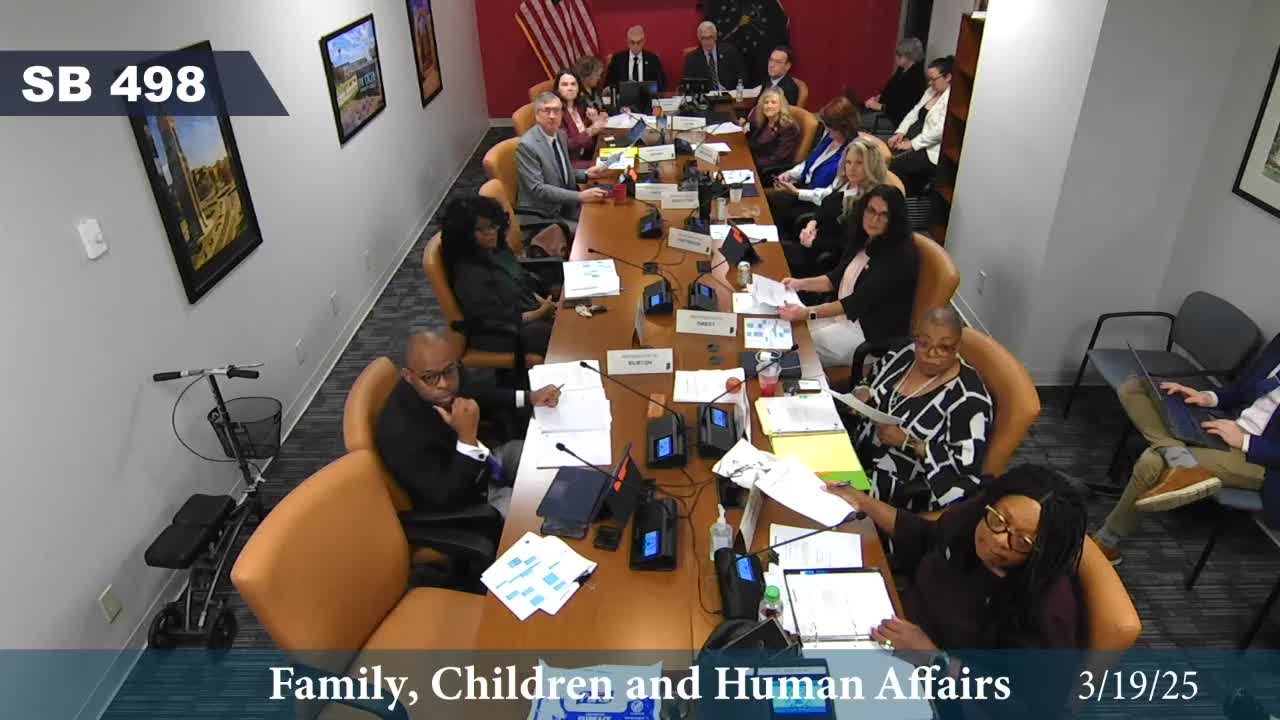
The Family, Children and Human Affairs Committee heard testimony on House Bill 463, a multi-part measure proponents say is intended to expand child-care capacity, shore up the early childhood workforce and give providers more flexibility on staffing ratios.
The Family, Children and Human Affairs Committee heard testimony on House Bill 463, a multi-part measure proponents say is intended to expand child-care capacity, shore up the early childhood workforce and give providers more flexibility on staffing ratios.
FSSA (Family and Social Services Administration) staff and representatives of after-school programs, chambers of commerce, school districts and employers outlined provisions that would: add an out-of-school-time (OST) program representative to the Early Learning Advisory Committee (ELAC); require FSSA to publish surrounding states' staff-to-child ratios for providers to consider; expand a microfacility ("microcenter") pilot program; and extend an employer child-care tax credit.
"FSSA and Governor Braun stands in support of House Bill 463," Kayla Skinner, an FSSA representative, told the committee, summarizing key provisions including the ELAC change, publication of surrounding-state ratios, a five-licensee minimum for the microfacility pilot, and a requirement that FSSA adopt interim rules implementing ELAC recommendations.
Sam Barnett of the Indiana After School Network supported adding OST representation to ELAC, saying it would "add a missing voice" for providers who serve school-age children. United Way of Central Indiana and the Indiana Manufacturers Association each voiced support for the bill's employer-oriented provisions, including the extension of the employer child-care expenditure tax credit.
Multiple witnesses and members raised questions about staff-to-child ratios—a recurring, and somewhat contentious, element of the proposal. The introduced legislation would require FSSA to publish ratios used by surrounding states; providers could then choose to adopt those ratios or keep current FSSA ratios. Witnesses urged caution in any change that could jeopardize child or staff safety, while also stressing that modest flexibility could help programs in workforce-shortage areas open seats.
"We have to be really thoughtful and careful and cautious about the ratio language," Sam Sneidman of United Way said. "It gives providers the ability to maintain more restrictive ratios," he added, describing a Senate amendment that made use of surrounding-state ratios optional rather than mandatory.
Several school districts and providers detailed how changes would affect local operations. Christy Jarka of Doolin School Corporation described existing developmental preschool and inclusive preschool partnerships and urged continuing requirements for first-aid certification, child-abuse detection training and annual continuing education for caregivers. She supported allowing high-school students age 15 participating in a supervised career-and-technical education (CTE) early-childhood pathway to count toward staff ratios when directly supervised, calling it a way to build a pipeline of trained professionals.
McCree Dorado of Westfield Washington Schools, which operates a large legally licensed-exempt childcare facility, described how current group-size rules limit simultaneous use of common areas such as gyms, cafeterias and playgrounds. Dorado asked for an amendment that would allow multiple classrooms to use large common spaces simultaneously (for example, on bad-weather days), as long as square-footage and supervision standards were met.
Mike Mullins (LSA) and others explained amendment language under consideration that would: permit a 15-year-old student in a school-run childcare program to provide supervised care with a three-month grace period to complete required credentials; allow a student volunteer age 15 or older to be counted as staff if directly supervised; and provide exceptions to group-size limitations in common areas when sufficient square footage (for example, 75 square feet per child) is available.
Economic-development and business groups urged the committee to retain an employer-childcare expenditure tax credit and to revive a county-level local childcare assistance matching-grant program that was in an earlier, introduced version of the bill. The matching program described by LSA would require FSSA to match county deposits dollar-for-dollar into a local fund to expand childcare capacity.
The committee accepted extensive testimony and did not take a final vote on HB 463 during the hearing. Chairman Devon said amendments would be refined and the committee would aim to consider amendment votes at a subsequent meeting.
Lawmakers asked stakeholder groups to work with staff to refine ratio language and the mechanics of microcenter and apprenticeship/practicum provisions before the bill returns for further action.