Get Full Government Meeting Transcripts, Videos, & Alerts Forever!
Get email alerts on the Land Use Rogo Evacuation topic
No spam. Unsubscribe anytime.
Monroe County officials back guardrails as Tallahassee negotiates ROGO allocation bills
Summary
Monroe County leaders told state lawmakers this week they want any change to hurricane-evacuation clearance rules linked to steps that steer new density to workforce housing and vacant buildable lots and pace new allocations over a set period.
Monroe County leaders told state lawmakers this week they want any change to hurricane-evacuation clearance rules linked to steps that steer new density to workforce housing and vacant buildable lots and pace new allocations over a set period.
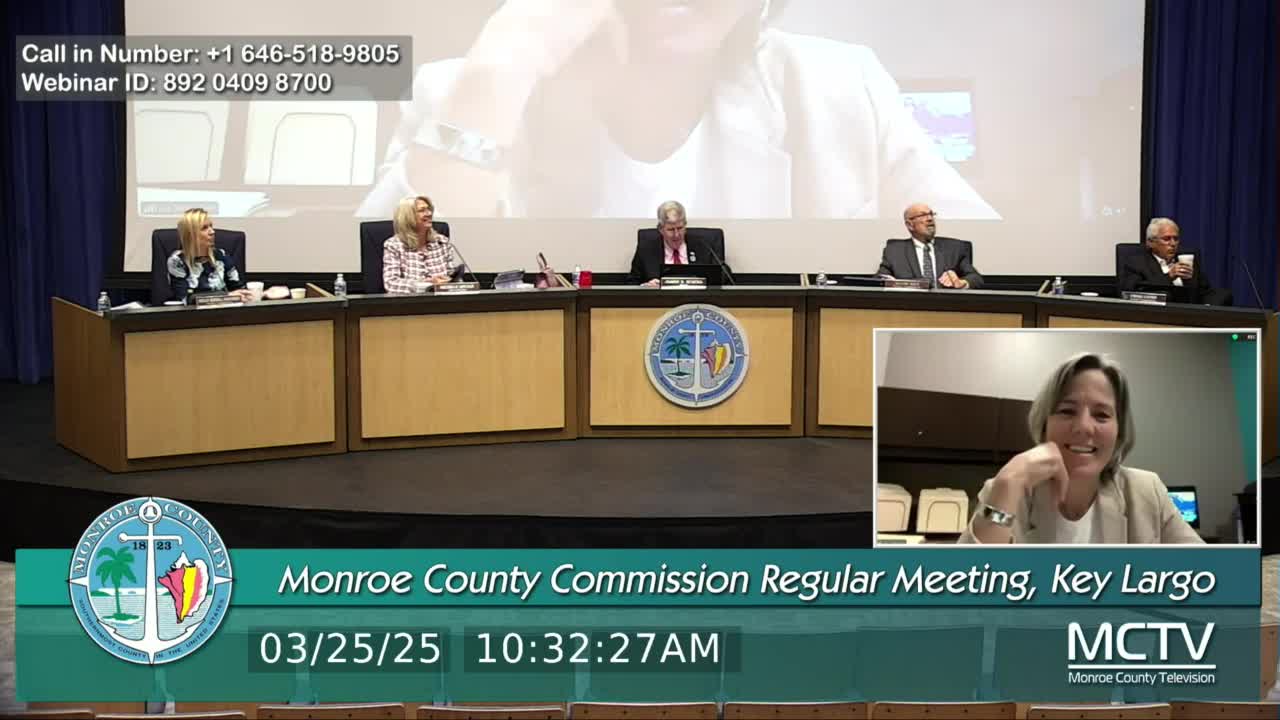
Lisa Tennyson, speaking from Tallahassee as the county's legislative representative, said Monroe County’s position is embodied in a resolution the Board of County Commissioners passed Dec. 19, 2024, and reiterated that the board supports changing the evacuation clearing time only if protective conditions accompany any new ROGO allocations. “The board’s clear position is … supports a change to the clearance time from 24 hours to up to 26 hours and a maximum of 3,550 allocations with the following key protective conditions attached,” Tennyson told the county at its March meeting.
Why it matters: The rules determining how long it must take to evacuate the Florida Keys influence how many new housing allocations (ROGOs) state law allows. The county's resolution asks that allocations be phased, target vacant/buildable lots, and prioritize workforce housing — measures the county says would reduce takings liability and help housing for year-round residents.
What was reported: Tennyson summarized three bills under active consideration. Representative Jim Mooney’s HB 995 originally proposed a 24.5-hour clearance window with up to 500 allocations over 10 years and included the board’s guardrails, she said. Senator Ana Maria Rodriguez’s bill initially proposed a 26-hour window with up to 3,550 allocations over 40 years but was being amended in committee to match a 24.5-hour window with 888 allocations over 10 years, Tennyson reported. A larger, statewide housing bill (SB 1730) contains language to change the clearance time to 26 hours but lacks the county’s guardrails, staff warned.
Public and stakeholder reaction: Local conservation and community groups urged the commission to insist on the guardrails and to oppose SB 1730. “We continue to strongly support HB 995,” said Chris Massacott of Keys Last Stand, adding the group would accept an amended Mooney bill if it matches Rodriguez’s 888-over-10-years compromise. Sugarloaf Shores Property Owners Association’s Stuart Schafer also urged the county to align with the ROGO coalition and support the Rodriguez approach as a “sensible compromise.” Commercial fishing guides raised environmental concerns if allocations increase without guardrails.
Commission discussion and direction: Commissioners repeatedly emphasized the importance of retaining the board’s guardrail language — notably directing most allocations to vacant buildable lots, phasing releases over time, and prioritizing workforce housing. Several commissioners said they would not initiate a new resolution opposing a particular Tallahassee bill, arguing that doing so could complicate negotiations with the county’s senator and representative. Instead the board agreed to reaffirm support for the guardrails and to continue coordinating with the county’s delegation and staff in Tallahassee.
The board’s public stance: Commissioners expressed general support for the revised, matched language that Tennyson said was developing in the House and Senate (24.5 hours; 888 allocations over 10 years as a negotiated compromise). They asked staff and the county’s lobbyists to continue advocating that any statutory change include the board’s protective conditions rather than adopting the broader 26‑hour language in SB 1730 without guardrails.
What’s next: Tennyson and county staff warned the legislation faces multiple committee and floor votes in both chambers; the bills are not final. The commission directed staff to continue outreach and advocacy with the delegation, Commerce and other stakeholders and to keep the commission updated as the bills move through committee.