Get Full Government Meeting Transcripts, Videos, & Alerts Forever!
Get email alerts on the Campaign Finance topic
No spam. Unsubscribe anytime.
Ethics Commission says 2024 was a record year for public financing and third‑party spending; flags individual expenditure ceiling for revision
Summary
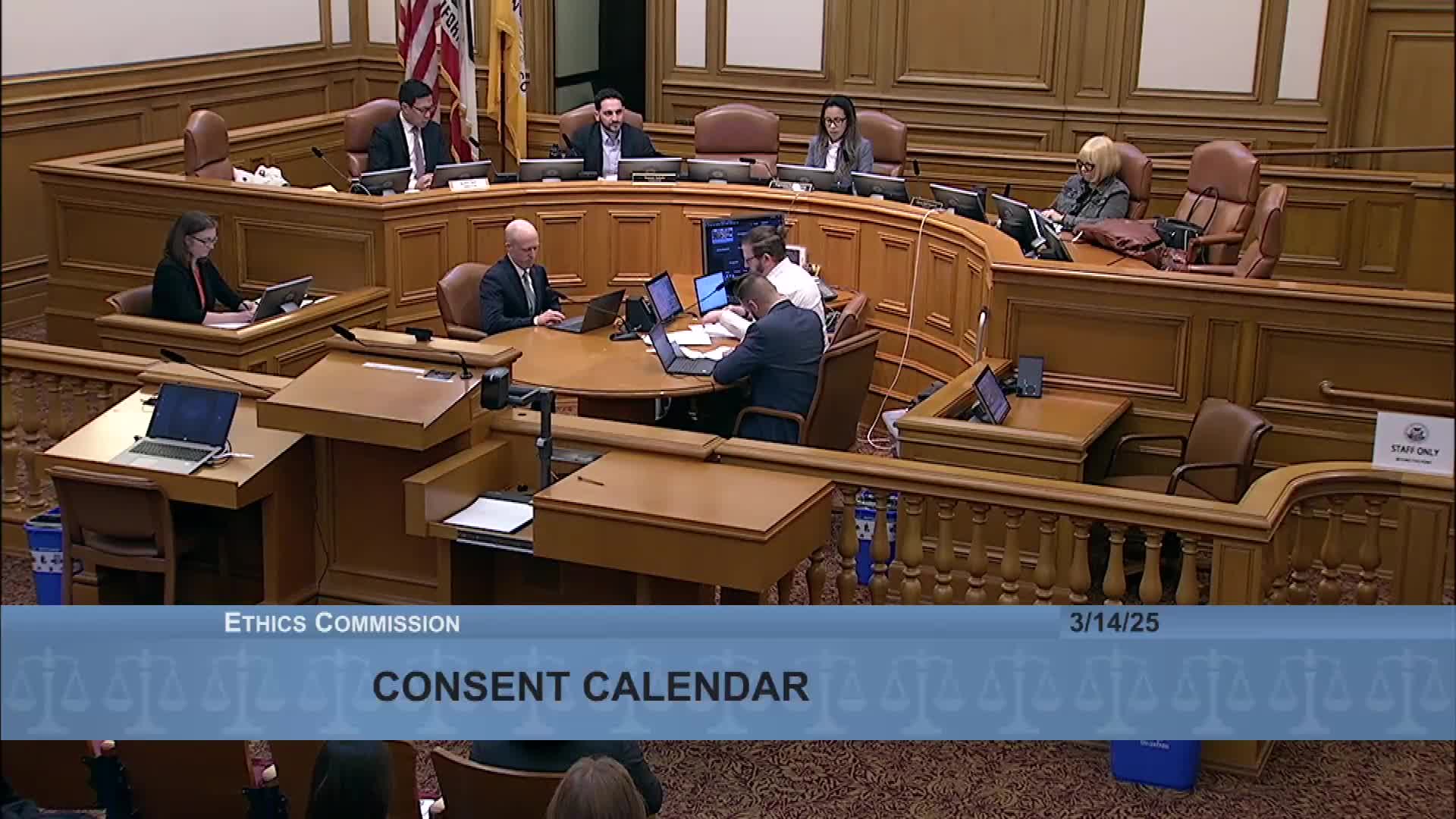
Audit manager Damon Wilson told the San Francisco Ethics Commission on March 14 that 2024 produced record public financing disbursements and third‑party spending, and staff will recommend revising the individual expenditure ceiling program after finding it resource‑intensive and rarely consequential.
Damon Wilson, audit manager for the San Francisco Ethics Commission, told commissioners March 14 that the city—xperienced record public financing disbursements and third‑party campaign spending in 2024 and that one program designed to limit candidate spending consumed heavy staff time while rarely affecting actual expenditures.
Wilson said the commission dispersed about $8.8 million in public funds in 2024 and that total candidate spending reached nearly $27 million. He added that third‑party independent expenditures totaled about $19 million, producing roughly $45 million in total reported election spending for supervisorial and mayoral contests combined.
"This was a record year for both the public financing program and for campaign spending in general," Wilson said during the commission's public meeting, noting that the commission raws the data from campaign disclosure filings and posts dashboards on its website.
Why it matters: the audit division is required by the city's campaign and governmental conduct code to audit all publicly financed candidates. Wilson said the surge in publicly financed candidates and in the volume of filings strained the division's capacity and that staff will seek ways to reduce administrative burden going into the next election cycle.
Key details and context
- Matching funds and totals: Wilson said changes adopted in 2019 increased the public match ratio from 2:1 to 6:1 and raised maximum public financing amounts, which contributed to the higher public disbursements in 2024. Mayoral candidates have a higher cap than supervisorial candidates under the code.
- Application and review workload: staff processed 27 qualifying requests for public financing and 96 matching‑fund requests, which together represented roughly 13,000 individual contributions that had to be reviewed to confirm donor residency and compliance with contribution limits.
- Threshold statements: Wilson said candidates (and, when applicable, all committees in races with at least one publicly financed candidate) filed 263 threshold statements in 2024 when they crossed reporting triggers set in the code.
- Individual expenditure ceiling (IEC) concerns: Wilson told the commission that the IEC program rives frequent recalculations. The IEC starts at $350,000 for supervisorial candidates and $1.7 million for mayoral candidates but is adjusted upward based on a formula that compares a candidate's opposition and the best‑funded opponent. "This program appears to be demonstrably ineffective," Wilson said, and staff plan to explore legislative revisions to roll back or change how IEC adjustments are calculated.
Wilson illustrated that staff performed 295 IEC adjustments across races in 2024 but that only 12 of those adjustments actually constrained a candidate's ability to spend (i.e., created funds that were required to be held because a candidate had raised more than their IEC). He said staff performed IEC analyses on roughly 65 distinct days between April and election day, on average about every two days.
- Outlier personal spending: Wilson also told commissioners that a single mayoral candidate contributed roughly $9.5 million in personal funds in 2024; because city contribution limits do not apply to a candidate—hoosing to use personal funds, that outlier reduced the share of mayoral spending that came from public funds in 2024. Excluding that outlier, public funds still made up a substantial share of mayoral spending in the period he examined.
Commission reaction and next steps
Commissioners asked staff about timelines and possible policy proposals. Wilson said the commission udit division will propose streamlining steps and indicated policy staff will draft potential code changes addressing the IEC and the threshold‑statement workload.
During public comment, David Pilpelt, a member of the Sunshine Ordinance Task Force, commended the post‑election report and urged the commission to treat task‑force referrals carefully. Pilpelt also raised a separate concern that the commission should revisit after the meeting: an instance in which a newly seated commissioner initially abstained on the consent calendar vote; Pilpelt cited Charter language and recommended the commission secure a definitive yes or no vote where the charter requires it.
What staff recommended: Wilson said staff will return with proposed legislative amendments and internal efficiency recommendations to reduce manual review work and free audit capacity for non‑election years.
Ending note: The presentation framed the 2024 election as an unusually active year for both publicly financed candidates and outside spending, and it put particular emphasis on the resource costs of administering the IEC and threshold reporting regime.